


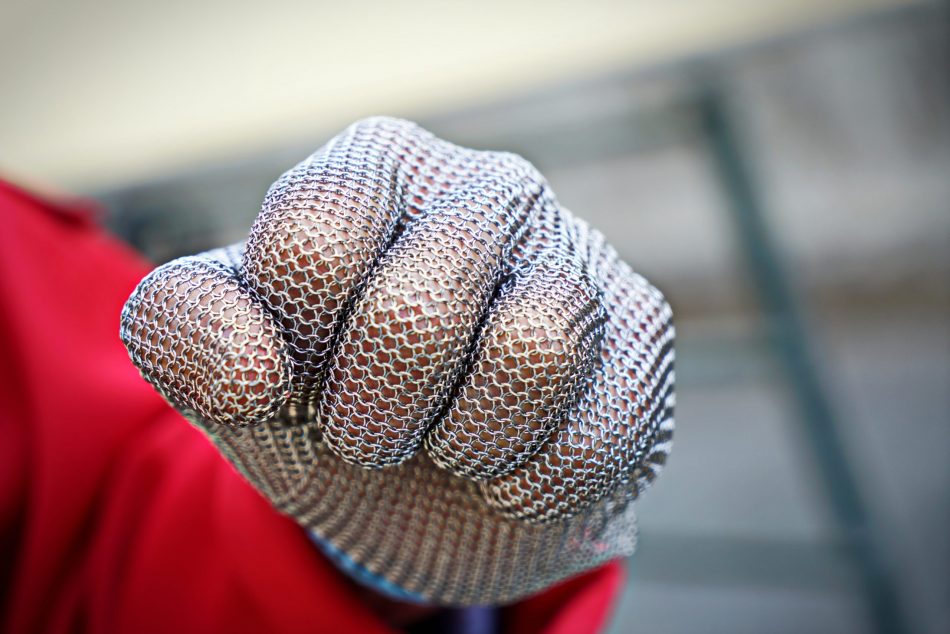
New shape-shifting material developed by scientists at Singapore’s Nanyang Technological University and Caltech in the US was inspired by ancient chainmail armor and Batman’s cape-turned-glider from the 2005 Batman Begins.
The fabric, which is described by the team as a type of “wearable structured fabric,” was designed to shift from flexible, soft, and foldable, to rigid and load-bearing.
“Inspired by ancient chainmail armor, we used plastic hollow particles that are interlocked to enhance our tunable fabrics’ stiffness,” says study author Assistant Professor Wang Yifan. They were able to achieve this based on the same principle that causes vacuum-sealed rice or beans to stiffen when packed up tightly, leaving the particles with little room to move.
The team 3D printed the octahedron-shaped particles for the material using nylon plastics in a chainmail-like arrangement. Then, the material is wrapped in a plastic envelope and compacted using a vacuum. Once vacuum sealed, the packing density is increased which pulls the carefully designed particles in and increases their points of contact between them, which results in a stiffened material that is 25 times more rigid than its pre-vacuum soft state.
The team found that the fabric was able to hold 50 times its own weight.
“To further increase the material’s stiffness and strength, we are now working on fabrics made from various metals including aluminum, which could be used for large-scale industrial applications requiring higher load capacity, such as bridges or buildings,” explains Yifan.
When the scientists 3D printed a version of the material using aluminum, the material, once vacuum-sealed, was even stiffer than the nylon. Instead of wrapping the aluminum version in plastic, the team envisions encapsulating the metal version with Kevlar to form a protective fabric for bulletproof vests.
Once perfected, this material will have several potential applications, including adaptive casts that can change in stiffness throughout the healing process, or being made into exoskeletons that can aid the elderly or those suffering from injuries to regain mobility.
Source Study: Nature—Structured fabrics with tunable mechanical properties






