


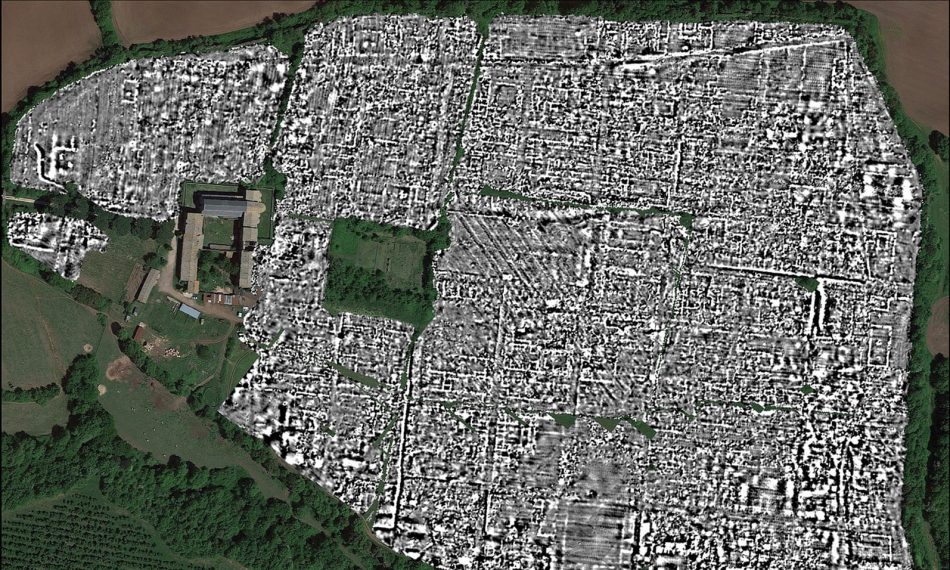
We have previously written about how high-tech laser scanners have enabled scientists to discover the oldest and largest known structure built by the Mayans. Equipped with similar state-of-the-art technology, a group of archaeologists has managed to map an entire ancient Roman city while it’s still beneath the ground.
Located 31 miles north of Rome, the ancient Roman city of Falerii Novi has been mapped using data taken from ground-penetrating radar. The map is still in its preliminary phase because it wasn’t humanly possible for the researchers to fully analyze the 28 billion data points collected during the course of the project, explained Martin Millet, a co-author of the study.
Using radar technology, the researchers were able to document the locations of buildings, monuments, passageways, and even water pipes – all without having to pick up a single hand trowel.
What else is fascinating is that in addition to documenting these previously unknown architectural features, the scientists were able to chronicle changes to the city over time and discern unique elements not seen elsewhere in ancient Rome.
For the survey, Millett and his colleagues used an all-terrain vehicle to tow a rig equipped with ground-penetrating radar. The scientists made scans every 12.5 centimeters (4.9 inches) across the entire 75-acre site. Falerii Novi was chosen as a good place to test the technology, as the town is not obscured by forests or buried beneath newer structures.
Equipped with their radar scans, the archaeologists documented a bath complex, a market, a pair of temples along the periphery, an outdoor theatre, atrium homes, and a shopping area. They also discovered a large public monument consisting of two structures facing each other in a configuration not seen elsewhere in ancient Rome.
To cope with the massive amount of data, the researchers are developing an automated process to help with the analysis, which will involve computer-aided object detection. This could result in further insights and discoveries.
What’s more, the paper represents an important proof-of-concept, showing how ancient history can be studied in detail while leaving everything in its place.






