


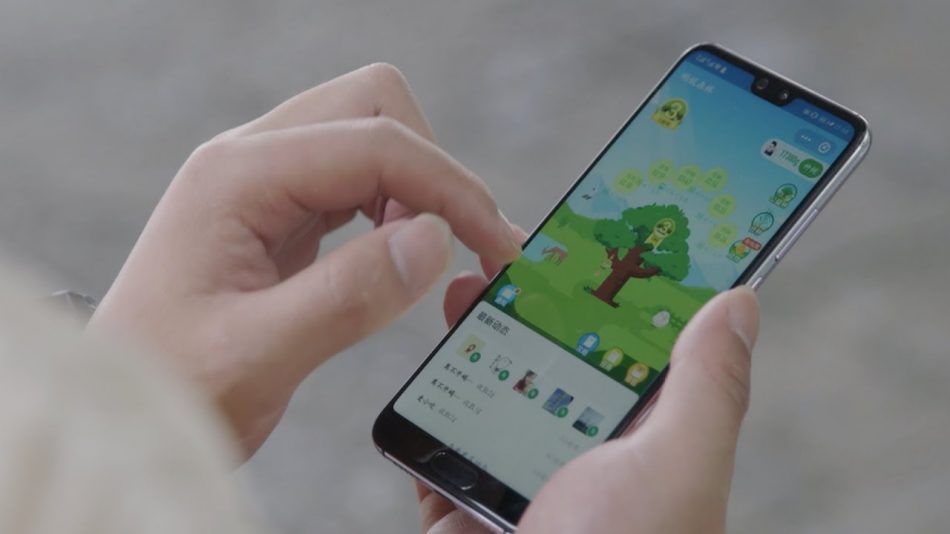
Since its launch in 2016, over half a billion people have used Ant Forest to convert lower-carbon activities such as using public transport into real trees. The game is helping China lead the way in re-greening the planet and is serving as a model for tree-planting schemes elsewhere. It’s the kind of innovation the World Economic Forum is seeking through UpLink, a platform for crowdsourcing sustainable development solutions to challenges including how to plant a trillion trees.
The Ant Forest Model: So how does it work? To start with, Ant Forest has plenty of potential players, being part of China’s Alipay mobile payments app, which is used by more than a billion people. Each time a user performs a lower-carbon activity, such as paying a utility bill online or cycling to work, they are rewarded with “green energy points.”
However, rather than immediately spending those points on a real tree, Ant Forest turns its users into game players. The green energy points “grow” into a virtual tree on the user’s app. And users can share green energy with friends and see how their virtual forests compare with others. For every virtual tree grown, Ant Forest donates – and plants – a real one. And this gamification has had real-world impacts.
According to a study in Nature Sustainability, NASA satellites have revealed a 5% increase in global green leaf cover since the early 2000s – with China leading that growth. While a third of Chinese greening is due to the expansion of agriculture, 42% comes from projects to plant forests. According to the UN, Ant Forest has become the country’s largest private-sector tree-planting scheme – so the game is a big part of China’s greening.
And the locations for planting are ambitious: arid areas of Northern China like parts of Inner Mongolia, Gansu and Shanxi. Many of the 122 million Ant Forest trees have been planted in areas that have become deserts.
There has been some criticism. In 2019, the journal Nature reported concerns that holding back deserts with trees could put pressure on water supplies. Scientists in China responded that local conditions are taken into account. Drought-resistant varieties, such as the “saxaul” shrub, are used by Ant Forest.






