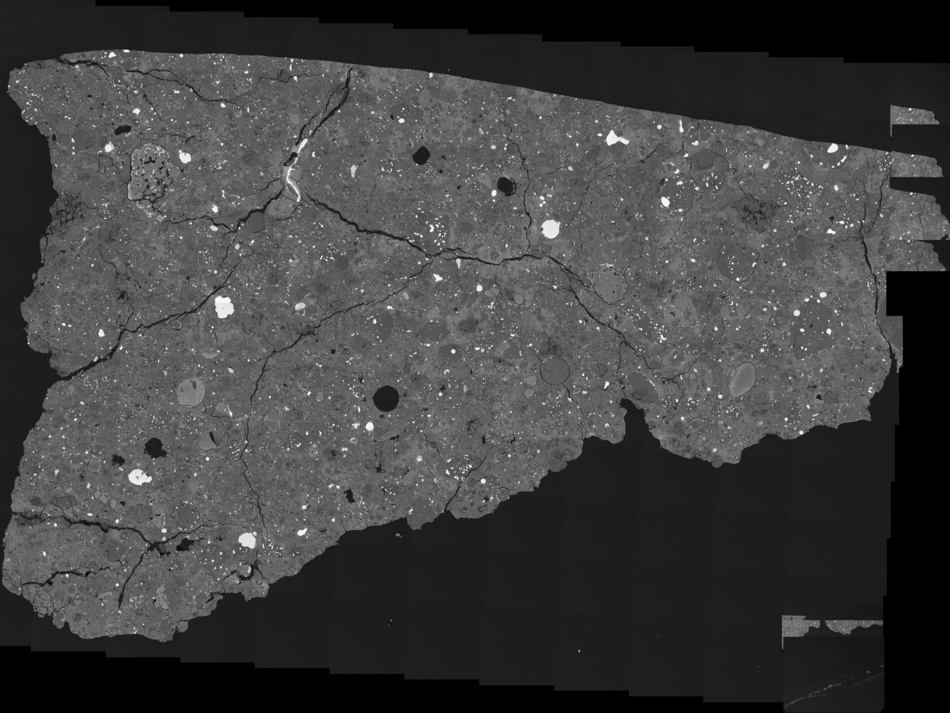
Back in 2012, a team of Japanese and Belgian researchers in Antarctica found a golf ball-sized space rock resting in the snow. Now, NASA astronauts have had a chance to study a piece of that meteorite, Asuka 12236, and they say it may hold new clues about the development of life.
Inside the meteorite, astrobiologists from NASA’s Goddard Space Flight Center found a high concentration of amino acids, particularly aspartic and glutamic acids. Those are two of the 20 amino acids that make millions of proteins which are essential for the bodily functions of animals. Researchers have found amino acids in other space rocks but not at such a high concentration.
Perhaps most surprisingly, Asuka 12236 contains more left-handed versions of some amino acids. While there are right-handed and left-handed versions of each amino acid, life as we know it uses only left-handed amino acids to build proteins. Researchers want to know why there was an imbalance toward left-handed amino acids and what kinds of space conditions might have led to that. They believe Asuka 12236 was exposed to very little heat or water — two important clues.
By studying different meteorites, scientists can create a timeline of changing space conditions to better understand the evolution of amino acids and life as we know it. That’s another reason Asuka 12236 is so valuable. NASA’s astrobiologists believe it may have formed before our own solar system.
While the Asuka 12236 findings are exciting, researchers are eager to study more space rock samples. In October, NASA’s OSIRIS-REx spacecraft will collect a sample of asteroid Bennu and return a sealed sample of dirt and rocks back to Earth. Researchers will look for amino acids in that sample too.