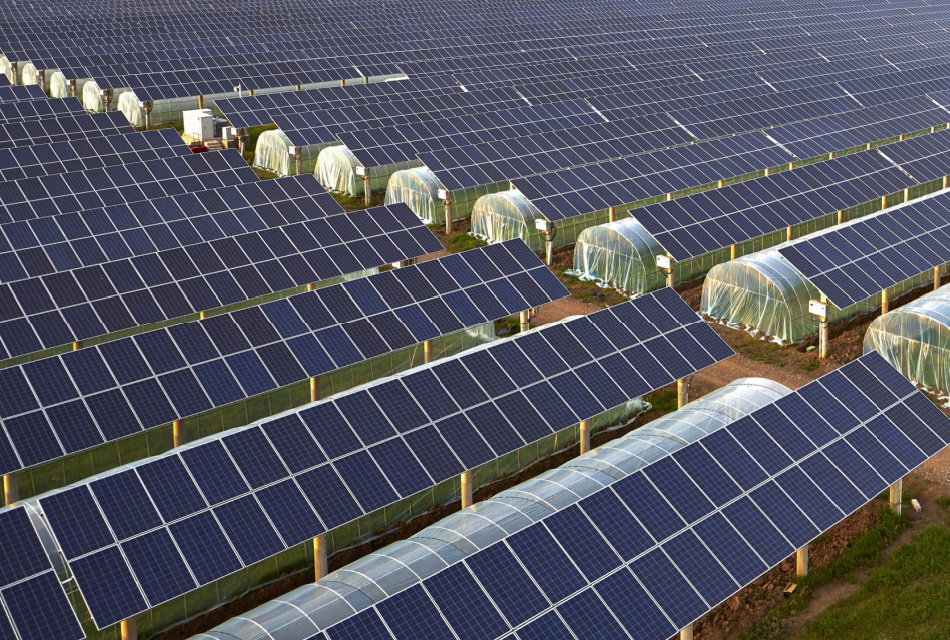
Crops and clean energy are increasingly sharing the same land as the globe struggles to deal with the climate problem and transitions to renewables and agrivoltaics — the cultivation of crops beneath the shade of solar panels.
Scientists are now investigating how to harness the sun’s light spectrum to improve agrivoltaic systems’ effectiveness in arid agricultural areas.
According to a news release about a recent study from the University of California, Davis, scientists determined that the blue component of the light spectrum is more efficient for solar energy production, while the red part of the spectrum is better for plant growth.
Not all light spectra were created equal
The journal Earth’s Future published the research titled “Not All Light Spectra Were Created Equal: Can We Harvest Light for Optimum Food-Energy Co-Generation?”
“This paper is a door opener for all sorts of technological advancements,” said Majdi Abou Najm, associate professor at UC Davis’ Department of Land, Air, and Water Resources and co-author of the study, in a press release. “Today’s solar panels take all the light and try to make the best of it. But what if a new generation of photovoltaics could take the blue light for clean energy and pass the red light onto the crops, where it is most efficient for photosynthesis?”
For the study, scientists created a computer model for photosynthesis and transpiration that compensated for various light spectra. The laboratory model replicated the reaction of plants including basil, strawberry, and lettuce to different light spectra. Scientists discovered that the red spectrum could be optimized for plant growth, while the blue spectrum could be filtered to produce solar energy.
From a plant’s point of view, red photons are the most efficient, according to Abou Najm, as reported by Modern Farmer. As Najm explains, “They don’t make the plant feel hot”.
Agrivoltaics increases the efficiency of land use by installing solar arrays – a group of solar panels — between crop rows. The panels shade heat-sensitive fruits and leafy vegetables, while the plants’ transpiration lowers the temperature beneath the panels, thereby enhancing the efficacy of the solar cells.
Harvesting the sun
Abou Najm stated in a news release, “We cannot feed two billion more people in 30 years by being just a little more water-efficient and continuing as we do… We require something revolutionary, not incremental.” He goes on to say that if we view the sun as a resource, we may produce crops while working with shade and generating electricity. “Kilowatt-hours become a secondary crop you can harvest.”
As the amount of usable land on Earth decreases due to climate change, the greater our understanding of how light spectral differences affect plants, the more effectively we can design agricultural systems that balance water consumption, sustainable land management, and food production.
Modern Farmer quotes Abou Najm as saying, “By 2050, we’ll have [an additional] two billion people on this planet, and we’ll need 60 percent more food, 40 percent more water, and 50 percent more energy,”
Najm’s hope is to optimize an “endlessly sustainable resource.” According to him, “If a technology kicks in that can develop these panels, then the sky is the limit on how optimized we can be.”
Source study: Earth’s Future— Not all light spectra were created equal: Can we harvest light for food-energy co-generation?