


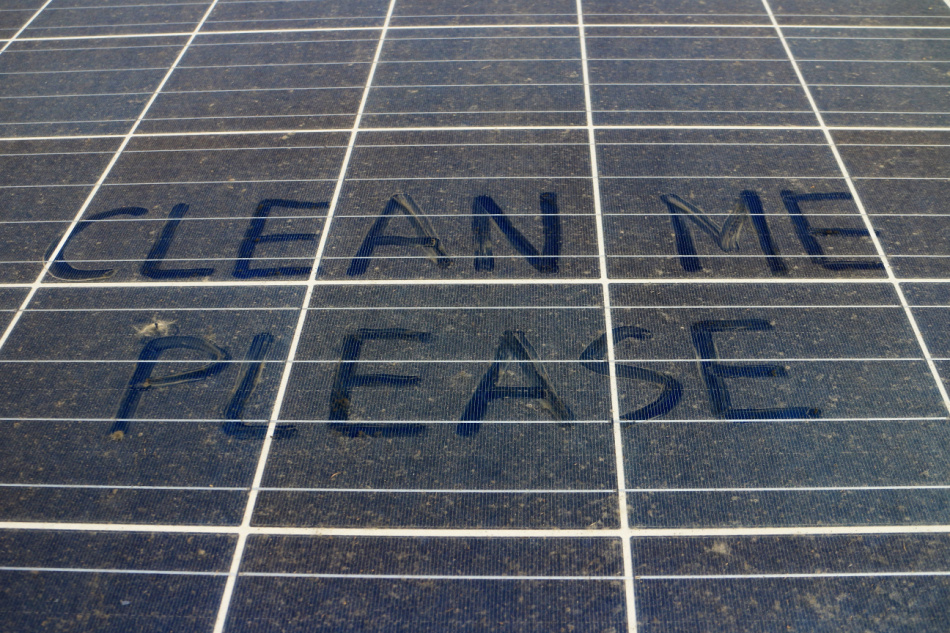
Solar panels cannot perform successfully if they are caked in filth, yet cleaning them on a regular basis can be time-consuming. Luckily, engineers in Germany are on the case and have created an ultra-thin coating that can self-clean solar panels and other surfaces.
Solar is the most important renewable energy source, and it is rapidly expanding. However, as you might expect, sending someone out with a squeegee to wipe millions of solar panels in each park is not realistic. It would be perfect if they could clean themselves, and now researchers at the Fraunhofer Institute in Germany have made progress toward that goal.
How does the self-cleaning coating work?
The researchers developed a covering that alters its reactivity to water depending on the time of day, allowing it to shed dust and debris rather fast. The main constituent is titanium oxide, which repels water in its natural condition, generating droplets that readily roll off. When exposed to UV light, titanium oxide changes state and becomes extremely water-attracting, keeping the surface moist with a thin layer of water.
This effectively creates a self-cleaning layer. The thin coating of water keeps dust and debris off the surface during the day and at night the water beads up into droplets that easily roll off, carrying the filth with it. In addition, when activated with UV light, titanium oxide degrades organic molecules, thereby sterilizing the surface.
The general concept has already been achieved in self-cleaning glass, although it normally uses either a water-repelling or water-attracting mechanism, rather than both. Even better, the Fraunhofer team’s new coating is intended for mass production roll-to-roll and could be applied to existing solar cells, windows, and other surfaces.
The researchers used a prototype plant to create rolls of thin glass 30 cm (11.8 in) broad, 20 m (65.6 ft) long, and only 100 micrometers thick, with a titanium oxide covering up to 150 nanometers thick.
Next steps
Of course, there are still obstacles to conquer. According to the experts, the thin glass is still exceedingly weak and prone to heat. Future research will concentrate on enhancing this, including the option of employing polymer films instead.
In April, the findings will be presented at the BAU trade exhibition in Munich.






