


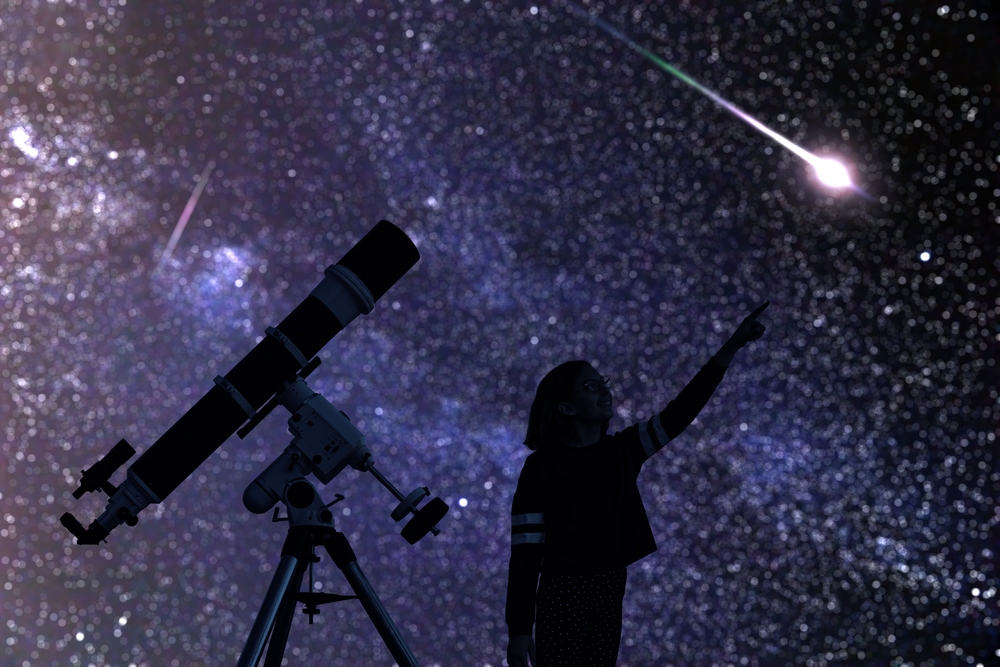
A celestial display unfolds beneath the velvety African night sky, amidst the peace of Kenya‘s isolated Samburu county. It’s 1:30 AM in mid-August, and 50 enthralled individuals lie on the dry riverbed, their eyes turned heavenwards, entranced by the stars. The Milky Way arcs gracefully across the obsidian expanse, and the Perseid meteor shower dances across the glassy plain, a celestial fireworks display.
Susan Murabana, a Kenyan astronomer, is in charge of organizing the “Star Safari.” She invites these enthusiastic stargazers to experience the faraway wonders of Jupiter, Saturn, Mars, and Venus with a 50kg, 70-inch-long telescope in tow, the SkyWatcher Flextube. What is her mission? To reveal the cosmos to all, instilling a love of science and astronomy in local youth.
A passion-fueled journey
Susan Murabana’s path to becoming a champion of the night sky began later in life, sparked by an outreach program at a remote school in Mumias, a tiny town in western Kenya, in her early twenties. This life-changing experience, supported by Cosmos Education, a non-profit dedicated to enhancing science education in disadvantaged countries, allowed her to stare through a telescope and see the magnificence of the universe.
Murabana’s life was affected by this single event. It sparked a love of the universe in her, which she is now attempting to share with the rest of the globe. “Looking through the telescope that day sparked my passion for the cosmos,” she says of the event. “If an outreach group had approached me when I was a young teenager, I would have been more interested in a career in science and astronomy.”
Bridging the cosmic gender gap
Susan Murabana’s adventure has been about more than just stargazing; it has also been about breaking down gender norms and encouraging young girls. Murabana is a trailblazer in a society where it is still believed that science, particularly astronomy, is only for guys. She hopes to reverse this attitude and extend young girls’ perspectives.
She reflects on the stereotype, stating, “There is a common misconception in Kenya that astronomy – and science in general – is hard, boring, for the West, and only for boys. I’d like to teach young girls that science is neither of these things and that they, too, can become astronomers like me.”
The Travelling Telescope: A source of inspiration
Susan Murabana established the Travelling Telescope in 2014, a social company funded by earnings from Star Safaris and overnight excursions. This effort is about more than just sharing the wonders of the night sky; it is also about education and empowerment. Susan and her husband, Daniel Chu Owen, go to remote areas every two months, bringing telescopes and inflatable planetariums. They allow up to 300 children to study the planets and delve into the mysteries of astrophysics.
The Travelling Telescope has reached more than 400,000 people since its start, primarily targeting outlying schools to maximize the impact of their outreach. Susan Murabana’s mission extends beyond simply presenting cosmic beauties; it is about sowing seeds of inquiry and desire, particularly among young girls who may have been discouraged from pursuing careers in STEM.
Susan Murabana’s extraordinary journey from a young woman who thought science was “for boys” to becoming a torchbearer for astronomy in Kenya is a monument to the transformational power of passion and knowledge. She envisions a future in which African girls and women not only gaze at but actually strive to reach for the stars.
Susan Murabana’s work resonates as a beacon of hope, lighting up the universe for everybody, regardless of gender or societal expectations, as she continues her quest to inspire the next generation of African space scientists. She has already been selected as a Space4Women mentor in 2021, demonstrating that her impact has gone far beyond the communities she strives to educate. In the end, her aim is to remind us all that the universe is a global wonder meant to be shared and treasured by everyone.






