BY THE OPTIMIST DAILY EDITORIAL TEAM
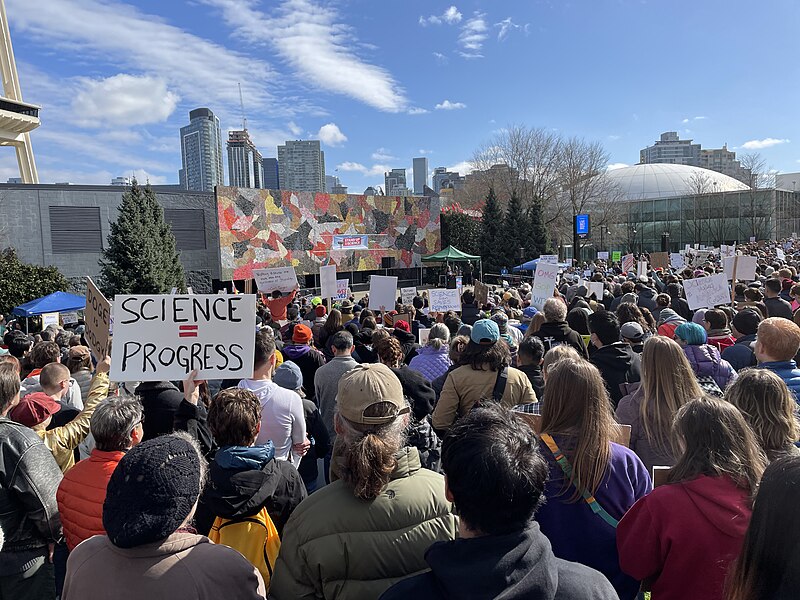
On March 7th, thousands of researchers and advocates took to the streets across the United States to protest cuts to scientific funding imposed by the Trump administration. Organized under the banner of “Stand Up for Science,” these rallies drew diverse crowds in at least 30 cities across the country, with over 150 events held worldwide.
In New York City, more than a thousand people gathered in Washington Square Park, chanting “Fund science, not war!” and holding signs with slogans like “Science makes America great.” Ana Vivinetteo, a neuroscientist at Weill Cornell Medicine, was among them. “Science is something that has to be treasured,” she said. “I would rather be in my lab working with my cells, but I think we have to bring awareness to these problems.”
Cuts threaten the future of research
Since President Donald Trump’s inauguration on 20 January, billions of dollars in federal funding for scientific and medical research have been either canceled or frozen. The cuts have heavily targeted research related to diversity, equity, inclusion, climate change, and gender studies. Additionally, thousands of federal employees at key agencies, including the National Oceanic and Atmospheric Administration, the National Institutes of Health, and the Centers for Disease Control and Prevention, have been laid off.
“Science is being attacked and funding is being slashed in a way that is going to impact our nation’s well-being now and for many decades,” said Maia, a postdoctoral researcher in cardiology at Columbia University, who preferred to give only her first name. She and her colleagues have already lost funding for their research.
A global call to action
The largest rally took place in Washington DC, drawing thousands of protesters and high-profile speakers, including Bill Nye the Science Guy and former NIH director Francis Collins. More than 1,500 people gathered in New York City, where speakers included Harvard theoretical physicist Lisa Randall and Nobel laureate Harold Varmus.
Protesters came from all corners of the globe. “America was very exceptional for science. We really believe that science made America great,” said a French cancer biologist at the New York rally, who asked to remain anonymous. “Now we are very disappointed because everything is going to be destroyed.”
For many, the protests were both a rallying cry and a desperate plea to preserve the integrity of American science. Dennis Robbins, a science educator at Hunter College in New York, carried a sign that read: “Now I’m a mad scientist,” a slogan he first used in the 2017 “March for Science.”
“It’s stunning that we still have to rally for science, that someone has to speak up for its meaningfulness in a democracy,” Robbins said.