BY THE OPTIMIST DAILY EDITORIAL TEAM
Building new foundations
Welcome to the third installment of The Optimist Daily’s Annual Local Changemakers series. Every Friday, we’re celebrating ten extraordinary individuals and organizations transforming their communities through heart-led innovation. This week, we’re spotlighting changemakers who are rebuilding, physically and culturally, what has been neglected or shut out.
Today, we travel to Kit Carson, Colorado, where longtime resident Amy Howlett Johnson has spent decades leading the charge to revitalize her rural town through affordable housing, infrastructure renewal, and fierce local pride. Her work is a testament to what’s possible when you stay rooted and invest deeply in the people and place you call home.
When a home means more than shelter
On the Eastern Plains of Colorado sits Kit Carson, a town of just 250 people and no public library, no parks department, and, until recently, no homes available to rent. When Amy Howlett Johnson moved there in 1995, she found a place with deep history, but with dwindling hope in its future: vacant homes, businesses closing, and a school teetering from low enrollment. Rather than leave, Amy dug in.
What started as a mother’s desire to keep her children in a functioning local school has grown into a transformative force for rural resilience. In 2005, she helped reactivate the then-dormant nonprofit Kit Carson Rural Development (KCRD) and quickly became its driving engine. What followed is one of rural America’s quietest yet most compelling comeback stories.
“I got started doing this work to make sure that there would always be a school for my kids,” Amy told the Colorado Housing and Finance Authority. “Now all my kids have graduated, but there’s still so much work to do.”
From abandoned lots to anchored lives
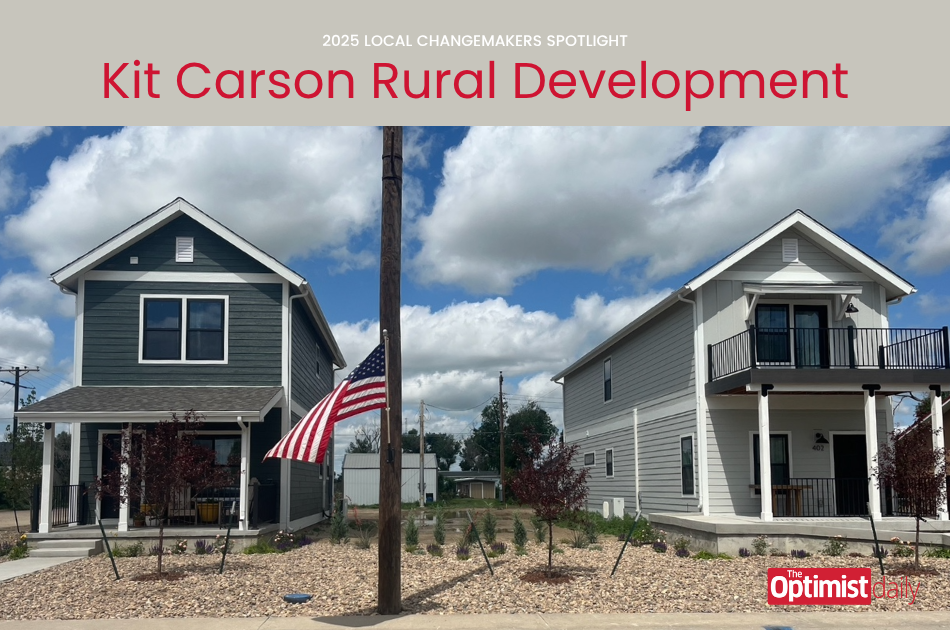
Housing was the flashpoint. By the late 2000s, Kit Carson had a stark shortage of livable homes, and school leaders warned that the district’s future was at risk. KCRD responded by acquiring, abating, and transforming blighted properties. That meant building or renovating homes designed not for profit, but for people.

Through partnerships with groups like Prairie Development Corporation and support from HUD, DOLA, and CDPHE, the nonprofit has now built 19 affordable homes and renovated another four. Some are rentals; most are now owned by the families who moved in. In a town where construction costs routinely exceed property values, Amy’s team sold homes for as little as half of what they cost to build simply because that’s what the community needed.
One moment made it all feel real: “Several years ago, my daughter, while working on a grant for KCRD, calculated that over 20 percent of Kit Carson School’s population had lived in the homes we helped develop,” Amy shared with The Optimist Daily. “It was a full circle moment for me.”
In Kit Carson, four new homes can mean four families who stay, a school that remains open, and a community that keeps beating.
Infrastructure, economy, and identity
But KCRD’s vision goes beyond housing. Under Amy’s leadership, the nonprofit has cleaned up a large brownfield site, turned a vacant building into a commercial space with a grocery store and community mural, and opened The Hub, a multi-use space with coworking areas, leasable storefronts, and even a Tesla Supercharging station.

With just one city worker and one clerk, Kit Carson isn’t built for bureaucracy, but Amy and her team navigate complex grants, compliance requirements, and layered restrictions, all while delivering real change.
“Rural America just needs houses,” she says. “We’re never going to attract a developer here. We rely on grants and belief.”
And that belief is spreading. Since 2006, KCRD has leveraged over $5 million in grants and in-kind contributions to support its work.
Why Amy’s work matters
In Kit Carson, homes aren’t just structures. They’re a lifeline for teachers, grocery store clerks, and families who want to stay.
Amy’s work is tailored for rural realities. KCRD builds where traditional developers won’t go and creates affordability in a market where the need far outweighs demand.
It’s a transformation of place and identity. Blight becomes beauty. Emptiness becomes energy. Decline becomes possibility.
And it’s deeply human. “It’s all about the people,” Amy says. “They are the ones who see the work you’re doing. Then they believe in you. Then they trust you. Then they invest more in you. That’s transformational.”

Still fighting. Still rooted.
Today, KCRD continues to grow despite the cost, complexity, and challenges that come with rural development. Amy says the work isn’t glamorous; it’s “plumbing, broadband, local ownership, and the willingness to stay in the fight.”
Her work has earned recognition locally and statewide. In 2022, she received the Good Scout Recognition at Kit Carson Days. But her motivation remains personal, local, and persistent: “Kit Carson is a great community full of amazing folks,” she says. “I don’t want to just see it survive—I want it to thrive.”
And thanks to her and those she’s rallied behind her, it just might.
Learn more about KCRD and how to support their work here.
Give them a follow on Instagram and Facebook for the latest updates.