
BY THE OPTIMIST DAILY EDITORIAL TEAM
The hardest part of any early warning system isn’t the science. It’s finding infrastructure that reaches everyone, holds up under pressure, and gets maintained over years by the people who depend on it. In Indonesia, a team of Japanese and Indonesian researchers think that infrastructure already exists. It broadcasts the call to prayer five times a day.
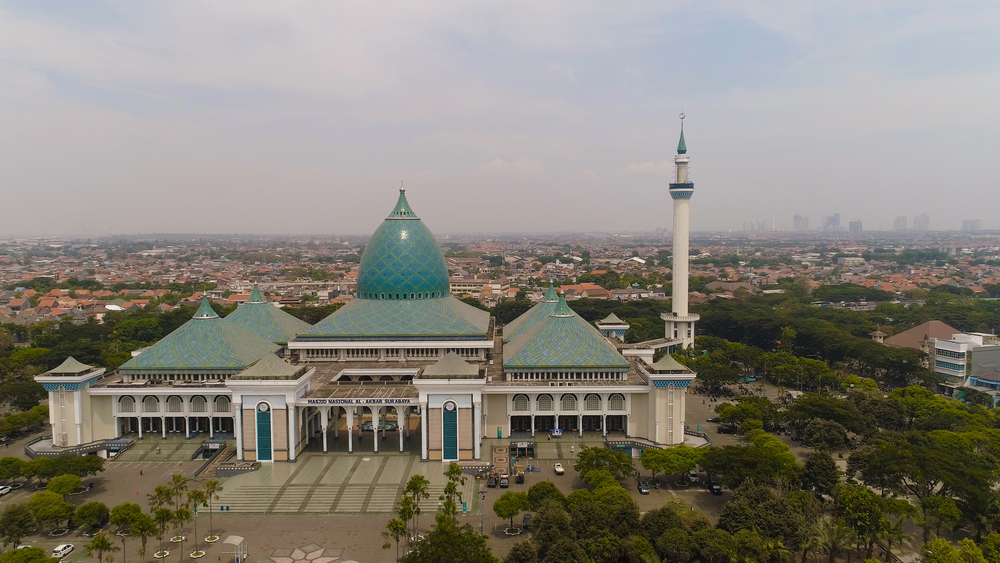
With the largest Muslim population in the world, Indonesia has hundreds of thousands of mosques, nearly all equipped with loudspeakers that reach the surrounding community. A five-year pilot project running until 2030 is testing whether those speakers can double as earthquake alert klaxons, connected to a seismic sensor network that sounds an alarm before the shaking arrives. Several mosques have already been hooked up.
The project was conceived by Dr. Inoue Hiroshi of the Disaster Prevention Research Institute at Kyoto University, who came up with the idea while researching deadly earthquakes in Sumatra nearly two decades ago. “Every community has a mosque,” he told the Guardian. The rest of his argument was practical: “The advantage of a mosque speaker is that they’re existing and well maintained. For any disaster infrastructure, maintenance is the big challenge… but the mosque speaker is maintained by the people.”
Mobile phones are the default tool for modern disaster alerts, but phone networks can fail in an earthquake. Mosque loudspeakers, tested five times a day by the communities that run them, are harder to knock out.
The seconds that matter in an earthquake
Earthquake early warning is different from tsunami warning. Tsunamis build over time and can be tracked; communities might have minutes or hours to act. Earthquake waves move through the ground at extraordinary speed. A village 31 miles (50 kilometers) from the epicenter might have only five to ten seconds, according to Andi Eka Sakya, senior researcher at Indonesia’s National Research and Innovation Agency and Indonesian co-lead on the project. The system isn’t issuing public warnings yet, but that’s what the team is working toward.
Dr. Inoue’s interest goes back to a 2009 earthquake in western Sumatra that killed at least 1,000 people. “I thought if Indonesia had the same service and people received the warning before the shaking came, then many people among those few hundred wouldn’t have died,” he says.
Drop and cover doesn’t always apply
What to do with five to ten seconds turns out to be its own research problem. In Japan, official guidelines center on drop and cover: get under a table, stay indoors, ride it out. That advice was written for well-constructed buildings.
In Indonesia and many developing countries, homes are frequently built from unreinforced masonry, which collapses under earthquake stress. In some documented cases in Indonesia, two-story buildings have had the first floor crushed while the second floor stayed relatively intact. The people who survived ran outside. “The way people react is they quickly escape out of the room,” Inoue says. “They know how to survive.”
Standard international guidelines don’t account for that. Project researchers are running simulations and human experiments to develop guidance grounded in how Indonesian buildings actually fail. Survival advice calibrated for the wrong type of building can kill people.
Other countries are exploring the same approach
Uzbekistan’s Ministry of Emergency Situations announced a pilot program this year to install alarm devices in 272 mosques, warning communities about floods, mudflows, landslides, and avalanches. The United Nations Development Programme, which partnered in the initiative, put it plainly: mosques “are traditionally perceived as authoritative social institutions with significant influence on local communities.” A broadcast from a trusted institution reaches people differently than one from a government system most residents have never interacted with.
The Indonesia project is also adding school loudspeakers, radio, and television as backup layers. But the mosque network is the foundation. It was already there, maintained every day by the communities that need it most.
Did this solution stand out? Share it with a friend or support our mission by becoming an Emissary.