


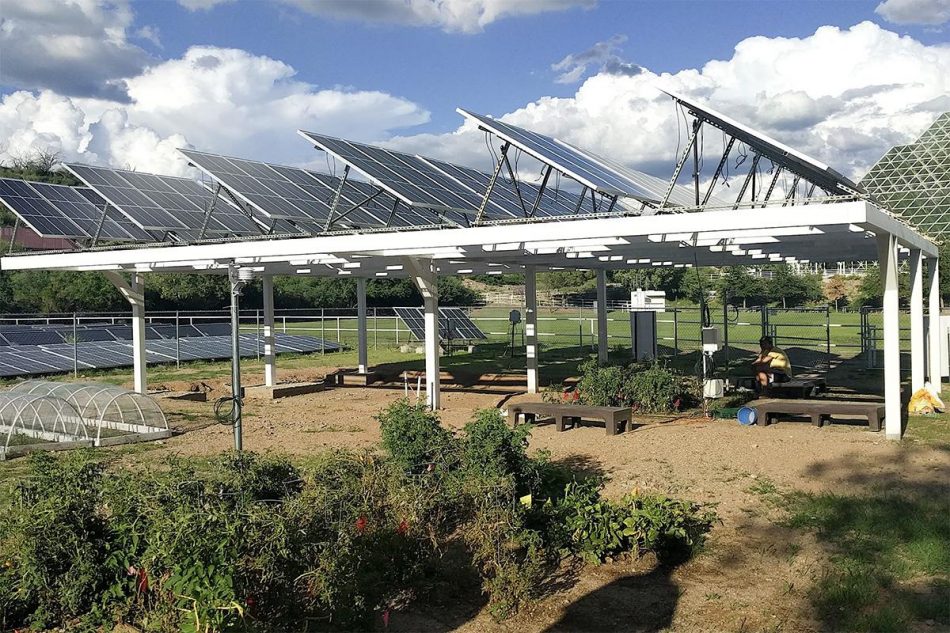
Are fields of open, often fertile land better used for producing renewable energy or food? The United States already hosts more than 2 million solar installations, and photovoltaic capacity is projected to more than double over the next five years. Meanwhile, our growing global population means we’ll need to produce 70 percent more food to feed 2.2 billion more people by 2050. It’s a hard question, but what if we embrace both?
An emerging land-use solution called agrivoltaics embodies both solutions: co-locating solar panels with agriculture. Within the small-but-growing U.S. agrivoltaic industry, an early winner is making solar ground into pasture for sheep. It’s common practice in countries such as the United Kingdom and Uruguay.
When sheep graze on fields that also support solar arrays, the same land can produce energy, wool and meat, all at the same time. Not to mention the benefits of their manure and hooves to the soil health. Some farmers are installing solar to power their own farms.
Others, including the American Solar Grazing Association’s several hundred members, are renting out their sheep to solar companies for vegetation maintenance. The collaboration is a win-win — the shepherds earn extra income, and the sheep keep greenery trimmed for less than it would cost solar companies to mow. Sheep, of course, aren’t the only livestock that graze. Solar co-location experiments also are being done with other animals.
A test project at the University of Massachusetts Crop Research Station, for instance, placed panels 7 feet off the ground so cattle could graze underneath. Although it worked well, the cost of steel to mount panels at this height largely has kept developers from following suit. Trials with goats, meanwhile, have shown that installations also might have to be modified, because the goats sometimes jump on panels or chew wires.
Experiments also are being done with row crops so they’re partially shaded by panels and thus use less water. University of Arizona researchers have been testing whether foods such as tomatoes, peppers, chard, kale and herbs could grow better under photovoltaic panels in dryland areas. Last year, their study found that chiltepin pepper plants yielded three times as much fruit, and tomatoes twice as much, in the agrivoltaic setup.
The results show that whether it’s with crops or animals, combining solar panels with farming can be a win-win for everyone.






