


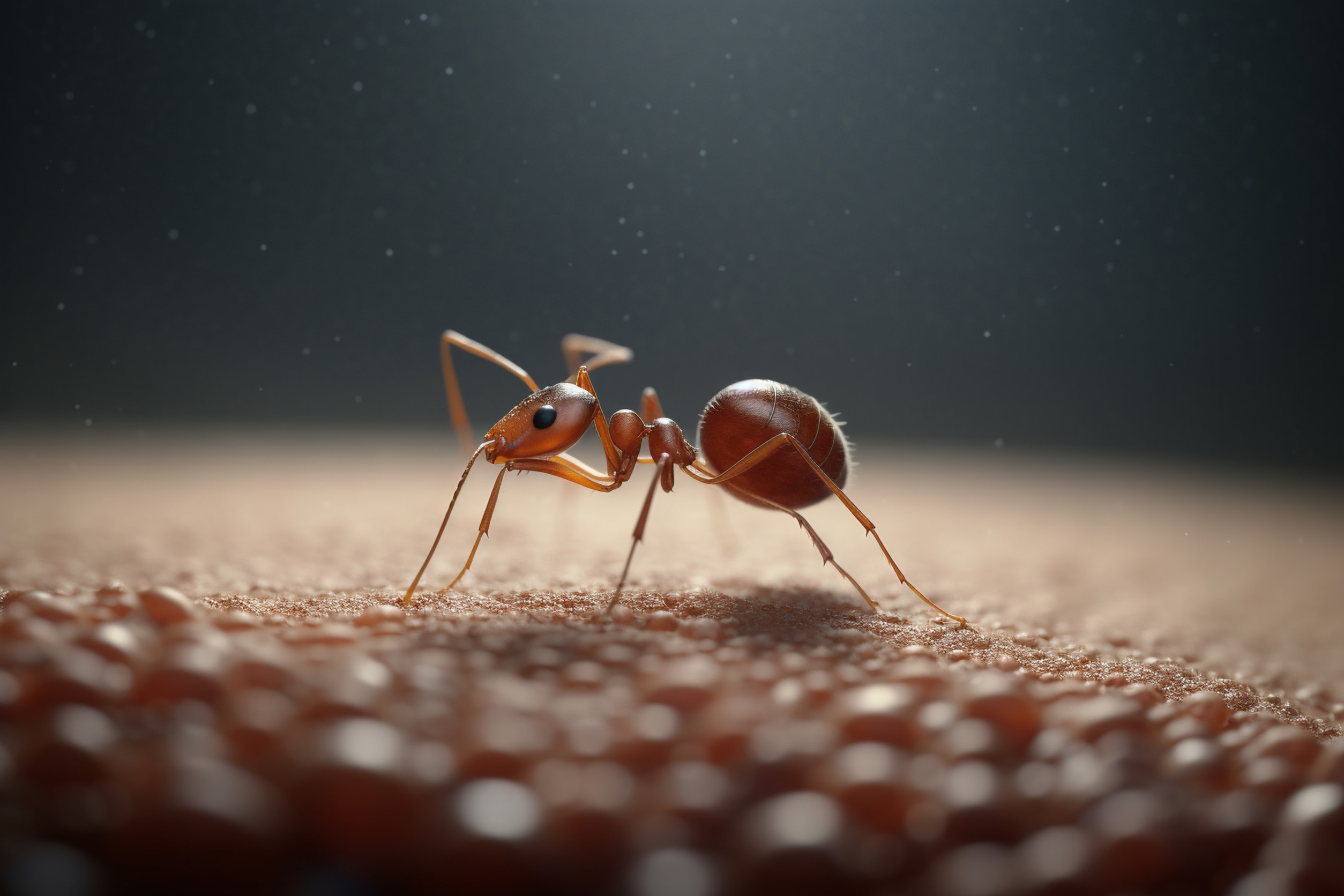
A proof-of-concept study from scientists in France has recently demonstrated something fascinating: the ability of ants to sniff out cancer cells. The research results provide proof that a particular species of ant, Formica fusca, can be quickly trained to detect cancerous cells with the same accuracy as other animals with smell disease-detection abilities, such as dogs.
Researchers have been increasingly tapping into the impressive potential of some animals to detect certain diseases. Of course, sniffer dogs are among the most commonly known cases, with some even able to detect Covid-19.
While that may be an impressive feat, training a detection dog can take up to a year, and the whole process is quite costly. That’s why, scientists have more recently turned their attention towards other organisms, such as honeybees.
Homing in on volatile organic compounds
Coming from researchers at CNRS, Université Sorbonne Paris Nord, the study focused on the ability of ants to smell out volatile organic compounds (VOC). Ants typically home in on VOCs to perform daily tasks. Previous research has found that different types of cancers have their unique VOCs.
The researchers focused on two types of breast cancer cells with differing VOCs. After little training, ants were already able to differentiate healthy human cells from cancerous human cells with the same accuracy as sniffer dogs.
Ants are as good as sniffer dogs at detecting disease
“Ants are thus equivalent to dogs – the most studied bio-detectors in terms of detection abilities,” the researchers write. “In some respects, ants surpass dogs because they need an extremely shorter training time (30 min compared to 6–12 months for a dog) and a reduced cost of training and maintenance (honey and frozen insects twice a week). Our simple conditioning protocol can be implemented by everyone, after a training time of about 3-day.”
Although the study is only a proof-of-concept, it demonstrates how detecting cancers, as well as other diseases, could become less invasive and expensive thanks to ants. The researchers also note that the technique could even be adopted for other purposes too:
“Our approach could potentially be adapted to a range of other complex odor detection tasks including the detection of narcotics, explosives, spoiled food, or other diseases (malaria, infections, diabetes for instance).”
Source study: iScience – Ants detect cancer cells through volatile organic compounds






