Early detection is an essential tool for treating cancer. Any time that doctors and technicians can shave off from testing or lab work saves lives. Even better are noninvasive and inexpensive tests, which benefit both the patient and the hospital.
The noble nematode
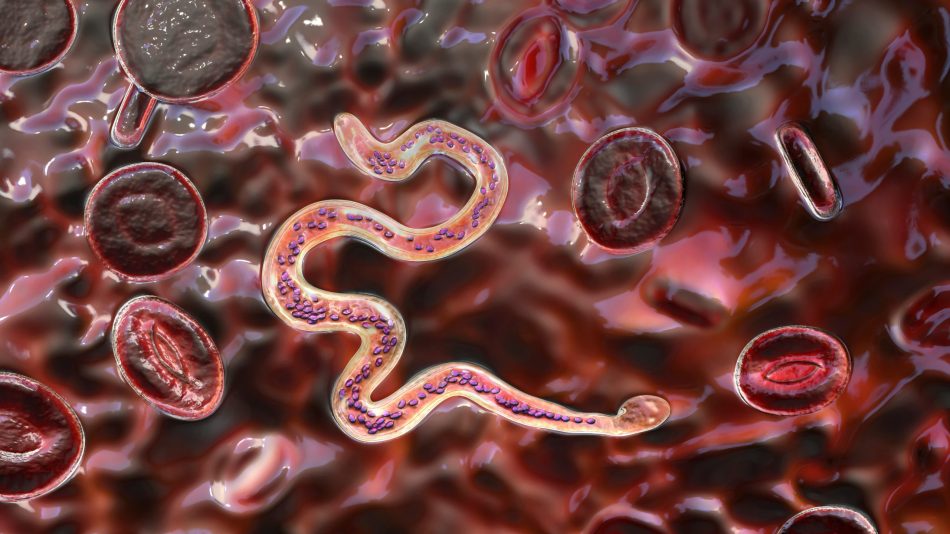
You might remember nematodes from your high school biology class. They’re extremely small worms — about a millimeter in length — also known as roundworms. They’re easy to raise in a lab, and they have an absolutely incredible sense of smell, much like dogs (or these ants). While it has been established that dogs can sniff out volatile organic compounds like cancer cells, it’s not exactly practical to keep a dog in a lab. A team of South Korean researchers decided instead to try nematodes.
“Lung cancer cells produce a different set of odor molecules than normal cells,” says Shin Sik Choi, Ph.D., of Myongji University and the project’s principal investigator. “It’s well known that the soil-dwelling nematode, C. elegans, is attracted or repelled by certain odors, so we came up with an idea that the roundworm could be used to detect lung cancer.”
Choi and the team created a chip made silicon-based organic polymer with a well on each side and a chamber in the center that was connected by a channel to each well. In one well, they placed samples of cancerous lung cells, and in the other they placed normal lung cells. They placed the nematodes in the middle chamber. After only an hour, they noticed that more nematodes had gone toward the cancerous sample than the healthy one.
How well can nematodes detect cancer?
Using a control test of nematodes that were bred without smell, they found that the little roundworms had a 70 percent accuracy at detecting cancer cells in a diluted sample. There’s still much work to be done in reliable accuracy and the reason why nematodes are attracted to cancerous cells. The team guesses that the odors are similar to their preferred foods, like bacteria and fungus for some species.
They plan to refine their tests using nematodes previously exposed to cancerous samples so that they have the memory for the right kind of tissue. They also plan to test urine, saliva, and even breathing samples from patients to refine the process even further while also expanding the number of non-invasive test samples.
If these tiny worms prove consistently effective at detecting cancer in different samples and in early stages, they could be the wriggly heroes that detect patients’ cancer quickly, cheaply, and non-invasively.
Source Study: ‘Worm-on-a-chip’ device could someday help diagnose lung cancer – American Chemical Society (acs.org)