In the north-western Indian city of Jaisalmer, female literacy ranks below 40 percent. The staff at a new, sustainable school located in the nearby Thar desert, aims to change that.
Students in the region often have to brave scorching temperatures of 45 degrees Celsius (113 degrees Fahrenheit) to attend class. The smart design behind the Rajkumari Ratnavati Girls School, however, keeps the school building cool without air conditioners.
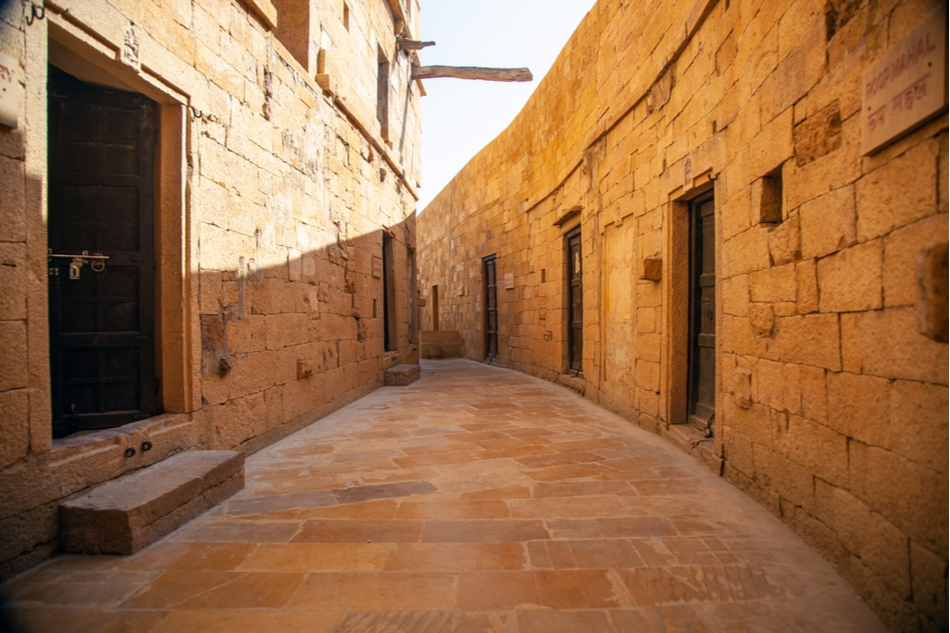
The school, which hosts over 400 students between four and 16 years old, was designed by New York-based architect Diana Kellog. The structure has a unique oval shape that allows students to study in peace without the distraction of the blistering heat and the regular sandstorms in the area.
“As a female architect designing for women, I looked at feminine symbols across cultures and specifically symbols of strength,” Kellogg told Dezeen. “I ultimately landed on this oval shape that is representative of femininity and resonated with me as the formulation of infinity. I knew I wanted to do a building that simultaneously blended and grew out of the natural landscape, much like the Jaisalmer sandstone.”
Symbolism and sustainability are at the heart of the design
In addition to ranking high in terms of sustainability, the 836-square-meter building also serves a symbolic purpose. Between the structure’s outer and inner walls are the classrooms, while a large oval courtyard lies in the middle.
“I wanted the design of the school to provide shading for the girls in the courtyard,” Kellogg said. “The ellipse shape seemed the most natural way to do this.”
In addition to powering the building with renewable energy, rooftop solar panels also provide extra shade. As for cooling, the building uses a geothermal energy system, while lime-plastering on the inner walls keep adds an extra layer of insulation.
Often used in Hindu temple architecture, jalis (a form of architectural decoration) protect the students from the area’s frequent sandstorms while allowing light inside the classrooms. Additionally, rainwater harvesting systems collect and recycle rainwater on the school’s perimeter.
Contributing to the entire community
Local builders constructed the school out of local sandstone, contributing to the building’s sustainability and the local economy. The school is part of a three-building complex, called the Gyann center.
The complex will have a performance and art exhibition space with a museum and library. It will also host the Women’s Cooperative, a learning space where local artisans will teach women traditional weaving and embroidery techniques.