


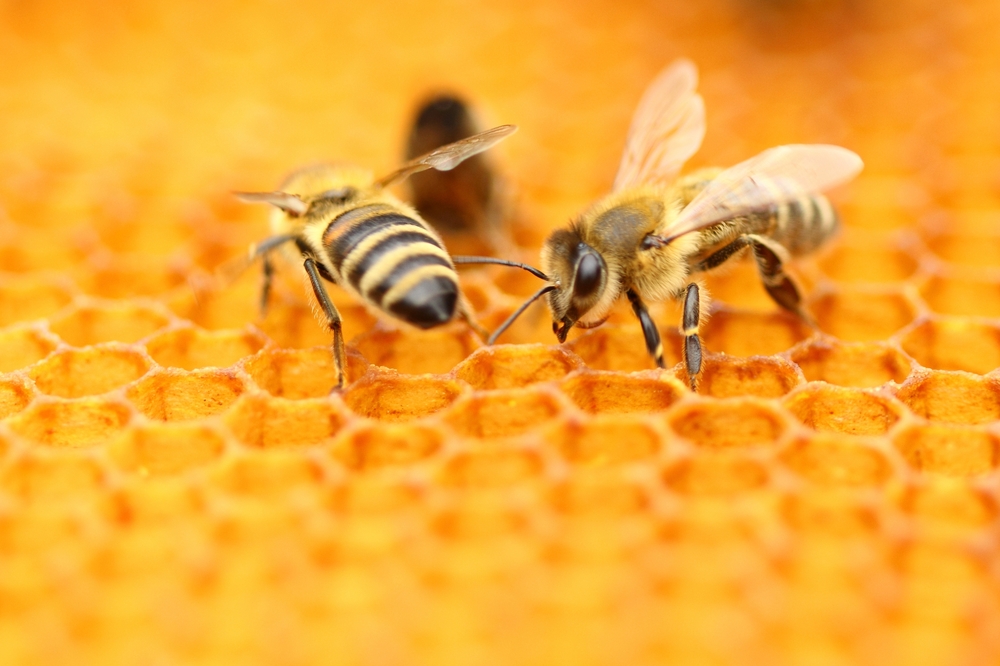
While honeybees are notoriously difficult to study, changing their natural behavior when any outside influences are detected, they are also extremely vulnerable to colony collapse due to cold. If hive temperatures fall below 50 °F, the bees stop buzzing and producing heat and fall into a lethal chill coma.
In a success for both bees and ecologists, a team of roboticists and biologists from Switzerland’s École Polytechnique Fédérale de Lausanne (EPFL) and Austria’s University of Graz devised a robotic honeycomb that both keeps bees warm during cold spells and allows them to be studied.
The robo-hive
The robotic beehive device was designed to fit unobtrusively into an existing hive, and it contained a central CPU that coordinated sensors, delivered commands to actuators, and transmitted data to a remote team. The robotic beehive used thermal sensors and actuators to assess and steer honeybee behavior by changing the localized temperature.
“Many rules of bee society – from collective and individual interactions to raising a healthy brood – are regulated by temperature, so we leveraged that for this study,” stated first author Rafael Barmak, a Ph.D. student at EPFL. “The thermal sensors create a snapshot of the bees’ collective behavior, while the actuators allow us to influence their movement by modulating thermal fields.”
Turning up the heat
Heat is also sent into the honeycomb linked to the robots. The heat is moderate enough not to upset the bees while allowing scientists to thermoregulate the colony. The researchers were able to maintain the colony alive over a 2020-2021 cold spell by testing the technology on 4,000 bees they invited to relocate inside this high-tech habitat.
“Previous studies on the thermal behavior of honeybees in winter have relied on observing the bees or manipulating the outside temperature,” University of Graz’s Martin Stefanec remarked. “Our robotic system enables us to change the temperature from within the cluster, emulating the heating behavior of core bees there, and allowing us to study how the winter cluster actively regulates its temperature.”
The “biohybrid superorganism” is an exciting step forward in population research and favorably, light-handedly influences behavior rather than damaging and upsetting animal community balances.
“By gathering data on the bees’ position and creating warmer areas in the hive, we were able to encourage them to move around in ways they would never normally do in nature during the winter, when they tend to huddle together to conserve energy,” said Francesco Mondada, head of the Mobile Robotic Systems Group. “This gives us the possibility to act on behalf of a colony, for example by directing it toward a food source, or discouraging it from dividing into too-small groups, which can threaten its survival.”
The scientists were also able to extend the survival of a colony despite the loss of its queen by dispersing heat through the actuators. While it is still in its early stages, the robotic hive shows promise in terms of mitigating colony collapse due to chill coma, as well as providing conservation scientists with new behavioral insights and knowledge.
Source study: Science Robotics— A robotic honeycomb for interaction with a honeybee colony
We are highlighting this piece as part of our annual “Best Of” roundup of articles published at The Optimist Daily this year. Today’s focus is on the top Science solutions of 2023.






