


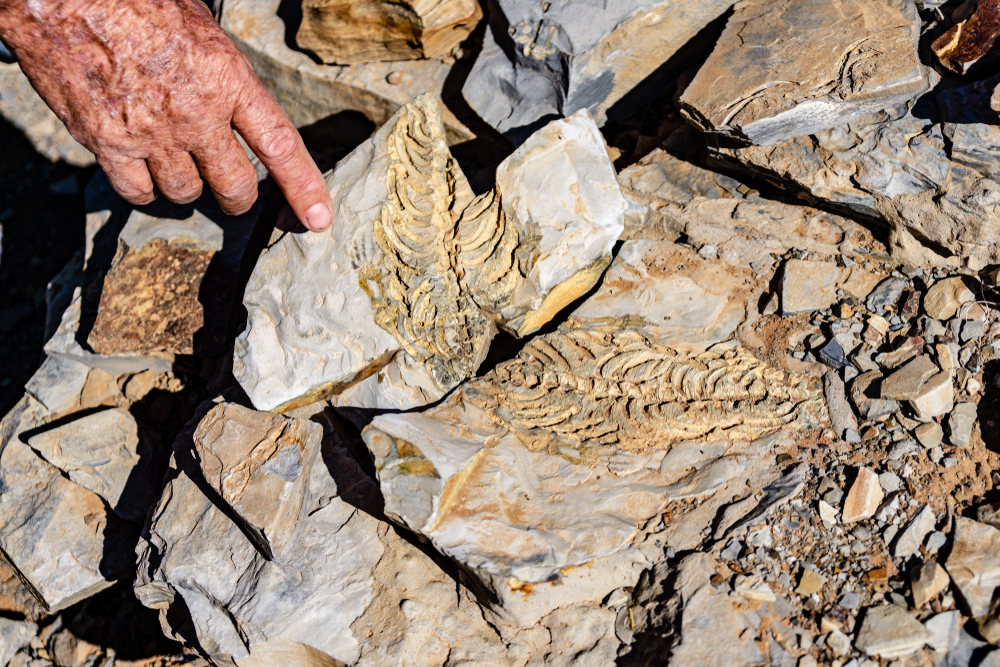
In southern Oklahoma’s Richards Spur, a region with a rich paleontological tapestry, scientists have unraveled a time-traveling tale. They discovered what is now regarded as the oldest known fossilized reptile skin, providing a fascinating glimpse into the evolutionary past. Ethan Mooney, the lead study author and a biology master’s student at the University of Toronto, characterizes the discovery as “quite an incredible story.”
A glimpse into the past: beyond mammals and dinosaurs
This relic, a slice of skin the size of a fingernail, provides a glimpse into an ancient epoch before both mammals and the oldest dinosaurs. This find, which dates back an estimated 286-289 million years, is more than 130 million years older than comparable samples. Mooney emphasizes the significance, writing, “It represents the first chapter of higher vertebrate evolution.”
The Richards Spur
Richards Spur, previously an open limestone cave, turned into a fossil-rich site between 286 and 289 million years ago. The site’s unique conditions, marked by oxygen-poor sediments and oil seeps, created a haven for preservation. Mooney goes on to say, “The sheer chance for a soft tissue structure to be preserved…is quite an incredible story.”
A mummified relic: fom fragility to resilience
Soft tissue, which is rare in fossils, decays before it can be preserved. However, the skin specimen from Richard’s Spur defies expectations. Tea Maho, a study co-author, recalls the delicate nature of the find, stating, “If you were to have pressed it a little too hard, it would have just cracked.” The chance preservation adds another element to the fascinating story.
Identifying the mysterious skin: Captorhinus Aguti’s legacy
While the exact reptilian source is unknown, the researchers suspect that Captorhinus aguti, a lizard-like creature from the Permian Period, was the original possessor. The similarities between the skin sample and the skeletal remains of C. aguti discovered on the site give persuasive evidence.
The ancient skin’s uncanny likeness to modern crocodile skin is an intriguing revelation. Mooney emphasizes, “The fact that we have an example from one of these earliest reptiles and it’s quite consistent with what we see in modern reptiles underscores how important that structure was.” The findings give concrete evidence for the importance of skin adaptation in the transition from aquatic to terrestrial settings.
Evolutionary milestones: lessons from 289 million years ago
As scientists continue to peel back the layers of Richards Spur, each fossil discovered adds a brushstroke to the changing picture of Earth’s past. Nearly 300 million years ago, life looked very different, but as Mooney proposes, “reptile skin might not have.”
In the silent depths of an Oklahoma quarry, a paper-thin relic whispers secrets from ages ago, challenging our understanding of the ancient dance of life and time.
Source study: Current Biology—Paleozoic cave system preserves oldest-known evidence of amniote skin






