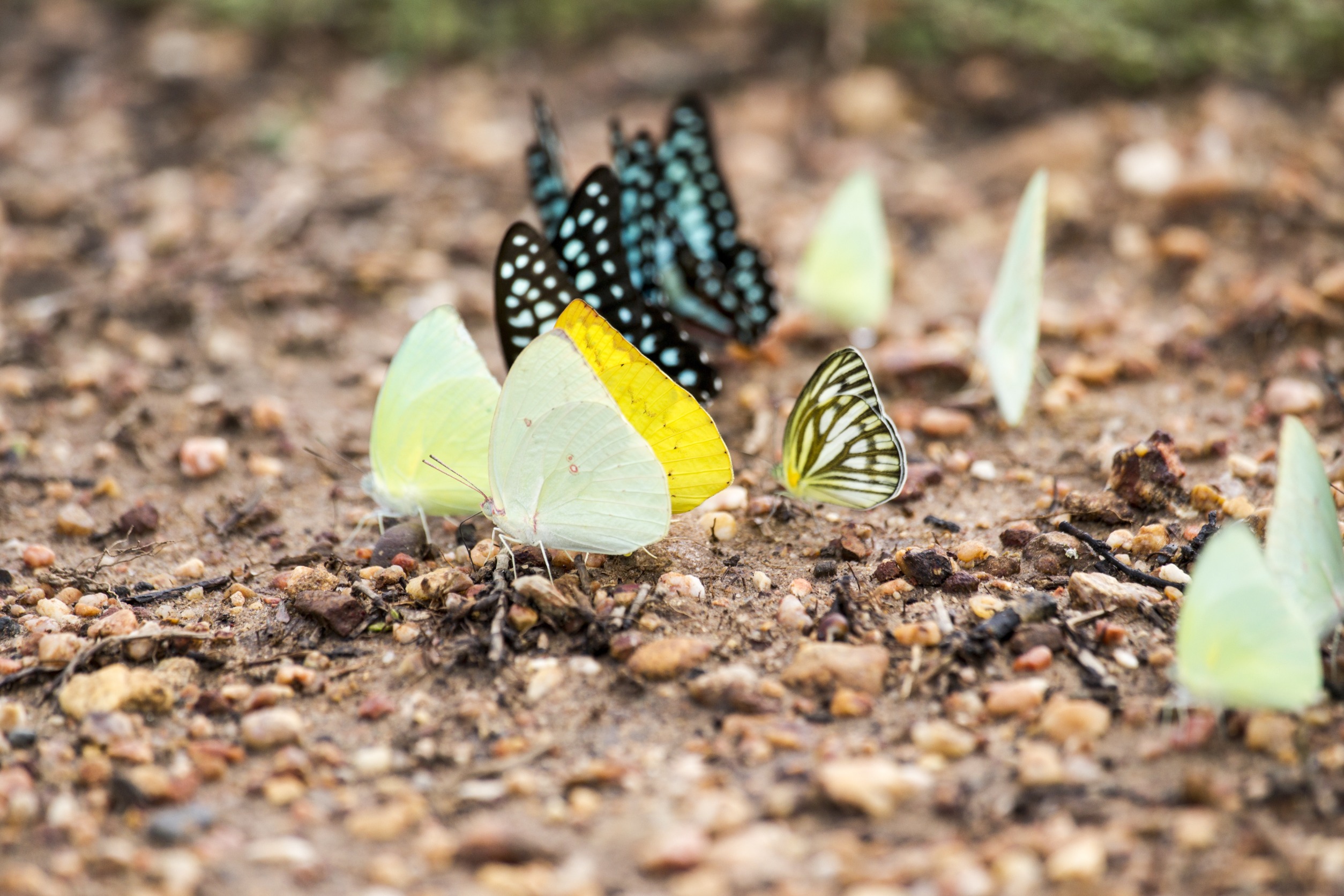
In the vast field of cognitive science, insects are frequently pushed to the periphery, judged to be too tiny and seemingly simplistic to possess significant intelligence. However, new research undermines this view, shedding light on butterflies’ amazing cognitive capacities. The University of Bristol’s innovative research reveals an intriguing component of butterfly behavior: spatial learning.
Small but mighty: revealing the complexity of butterfly cognition
The study’s senior author Dr. Stephen Montgomery from the University of Bristol’s School of Biological Sciences highlights the importance of this discovery, saying, “It’s fascinating to learn about the complex behaviors that even familiar animals like butterflies express as part of their natural ecologies.” In a groundbreaking move that calls into question long-held beliefs about insect cognition, this study provides experimental proof of spatial learning in butterflies and moths.
Spatial learning experiments: a closer look
The researchers conducted spatial learning tests on Heliconius butterflies at different spatial scales, mimicking ecologically relevant behaviors. From feeding in a restricted space to negotiating a complex maze, the butterflies demonstrated incredible adaptability and learning abilities.
Success across a range of scenarios
Interestingly, the butterflies performed well in all three settings, demonstrating their ability to learn and adapt to varied spatial environments. According to Dr. Montgomery, “Wild Heliconius appear to learn the location of reliable pollen sources and establish long-term ‘traplines’—efficient foraging routes similar to other pollinators.”
Exploring the evolutionary implications
The findings also raise intriguing issues regarding how butterflies’ cognitive abilities evolved. The researchers intend to explore Heliconius’ spatial learning ability in comparison to closely related species, which will provide insights into how ecology influences cognitive evolution.
Understanding how butterflies navigate their surroundings is critical for unlocking the secrets of their cognitive capacities. Dr. Priscila Mourarom who hails from the Universidade Federal do Rio Grande do Norte underscores the importance of this research, stating, “Now we are able to provide actual evidence on their fascinating spatial learning. And this is just the beginning.”
Future directions for butterfly cognition research
The finding allows for more investigation into butterfly cognition, opening the path for future research attempts. Scientists hope to identify the fundamental causes of butterflies’ spatial learning ability by looking into their complicated navigation algorithms.
The discovery, published in Current Biology, represents a substantial advance in our knowledge of butterfly cognition. As researchers delve deeper into the subtleties of insect intelligence, butterflies emerge as unexpected champions of spatial learning, defying established beliefs and exciting the scientific community.
Source study: Current Biology—Long-term spatial memory across large spatial scales in Heliconius butterflies