BY THE OPTIMIST DAILY EDITORIAL TEAM
When Helsinki needed to connect a growing island suburb to the city center, the planners made a decision that would be unusual in most countries: they never considered building a car lane.
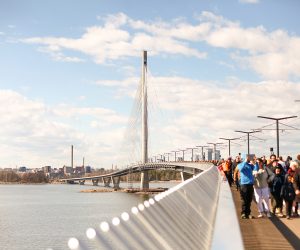
The Kruunuvuori Bridge, which opened to the public this past weekend, stretches 0.74 miles across the water between Helsinki’s eastern island suburbs and the city center. Pedestrians and cyclists can cross it now. Trams will begin running on it early next year. Cars and motorcycles will never use it.
The bridge is the last of three so-called Crown Bridges, each one part of a deliberate strategy to link residents of Helsinki’s eastern islands to the city while protecting the quality of life those areas are known for. The islands are popular precisely because of their connection to nature, and the city’s approach to mobility reflects that.
Engineering a bridge for people
The structure is cable-stayed from a single pylon standing 443 feet (135 meters) tall, designed by UK-based Knight Architects and structural engineers WSP Finland. Its horizontal curve was not purely a structural decision. According to WSP, a curved bridge allows someone crossing it to actually perceive where they are headed, improving the experience of walking or cycling across it in a way a straight span would not.
Practical details were worked in at every level. Railings on the south edge shield users from the prevailing harsh winds from that direction. Patterned plastic piping on the cables causes ice to flake off rather than accumulate. The pylon is fitted with LED lighting across its entire facade, changing color with the time of day and the season. A total of 100,000 hours of design work went into the project.
The bridge is engineered to last 200 years. That involves stainless steel on the outer layer of rebar in the sea piers to resist corrosion, specific concrete formulations in water-exchange areas built to handle high stress, and a maintenance schedule written into the design from the start.
Built for a city that’s still growing
The timing matters. The Laajasalo district, which the bridge connects to central Helsinki, is expected to see its population double as a new residential area called Kruunuvuorenranta opens up. Rather than widening roads to absorb that growth, the city is routing the new residents through the light rail system that the bridge will carry.
That decision also reduces projected strain on the eastern branches of Helsinki’s metro, distributing transit load across the network rather than concentrating it.
The result is a piece of infrastructure that may be the longest combined pedestrian and light rail bridge in the world. Whether that claim can be fully verified is an open question, but the more relevant point is what the city chose to build. For a neighborhood whose identity is tied to being outside and away from traffic, the bridge delivers connectivity without the car culture that often comes with it. Helsinki treated the crossing as a place worth experiencing, not just a route to get through quickly, and the engineering reflects that intention throughout.
Did this solution stand out? Share it with a friend or support our mission by becoming an Emissary.