BY THE OPTIMIST DAILY EDITORIAL TEAM
Nobody watches the World Cup to think about footwear. But the shoes on the pitch at the 2026 tournament are the end result of about 500 years of iteration, and the story is stranger than you’d expect. It involves a family feud, kangaroo leather, and at one point, someone trying to understand the molecular structure of mud.
They started as actual work boots
Modern soccer took shape between the 18th and 19th centuries, played by middle- and lower-class workers for leisure. No professional leagues, no formal teams. People played in whatever they had, which usually meant factory boots: heavy, high-cut leather, the kind worn on shop floors.
The name “football boots” stuck for obvious reasons. Those first shoes were indistinguishable from work boots because they were work boots.
Players figured out fast that leather soles on wet British turf were nearly useless. The fix: hammer nails into the bottom. Hardware store nails, sharp ones, which presumably made tackling more complicated than it is today. Anyone on the wrong end of a nail-studded boot wasn’t necessarily getting back up.
In 1886, the Football Association published guidelines making shoes mandatory and banning uncovered metal nails. A standard settled: all-leather, lace-up, six studs across the sole. That layout is the distant ancestor of every cleat pattern worn today.
The brothers behind Adidas and Puma
The cleat’s real transformation began in Herzogenaurach, a small German town. Rudolf and Adolf Dassler started the first company to specialize in athletic shoe design. Through a chain of circumstances that included the 1936 Berlin Olympics and Jesse Owens’s performance there, they became the most recognized name in athletic footwear.
Then, the siblings had a disagreement that they couldn’t reconcile.
The falling-out produced Puma and Adidas. Both companies are still in Herzogenaurach more than 80 years later. Their rivalry drove most of what followed: interchangeable studs, lower-cut designs that let players move faster, and eventually the 1979 Copa Mundial made with kangaroo leather, which became one of the best-selling shoes ever made.
K-leather, as it came to be called, was lightweight, soft, and durable. ESPN estimated the global kangaroo product industry at $200 million in 2021, much of it tied to athletic footwear. In 2023, both Puma and Nike announced they’d stop making kangaroo leather products, following proposed US legislation and as synthetic alternatives had gotten good enough to make the switch worth taking.
From television to sock-shoes
As soccer’s global viewership expanded through the 1990s and 2000s, cleat design moved faster. Adidas’s 1994 Predator added rubber strips to the toe for grip and spin. Nike’s Mercurial in 1998 was among the first major models built on synthetic leather. By 2014, the Nike Magista was a single piece of fabric, worn more like a sock than a shoe.
In 2015, Adidas made the first cleat to weigh under 100 grams. About the same as four AA batteries.
Engineering meets mud science
Making a soccer cleat now means engineers and 3D models, not cobblers. Nike uses Finite Element Analysis to test plate positioning digitally before anything gets physically built. That’s how the company landed on chevron-shaped studs: the data showed they outperformed blade-shaped ones for propulsion and multidirectional movement.
Getting mud not to stick turned out to require understanding mud at a molecular level. Nike’s Anti-Clogging Technology uses an adaptive polymer and a hydrophobic solution to keep plates clean during a match. The company also built adaptive traction technology where pegs adjust automatically based on the ground, going deeper into soft turf and sitting flatter on harder surfaces.
The psychology of hot pink
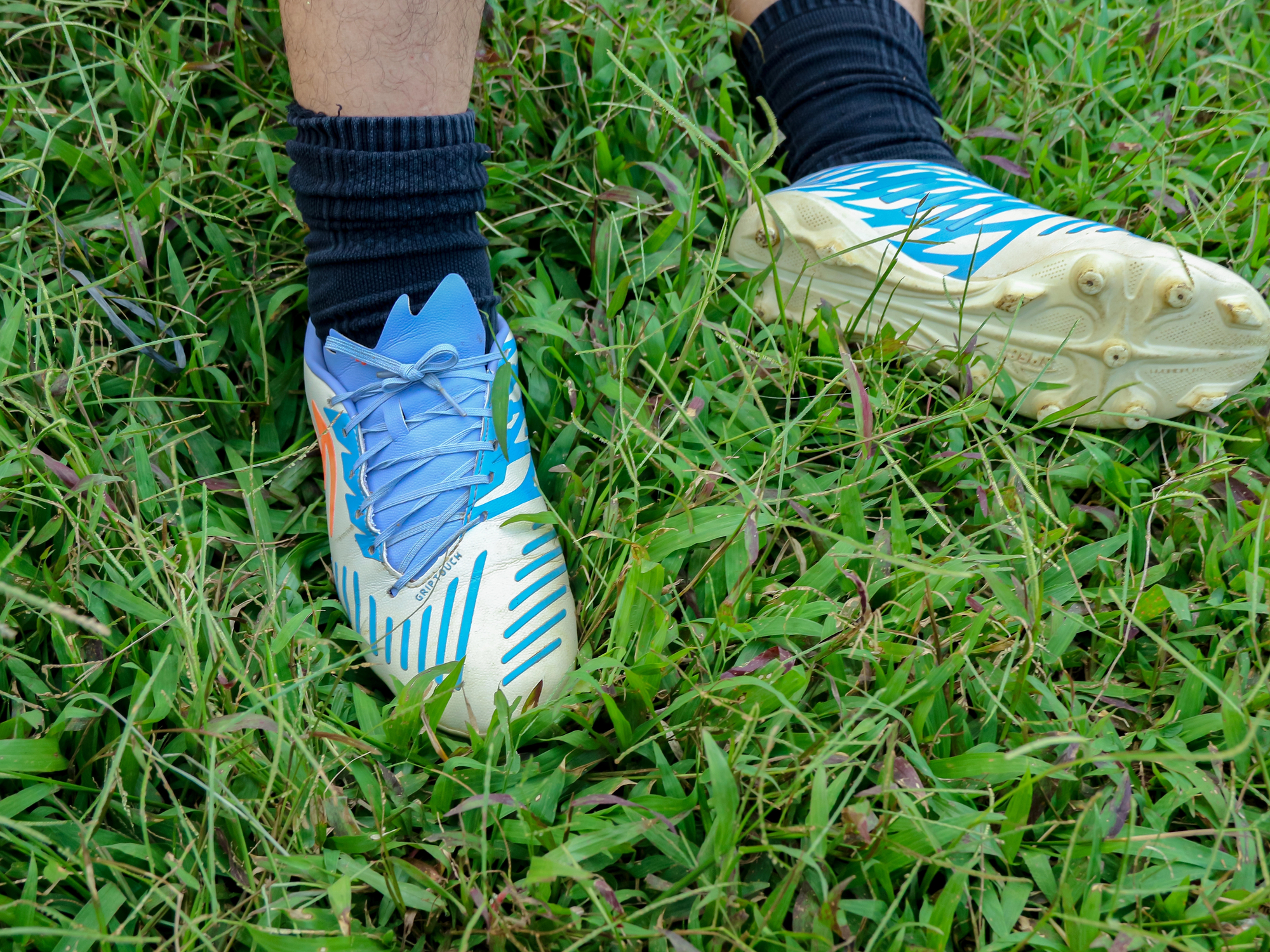
The most visible change at this year’s World Cup has nothing to do with polymers. It’s the colors. Cleats were black or white for most of soccer’s history. Now they’re neon green, electric blue, and a lot of hot pink.
Some of that is practical: bright colors read better on television. But there’s also a psychological case for it.
“What we’ve been hearing consistently from the athlete and the consumer, especially when it comes to big moments, is that bright colors give them confidence,” said Odinga Nimako, Nike’s Global Footwear Product Line Manager.
From a factory worker’s nailed-up boot to a computer-designed, sub-100-gram piece of hydrophobic fabric: the cleat has traveled far. Worth a glance down at the pitch the next time someone takes a free kick.
Did this solution stand out? Share it with a friend or support our mission by becoming an Emissary.