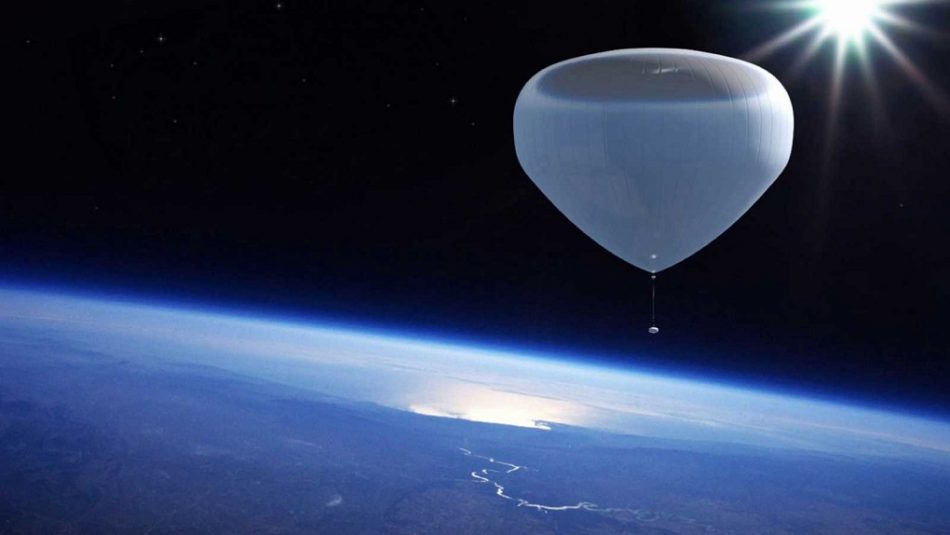
NASA’s latest mission won’t involve launching a rocket into space, but rather a stadium-sized high-altitude balloon that will fly high up in the Earth’s atmosphere – all in an effort to watch newly formed stars.
The mission is called ASTHROS (Astrophysics Stratospheric Telescope for High Spectral Resolution Observations at Submillimeter-wavelengths) and is expected to kick off in December 2023.
As part of the plan, a 400-foot wide balloon will float over Antarctica for about three weeks at altitudes well below the internationally agreed-upon edge of space, but high enough to observe wavelengths of light cast from newly formed stars that are blocked by Earth’s atmosphere.
The main payload will be an 8.4-foot telescope – the largest ever to be flown in this way – that will point itself at four primary targets, including two regions in the Milky Way where scientists have observed star formation activity.
After drifting around the South Pole for a couple of weeks at high-altitude stratospheric winds, the telescope will separate from the balloon and return to Earth slowed by a parachute so that it can potentially be recovered and flown again in the future.
The end goal is for ASTHROS to create “the first detailed 3D maps of the density, speed, and motion of gas” in these regions around newborn stars, in order to help better understand how they can impede the development of other stars, or encourage the birth of some. This will be helpful in refining existing simulations of the formation and evolution of galaxies, the agency says.