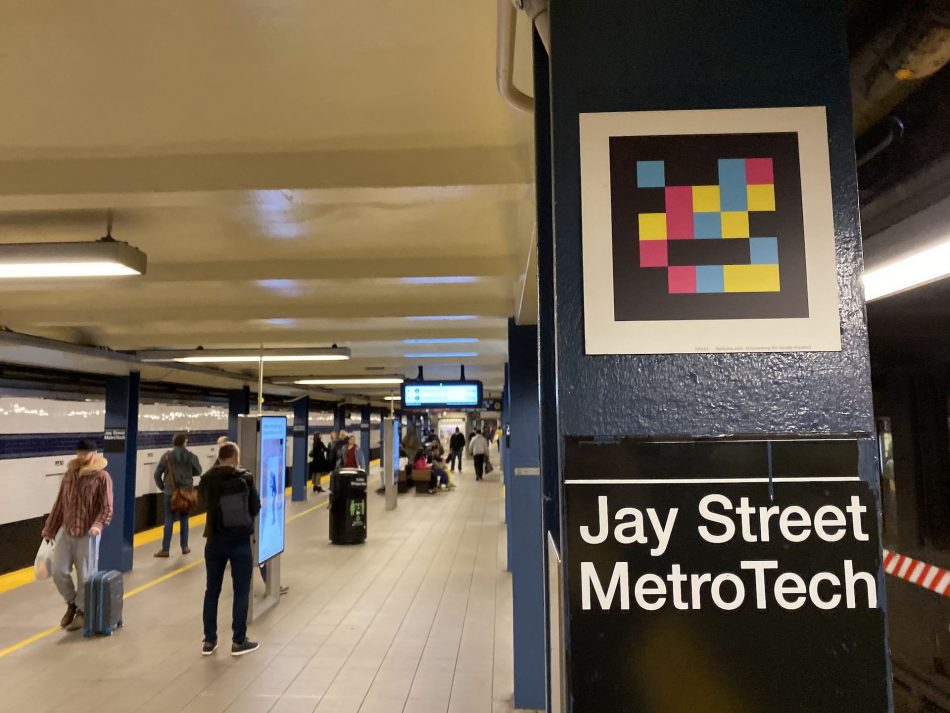
If you’ve ever navigated an unfamiliar public transportation system, you likely relied heavily on signage to find your way around, but for the visually impaired, public transportation systems are often far less accessible. A new navigation app, NaviLens, hopes to change this by providing auditory cues in public spaces.
Developed by the University of Alicante’s Mobile Vision Research Lab and the technology company Neosistec, the app allows users to scan codes in public spaces and hear the information listed on the code’s corresponding sign.
The researchers have experimented successfully with their design in transit systems and museums in Barcelona, Murcia, and Madrid. Now, they’re expanding their trials to the US at the Wisconsin School for the Blind and Visually Impaired and in New York subway stations.
Using the app, individuals can scan a sign up to 40 feet away and hear an auditory cue in 1/30th of a second. The information can be communicated in 20 different languages and cues include not only the information listed on the sign, but also valuable details such as when the next train will arrive, anticipated delays, and how many feet away a staircase is. In museums, the app can be used to learn more about different works of art or navigate towards various exhibits.
Although NaviLens does require scanning codes to be installed in the systems it operates in, these can easily be added to existing signage to boost accessibility.
Moving forwards, the researchers anticipate the technology will be useful not only in transportation systems and museums, but also schools, hotels, restaurants, and other public spaces.
Image source: NaviLens