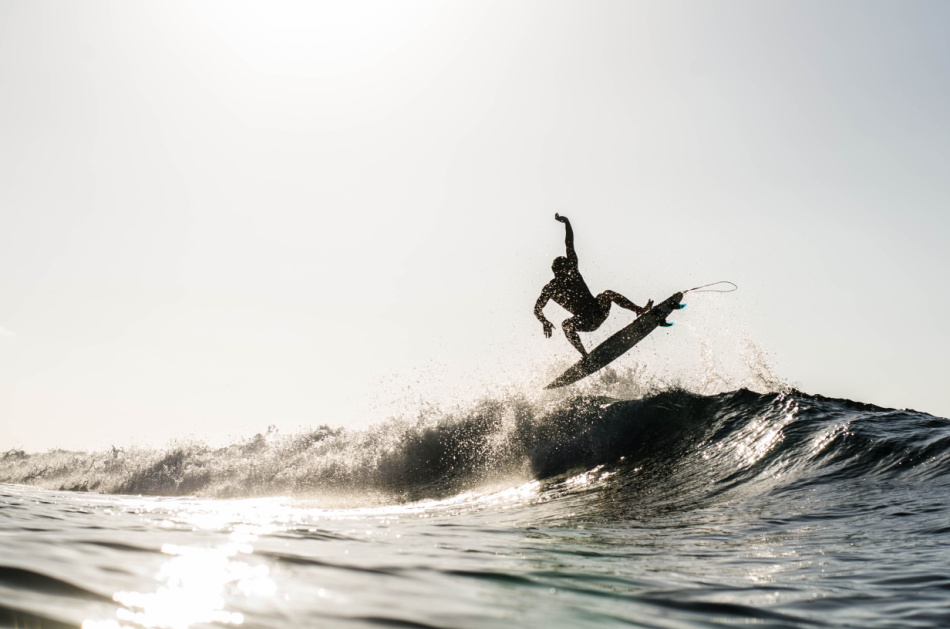
Surfing is a sport that is all about getting close to and appreciating nature. Unfortunately, conventional surfboards tend to contribute to environmental degradation.
Steve Davies, a 23-year-old board designer from Porthcawl, Wales, is working on a surfboard built of mycelia, the root-like structures of mushrooms and other fungi to turn this trend around.
According to Davies’s BBC interview, this “sounds a little bit crazy,” but using natural materials like mycelia is a means to get away from polystyrene, polyurethane, and resin boards, which can remain in trash for hundreds to thousands of years without decomposing.
Making surfing sustainable
According to Davies, around 400,000 boards are manufactured each year. Following a 2022 analysis, the global surfboard industry reached $2.2 billion in 2020 and is predicted to reach $3.2 billion by 2027.
However, around 80 percent of boards are not created in a sustainable manner, which will become more of a concern as the industry expands.
Many boards are constructed of plastic, which might take hundreds of years to degrade.
Nevertheless, “even when it does break down, it can go into fish’s ecosystem and bio-accumulate, so it ends up that human beings will end up eating this polystyrene plastic,” Davies said.
Davies created his first surfboard in 2020, but the experience taught him how many toxic chemicals are used in the manufacturing process. During his final year at Cardiff Metropolitan University, he began researching mycelia and ways to make his favorite sport more sustainable.
How Davies’ sustainable surfboards got started
Since Davies’ family owns a farm with horses, he had easy access to the substrate material he needed to produce the mycelium in the form of horse bedding and straw. “This sparked an idea to start a business/surfboard manufacturer from an agricultural point of view — growing surfboards on a farm near the beach whilst using waste materials from that very same farm, reducing the transport of materials, and therefore reducing carbon released into the environment.”
The mycelium connects a natural board skeleton formed in a mold and then coated with a waterproof substance. According to the BBC, Davies examined numerous compounds for the coating, including beeswax and linseed oil.
Davies aims to someday scale up to a commercial level, but in order to compete with traditionally manufactured surfboards, the boards must be robust, high-performance, and quick to produce.
“In the right conditions, we will grow a mycelium board in around 21 days,” Davies told BBC. “The dream would be to make it the new norm. Connecting with nature would be the new design rules and a lot of things like that would be really cool. We’re using the sea, we should give back to the sea and it should be a circular model.”
Davies is not the first person to try to make surfboards out of mycelium. Mycelium has also been used to make surfboards by companies such as ENV Boards and Ecovative.
While working with organic materials has a unique set of obstacles when manufacturing items like surfboards, mycelium is a strong, naturally biodegradable material that has the potential to minimize the quantity of plastic in the industry.
We are highlighting this piece as part of our annual “Best Of” roundup of articles published at The Optimist Daily this year. Today’s focus is on our staff’s picks! Our favorite solutions of 2023.