BY THE OPTIMIST DAILY EDITORIAL TEAM
For decades, advances in medical technology have focused on restoring movement to people living with paralysis. But for scientists like Chad Bouton, an engineer at the Feinstein Institutes for Medical Research, movement alone is not enough. True independence, he realized, requires something more: the ability to feel.
This epiphany came in 2014, when a man using Bouton’s brain-computer interface to control his paralyzed hand shared a frustration, saying: “You know, Chad, I can’t feel this object.” It was a lightbulb moment.
Now, after years of research, Bouton’s team has developed a system that restores both movement and sensation. Their work is already changing lives, starting with Keith Thomas, a man who had been paralyzed from the chest down since a diving accident in 2020.
A breakthrough in restoring touch
Thomas became the first person to undergo a new procedure involving a “double neural bypass,” a system designed to reroute signals around damaged nerves. In 2023, surgeons implanted two sets of computer chips into his brain: one set detects movement-related signals, while the other delivers sensory information back to the brain.
The system works in two ways. The first bypasses the injured spinal cord by sending signals directly from the brain to the muscles. The second branch reestablishes communication between the brain and spinal cord, strengthening any remaining neural connections and making them more responsive to movement.
From the moment Thomas was connected to the system, the results were striking. “They hooked me up to the machine and I felt my index finger,” he recalled. “It was like, ‘whoa!’ ”
A lab wired for progress
Inside the Feinstein lab, bringing Thomas’s right hand back to life requires teamwork and precision. Twice a week, he arrives for hours of therapy, guided by engineers, therapists, and researchers who help refine the system.
The process begins with electrical engineers attaching NeuroPlex E adapters to the pedestals on Thomas’s head. These adapters link him to a network of amplifiers, signal processors, and a computer that deciphers his brain activity. Artificial intelligence within the system interprets his thoughts about movement, while small sensors placed on his fingers and palm relay touch sensations back to his brain.
Once he is fully connected, Thomas undergoes rigorous mobility and strength testing. On a nearby screen, two animated hands display the process in real-time: one showing the intended movement, the other reacting to his brain’s commands.
“He cannot move his own hand, but he’s trying to do that,” explains research scientist Santosh Chandrasekaran. “The decoder figures out what he’s thinking about and then controls the other hand on the screen.”
With each session, Thomas’s control improves—especially when sensory feedback is activated. “What we are measuring is the force levels on the sensor,” says Chandrasekaran. “And then appropriately stimulating the right electrodes in the brain so that we can make him feel a sensory percept at the right location on the hand.”
Small moments, big impact
The ability to sense touch again has led to profound experiences. One of the most emotional moments came when Thomas was able to feel his sister’s hand. “The sensation was like a rush of energy,” he said.
Beyond sensation, movement is returning as well. The first major milestone came when the team placed a cup of water in front of Thomas. “He lifted that cup up, for the first time, to his mouth, took a drink and then set it back down all on his own without any help,” Bouton recalled.
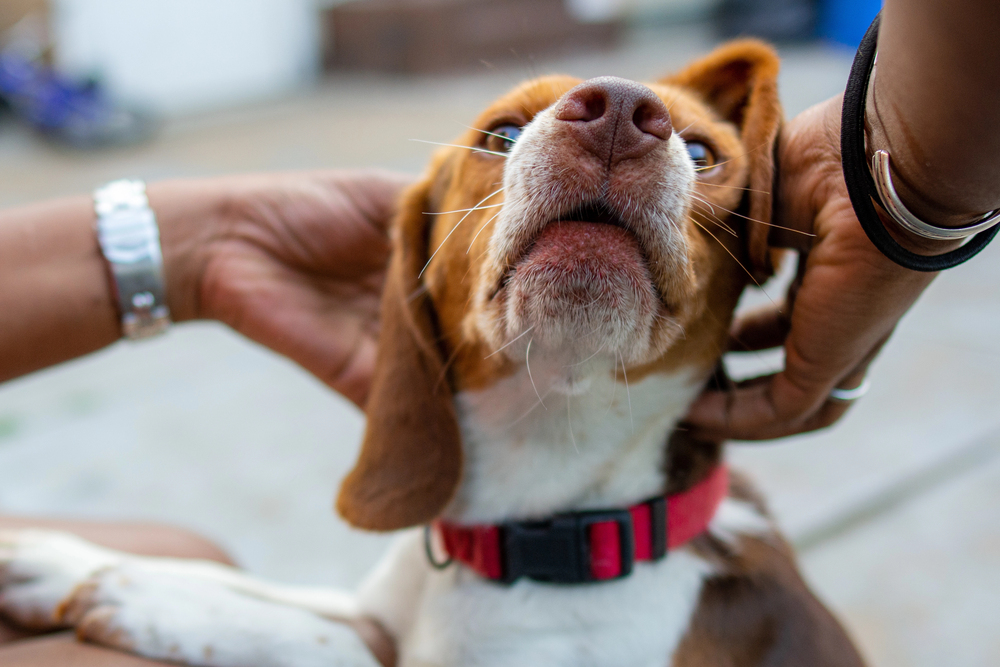
Even more promising, his progress is no longer confined to the lab. After a year of therapy and spinal stimulation, Thomas has regained enough strength and sensation to experience these benefits at home. During a recent Zoom conversation, he demonstrated how he can now lift his arm unassisted. He can also pet his dog—”I can feel a little bit of the fur,” he says.
A glimpse into the future
What started as an ambitious experiment is now pointing toward new possibilities for people with paralysis. The double neural bypass, still in its early stages, is showing that paralysis may not be permanent. With continued advancements, this technology could one day become widely available to help those with spinal cord injuries regain both movement and feeling.
For Thomas, every improvement represents a step toward independence. Whether lifting a cup or sensing his dog’s fur, each moment reinforces what’s possible when science and determination meet.