BY THE OPTIMIST DAILY EDITORIAL TEAM
In the heart of the Amazon Basin, along the Guaporé River where Brazil meets Bolivia, a remarkable discovery has been made. Scientists identified the largest known nesting site of the endangered giant South American river turtle, with more than 41,000 individuals recorded thanks to a cutting-edge drone study.
Conducted by researchers from the University of Florida and the Wildlife Conservation Society, the study combined drone imagery with advanced statistical modeling to achieve a milestone in wildlife monitoring. Published in the Journal of Applied Ecology, the research not only sets a record for turtle nesting but also introduces a more efficient, non-invasive method of counting animals in the wild.
“We describe a novel way to more efficiently monitor animal populations,” says lead author Ismael Brack. “And although the method is used to count turtles, it could also be applied to other species.”
Meet the Arrau: social, sizable, and at risk
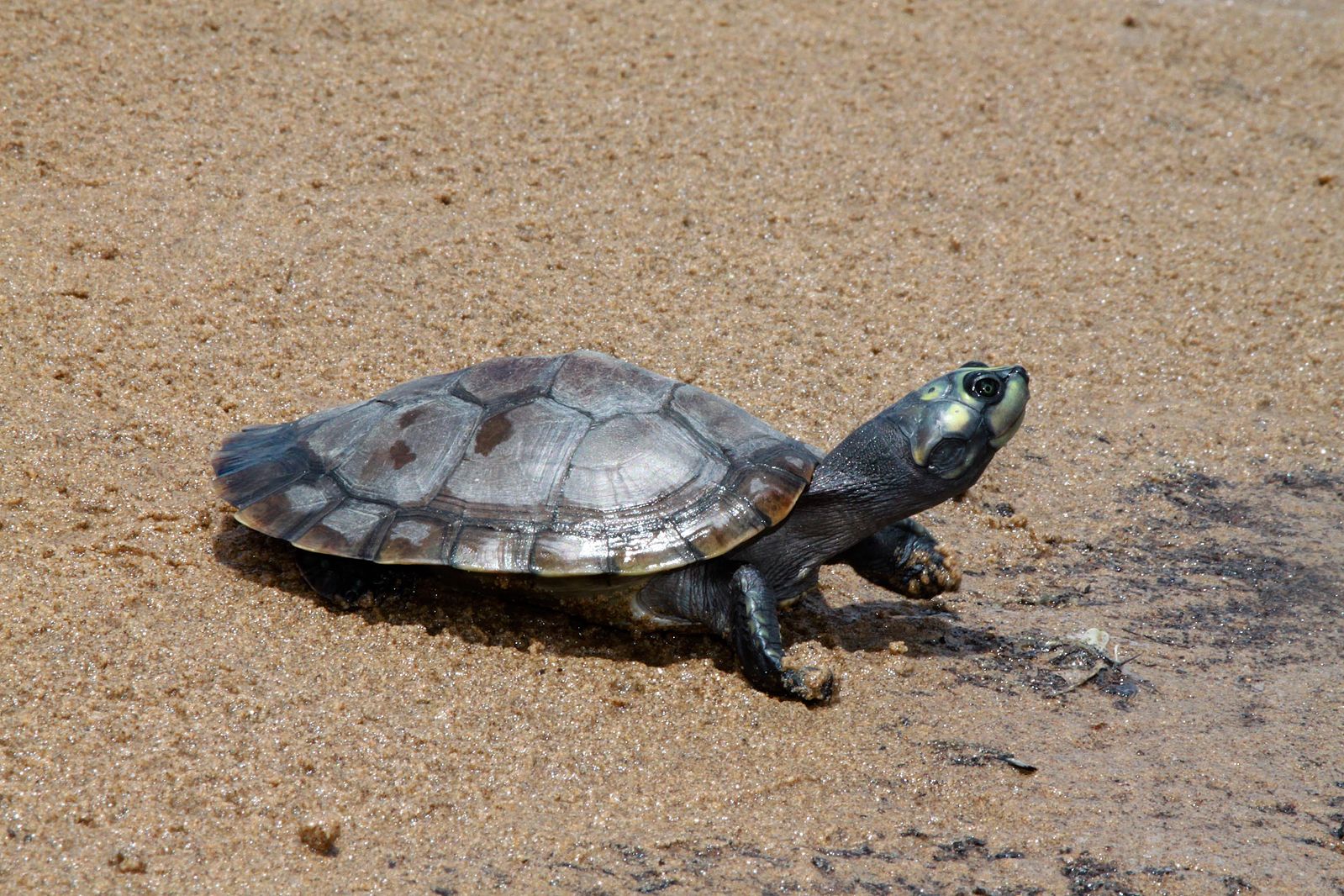
The stars of this story are giant South American river turtles, also known as Arrau turtles (Podocnemis expansa). These gentle giants are among the world’s largest freshwater turtles, growing up to 90 centimeters long and weighing as much as 80 kilograms. They range in color from olive green to dark gray and are famous for their collective nesting behavior.
Each year during the dry season, which typically spans July and August, female turtles gather by the thousands on sandy riverbanks to lay their eggs. It’s a spectacular sight, but one under threat. Despite legal protections, Arrau turtles face ongoing dangers from poaching and habitat degradation.
Understanding whether their populations are stable, declining, or recovering is crucial. But accurately counting turtles has always been a tricky task.
A smarter way to count wildlife
Traditional ground surveys can be invasive and inconsistent, and even drone imagery has its challenges. Animals move. Observers miss things. Double counts happen. These discrepancies can skew data and complicate conservation efforts.
To improve accuracy, Brack and his team designed an innovative survey system. Over 12 days, drones flew four times daily over a nesting site along the Guaporé River. The team marked 1,187 turtles with white paint and tracked their activity through 1,500 high-resolution images captured per flight. These images were stitched into detailed orthomosaics, allowing researchers to note which turtles were nesting, moving, or resting.
Using probability models, the team reconciled the differences between traditional counts and raw drone images. While ground surveys counted around 16,000 turtles and unadjusted drone footage suggested nearly 79,000, the new method produced what scientists believe is the most accurate estimate: just over 41,000 turtles.
“These numbers vary greatly, and that’s a problem for conservationists,” Brack explains. “If scientists are unable to establish an accurate count… how will they know if the population is in decline or whether efforts to protect it are successful?”
Why it matters for the Amazon
The Arrau turtle is not just a biological curiosity. It plays a vital role in the Amazonian ecosystem. These turtles act as seed dispersers and are a key food source for predators. Their nesting grounds support biodiversity and help maintain ecological balance along river systems.
Accurate population data enables more targeted conservation, from protecting crucial nesting beaches to allocating resources where they are needed most. And this drone-driven method could benefit more than turtles. The researchers believe it could be adapted for use with other species like seals, mountain goats, or elk; basically anytime movement or visibility makes population counts difficult.
Looking ahead, the team hopes to apply their refined methodology across other parts of the Amazon, including Colombia, Peru, and Venezuela. “By combining information from multiple surveys, we can detect population trends,” Brack notes. “And the Wildlife Conservation Society will know where to invest in conservation actions.”
Awe in the data
This study captures more than numbers; it captures the awe of nature’s scale and resilience. To witness tens of thousands of endangered turtles congregating in a single place is to be reminded of what’s still thriving, even as threats loom.
Thanks to drones, algorithms, and the passion of conservation scientists, we now have a clearer picture of one of the Amazon’s most extraordinary phenomena. And perhaps, a clearer path forward in protecting it.
Source study: Journal of Applied Ecology— Estimating abundance of aggregated populations with drones while accounting for multiple sources of errors: A case study on the mass nesting of Giant South American River Turtles