THE OPTIMIST DAILY EDITORIAL TEAM
Finding parking in a city has always been a small daily nightmare. In places like Los Angeles, drivers can spend more than 80 hours a year circling the block, and cities across the globe, from London to Frankfurt, offer little relief. But Vienna is taking a different approach: instead of building more places to park, the Austrian capital is removing them. Surprisingly, it’s going pretty well.
Faced with the dual challenge of climate change and limited space, Vienna is on a mission to swap asphalt for trees, bike lanes, and public seating. In doing so, it’s not just making the city cooler and more livable but also challenging a long-held assumption in urban planning: that cars should always come first.
The hidden cost of parking lots
Parking spots may be individually small, but collectively, they take up an enormous amount of space. In the United States, roughly 25 percent of developable urban land is devoted to parking. That’s a lot of heat-trapping pavement and a lot of real estate that could be doing something else.
All that asphalt contributes to rising summer temperatures, worsens flooding by blocking stormwater drainage, and prioritizes cars over people. Some cities are starting to realize the trade-offs aren’t worth it.
Vienna’s plan: break up the asphalt
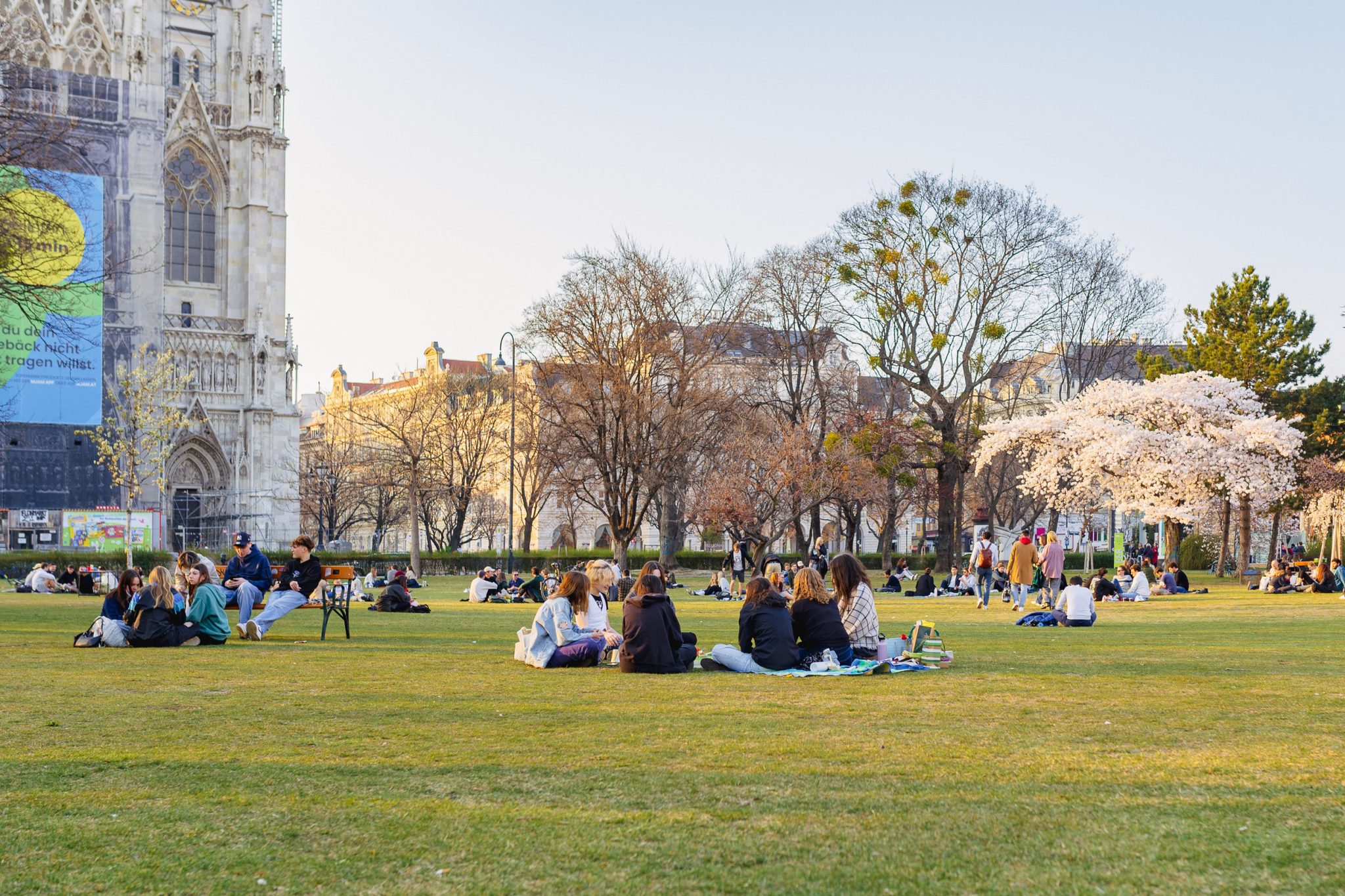
Vienna has been quietly removing street parking in favor of public space, and not just in the outer districts. Even Neuer Markt, a historic square in the heart of the city, has been transformed. Once packed with parked cars, it’s now a pedestrian-friendly area with trees, benches, and open space for people to gather.
The city has more than 350 projects underway to replace parking spots with green infrastructure and public areas. That includes a major street reimagined as a Dutch-style cycling corridor, where 140 parking spaces were swapped for nearly a mile of bike lanes and plants.
Residents can even apply to convert individual parking spots into what the city calls “neighborhood oases” made up of community gardens, playgrounds, or outdoor seating areas.
On top of this, in a major policy shift, Vienna now requires payment for all street parking city-wide, with a strict two-hour limit for non-residents. Free parking is a thing of the past.
The key to success: offer real alternatives
Of course, making parking harder isn’t the point; making alternatives easier is. Vienna has invested heavily in a reliable, affordable transit system. “Park and ride” garages allow commuters to leave their cars outside the city center and connect seamlessly to subways or trams. The public transport system is fast, cheap, and well-connected, which is exactly what’s needed to encourage behavioral change.
“We have to take people on board,” said Ina Homeier from Vienna’s Department of Urban Planning and Development. “We have to ask: how do you want your neighborhood? Do you want it to be filled with cars and without any trees, or do you want something different?”
This approach is working. The city’s investment in greener infrastructure is partly funded by parking fees, which now bring in around €180 million ($209 million) annually. Those funds go right back into cycling infrastructure and public transit. As a result, car use in Vienna has dropped by 37 percent compared to the 1990s.
Changing car culture isn’t easy
Still, resistance remains. “There’s been very complicated politics around taking back some of the space we’ve accorded the automobile,” said journalist Henry Grabar, author of Paved Paradise: How Parking Explains the World. For those who rely on cars, especially in places where transit isn’t a viable option, reducing parking can feel like an attack.
This tension is especially strong in countries like the United States, where 92 percent of households own at least one car. Drivers are a powerful political group, and car culture is deeply ingrained in urban policy.
Yet even in the US, cities are beginning to rethink their approach. Dallas turned a large downtown parking lot into a 3.7-acre park. San Francisco and New York have kept many of the “parklets” that popped up during the pandemic, turning curbside parking into outdoor dining and gathering spaces.
Raising street parking fees has also proven an effective measure to manage demand and fund better alternatives. “There are lots of cities that are starting to realize the opportunity that parking offers for cities that have relatively limited budgets,” said Dana Yanocha of the Institute for Transportation and Development Policy.
And cities like San Jose and Austin are rolling back zoning laws that required new developments to include a minimum number of parking spaces, freeing up land for housing, green space, or businesses instead.
It’s not just about cars, it’s about choice
At the heart of all this is a simple idea: people need options. “You cannot reduce anything without offering a good alternative,” said Homeier. That’s especially true for transportation. When people have a cheap, fast, and pleasant alternative to driving, they’re far more likely to use it.
Vienna’s success didn’t come from banning cars. It came from making room for something better. The city is betting that the future of urban life is not about where to park, but about what kind of place we want to live in.
Did this solution stand out? Share it with a friend or support our mission by becoming an Emissary.