BY THE OPTIMIST DAILY EDITORIAL TEAM
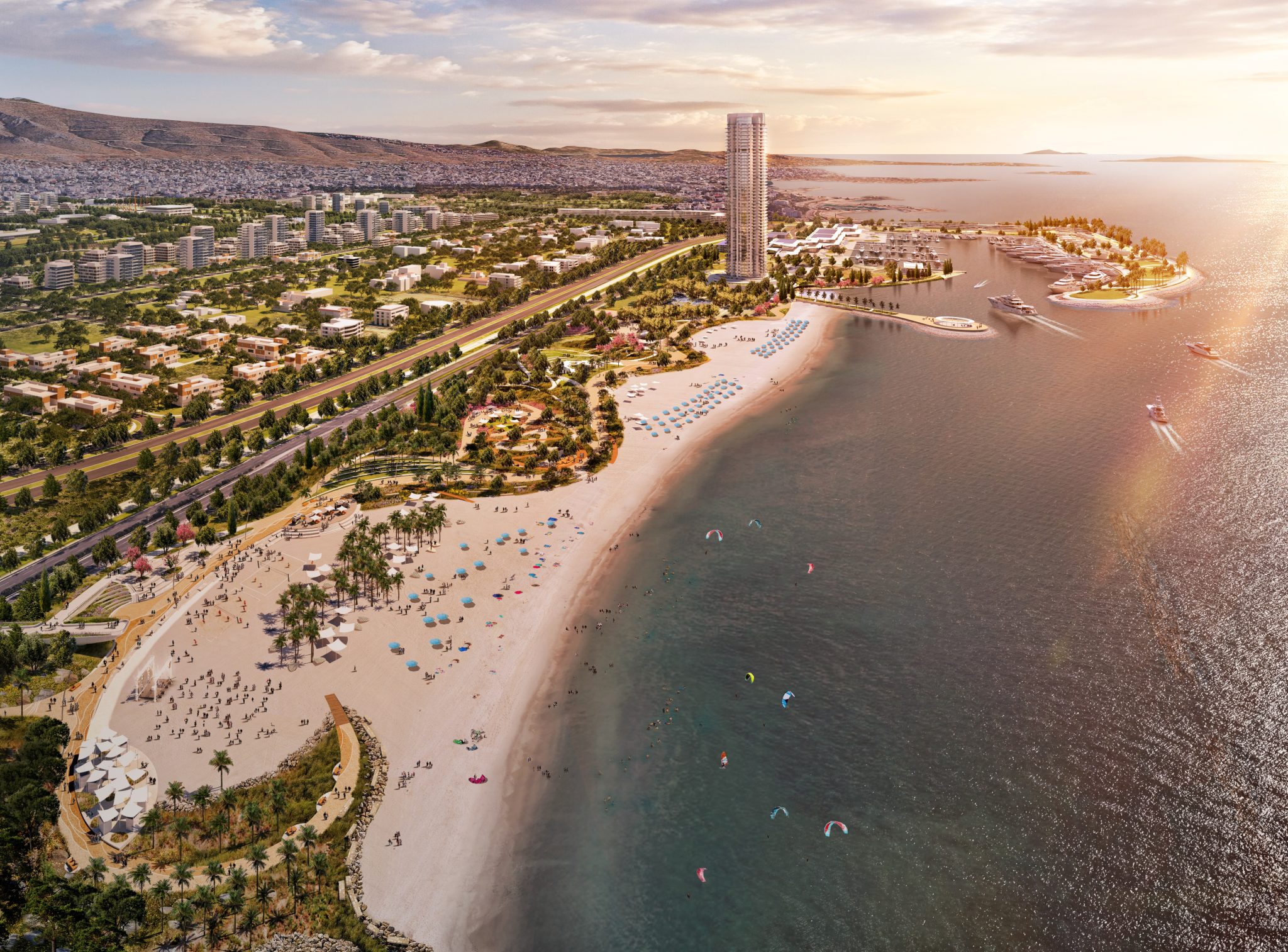
Two million square meters of former airport land in the southern suburbs of Athens are being converted into The Ellinikon Park. The park is designed to actively lower surrounding air temperatures, process 100 percent of its own rainfall on site, and keep more than 520 plant species alive through a sensor-driven irrigation system.
It is scheduled to open in early 2027, with additional infrastructure following through 2030. At 200 hectares (494 acres), it will be the largest coastal urban park in Europe.
Cooling engineered into the park’s design
The design started with climate modeling, not landscaping. Designers ran digital simulations using thermal mapping and Computational Fluid Dynamics (CFD) to map airflow across the site, find where heat builds up, and identify where natural ventilation already exists. That data shaped the park’s entire circulation plan.
Paths plotted from airflow data
The result is a network of cool routes: pedestrian paths laid out to follow existing air circulation and tree cover. Temperatures along these routes are projected to run up to four degrees Celsius (7.2 degrees Fahrenheit) below those of the surrounding streets.
Rest areas are being designed with a shading ratio above 60 percent, with gaps kept open for natural airflow. Vegetation is selected and placed to maximize evapotranspiration, the process by which plants release moisture into the air. That moisture extends the cooling effect beyond what canopy shade alone provides.
Water features as cooling infrastructure
Water runs through the park as a working part of its climate system, not as decoration. Channels, misting systems, and low-consumption basins are spread across the design, each contributing to evaporative cooling at ground level.
Sensors will continuously track temperature, humidity, solar radiation, soil moisture, and shade coverage. The readings feed into real-time adjustments of the park’s microclimate management and maintenance schedule.
Irrigation driven by sensors, not schedules
Rather than irrigating on a fixed schedule, the park’s system draws from weather stations and soil sensors and adjusts water delivery to what the vegetation actually needs. According to a technical guide co-authored by landscape architect Dimitra Theochari and UNEP Global Chief Heat Officer Lenio Myrivili, the approach can cut water use by up to 90 percent compared to conventional irrigation.
A wastewater treatment unit capable of producing up to 7,000 cubic meters of treated water per day will cover all non-potable uses on site, including irrigation. A 10,000-cubic-meter storage tank handles dry spells and high-demand periods.
The goal is to keep 100 percent of rainfall on site with no runoff leaving the park. The Trachones stream, which runs through the site, is being restored as part of that system and will also serve as flood protection infrastructure.
Rebuilding with what was already there
Concrete slabs from the demolished airport are being repurposed as retaining walls, plinths, and structural elements. Crushed aggregates from the demolition are going into gabions and backfills. Nothing gets trucked out if it can be reused on site.
New surfaces will be paved in Greek natural stone: Kavala marble, white Dionysos-Penteli marble, Karystos slate, and Mandras sandstone. The materials were chosen for heat performance and because they look like they belong in the Attic landscape.
How Athens’ Ellinikon compares to European parks
For scale: at 200 hectares, The Ellinikon is 40 percent larger than London’s Hyde Park (142 hectares) and close to Berlin’s Tiergarten (210 hectares). Brussels’ Parc du Cinquantenaire, at 30 hectares, is roughly one-seventh its size.
New York’s Central Park, at 341 hectares, is about 1.7 times larger. But Central Park is landlocked. The Ellinikon runs directly alongside a two-kilometer (1.2-mile) stretch of Athenian Riviera waterfront. Among coastal parks specifically, it is larger than Barcelona’s Parc de la Ciutadella at around 31 hectares and about four times the size of Athens’ future Faliro Bay development at 54 hectares.
The park’s design has been written up as a technical reference for other cities, with Theochari and Myrivili treating it as a template rather than a one-off.
Did this solution stand out? Share it with a friend or support our mission by becoming an Emissary.