BY THE OPTIMIST DAILY EDITORIAL TEAM
There are places where the land itself seems to generate energy. The Quebrada de Humahuaca in Jujuy province, in Argentina’s far northwest, is one of them. At altitude, in clear desert air, the valley gets solar radiation that would be hard to match anywhere at lower elevation. For most of its history, that energy was just weather. Now it runs a train.
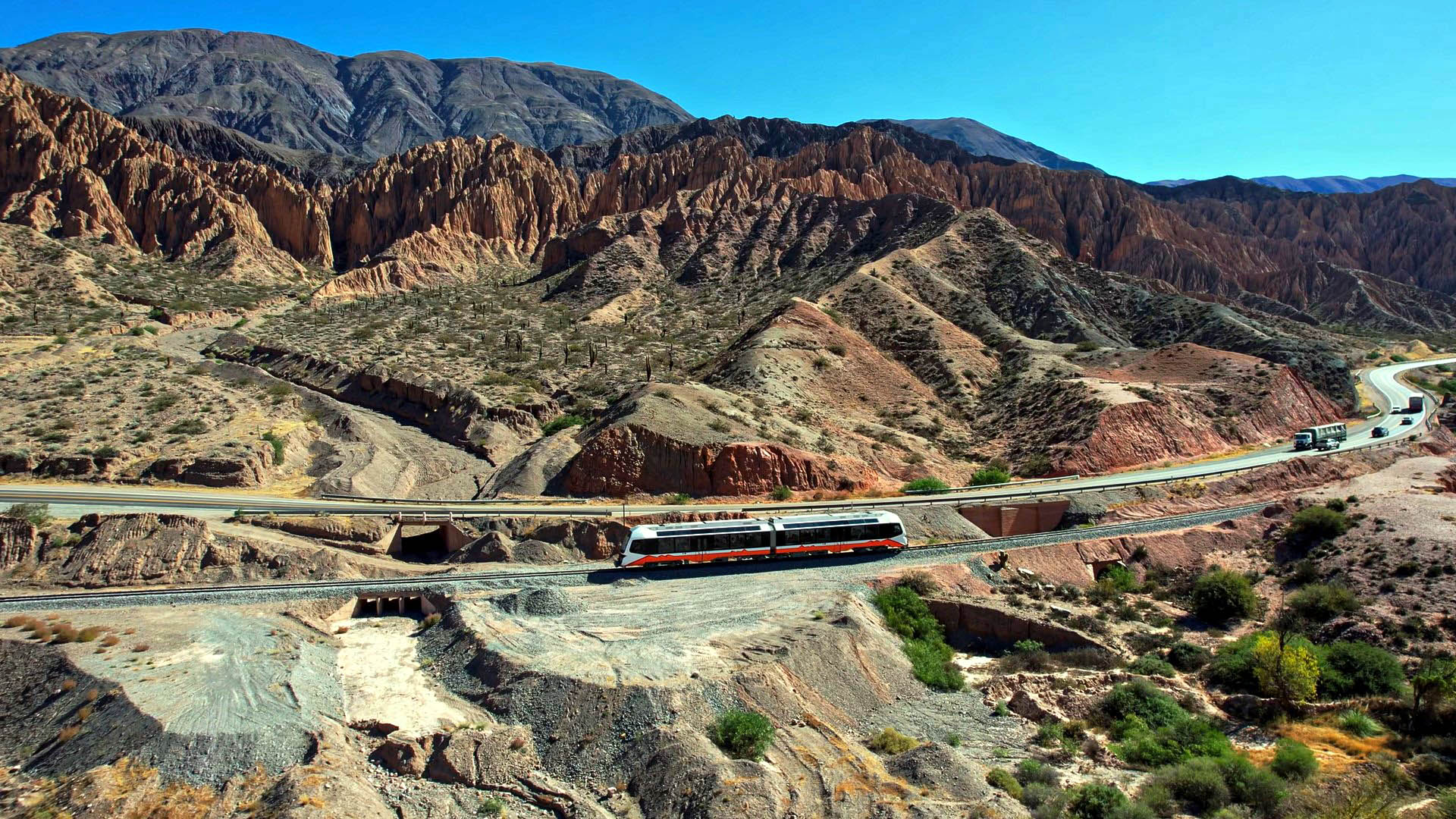
The Tren Solar de la Quebrada, Latin America’s first solar-powered railway, has been running since June 2024, carrying passengers 42 kilometers (26 miles) through the Andes between six towns. The route passes through a UNESCO World Heritage valley that people have crossed for thousands of years.
A route through the Andes for millennia
The Quebrada de Humahuaca is not a valley that has been waiting for discovery. Pre-Inca peoples used it as a trading route. Spanish colonial roads followed the same path centuries later. Today, it connects communities between Volcán in the south and Tilcara in the north, places that had passenger rail for much of the 20th century, and then didn’t.
Rail disappeared from the valley around 30 years ago. The Tren Solar brought it back, minus the diesel.
How the battery system works without a grid
Six batteries and two fast-charging stops
The train does not generate electricity from panels on its roof. Rather, the two-car train runs on six lithium batteries, charged with solar energy from Jujuy province. That gives it a range of 100 to 120 kilometers (62 to 75 miles), more than twice its current route length. Fast-charging stations at Volcán and Purmamarca allow top-ups along the way; a third is planned for the northern terminus at Tilcara.
Regenerative braking in the mountains
Mountain railways brake often. The Tren Solar captures some of that motion and stores it as electricity. No diesel, no overhead lines: on a route where neither exists anyway, that’s the whole point.
Thirty years without rail, now 90,000 riders
More than 90,000 people have taken the train since its June 2024 launch, according to the Jujuy government. Tourism was part of the intent, but the train also matters to people who live in the valley. The communities here are strung along a narrow corridor with no real alternative to road travel.
Where a system like this makes sense
The Tren Solar works partly because Jujuy has no energy shortage. Solar conditions here are among the best in the world, and the train’s battery range covers more than twice its current route. Standard electric rail needs overhead lines and a grid connection. There isn’t one here, so the design simply went around it.
The same problem shows up elsewhere. In Switzerland in 2025, a startup called Sun-Ways put 48 solar panels between the rails on a 100-meter (328-foot) test track, generating around 16,000 kilowatt-hours in its first year. The company has since signed an agreement to try the system in Italy. The underlying issue is the same in both cases: much of the world’s rail still runs on diesel, and the electrical grids that could replace it don’t reach everywhere. For those places, the resource is often already there. It just hasn’t had a train built around it yet.
Did this solution stand out? Share it with a friend or support our mission by becoming an Emissary.