


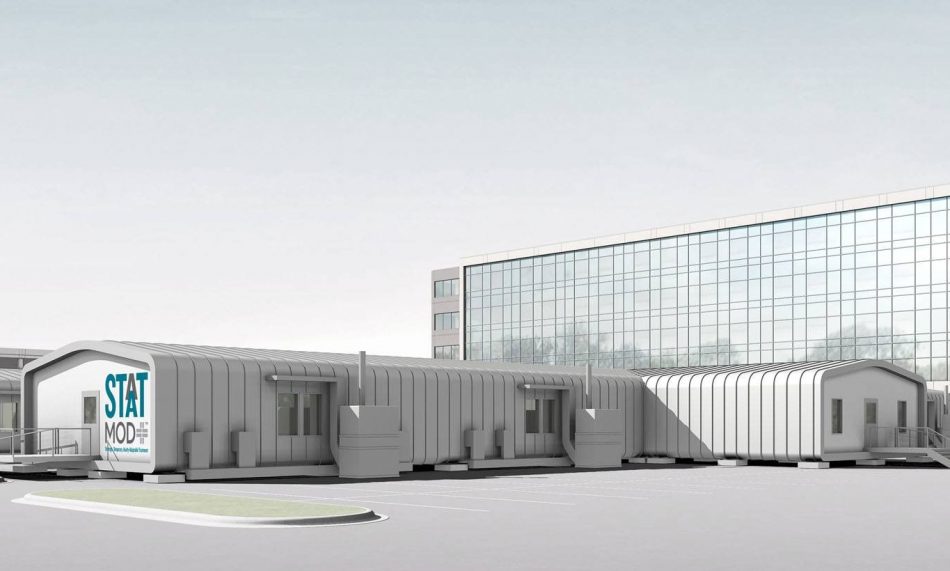
Hospitals overwhelmed by the coronavirus pandemic could soon find a much-needed capacity lifeline in modular emergency care units built right in their parking lots.
Called STAAT Mod (Strategic, Temporary, Acuity-Adaptable Treatment), the prefab system is built in a factory and delivered by truck and has the same complex features as standard hospital rooms. But while traditional construction of an intensive care unit might take up to two years, the modular system can be set up in just a few weeks.
“This goes together like a series of Legos or an erector set,” says Kurt Spiering, principal and national healthcare sector leader of HGA, the architecture firm behind the design. “That was really the challenge: How would you create something that’s repeatable and modular, but something that has infinite variations, so it could be adapted and assembled in any different arrangement?”
The idea behind the project came about in March when construction firm Boldt Company reached out to HGA — which designs hospitals — and suggested working together on prefab modules.
As you can imagine, building hospitals is no easy feat. It involves a series of complex requirements for air quality and clinical equipment, and the process is even trickier when the components have to fit on trucks.
“We had to analyze what we do from our traditional, critical quality requirements in healthcare and how we do our process work, and then make that all fit inside a box,” says senior associate Kyle Weisman.
Before the architects have started building the first STAAT Mod in a parking lot next to a hospital in an Atlanta suburb, the modular units were tested in part by emergency care nurses with the help of virtual reality. Some units feature two patient isolation rooms and bathrooms, while others have rooms where healthcare workers can take on and off protective equipment.
What makes the design particularly attractive is that everything can be configured to meet the needs of a particular site and the system can be placed outside or within a larger building such as a convention center.
In the hospital near Atlanta, called Northside Hospital Gwinnett, 71 isolation rooms are being put in place outside. According to the architects, fabrication took about a month, and modules began to be installed in September. The new hospital “wing” is expected to be completed in December.
As COVID-19 cases continue to grow, other overwhelmed hospitals could also move quickly and install these life-saving modular systems.






