


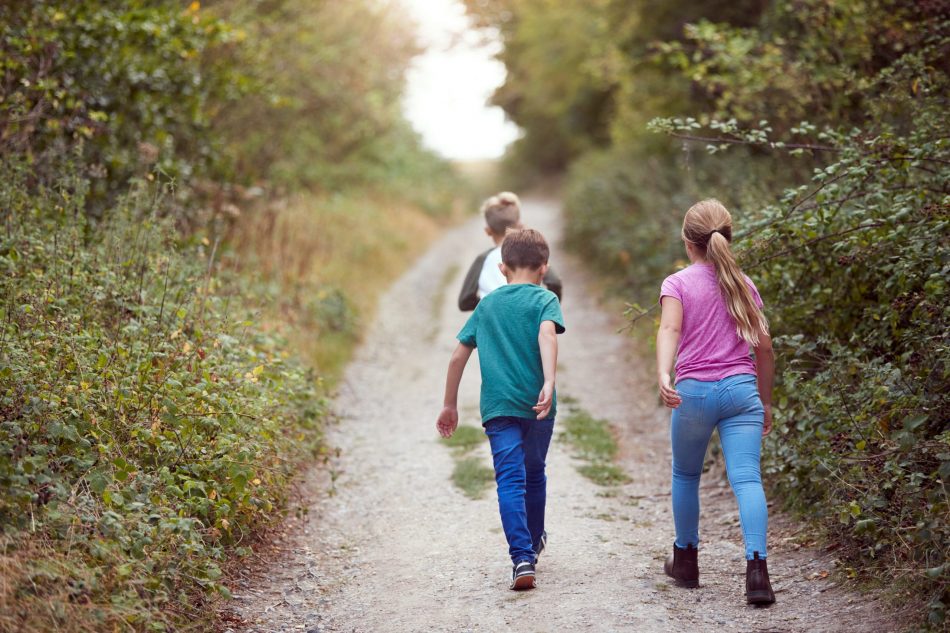
Children have a lot less freedom to roam and play unsupervised than they did 50 years ago. A lot of this has to do with parents’ concern over safety, especially in urban areas. Now, the Covid-19 pandemic has further restricted children’s freedoms, which may have a detrimental impact on their spatial awareness and navigation skills, leading to a generation that is prone to getting lost.
To avoid this from happening, a new study suggests allowing your kids to roam by themselves, farther away from home, as children who are less restricted tend to grow into more confident navigators as adults.
How people navigate
We employ spatial navigation, also called “wayfinding,” when we decide to take a shortcut, visualize our own neighborhood, or explore a new location.
This skill is an essential part of intelligence as well as survival for people and animals who must travel to find food, water, shelter, or potential mates.
Some people use route information, which means that they pay attention to landmarks to find their way around. Others prefer to use cardinal directions like north and south, or global reference points like the Sun and the stars, which is called orientation information.
Most people don’t just stick to one of these methods, but rather combine both navigational styles. That said, those who rely more on route strategy are generally slower and less efficient navigators than those who use cardinal directions, probably because route cues can change or disappear, whereas north remains north, no matter what.
Letting kids explore
A peer-reviewed study published in March 2020 gave 159 undergraduate students at a large public university in Miami a series of questionnaires to assess their childhood wayfinding experiences, how they tend to navigate now, and if they find wayfinding an anxiety-inducing activity.
The participants were asked about the frequency with which they were permitted to go out on errands and how far they were allowed to travel alone or with friends when they were between the ages of six and 15. They were also asked to report the extent to which they now use route and orientation information to navigate, and how anxious they are when finding their way in new environments.
The researchers found that the distance of unsupervised travel in childhood had more impact on their preferred method of navigation than how often they went out on errands without adult supervision. It also predicted whether they experience anxiety as adults. Those who reported being allowed to roam farther alone as kids were also less worried when navigating as adults and often prefer to use orientation information to find their way.
Gender differences
Typically, boys are granted more unsupervised wayfinding experience and are allowed to stray farther from home, which factors into the widely perceived differences between men and women as navigators. This is reflected in the study, as men reported being allowed to go outside more often and travel farther distances without adult supervision as children.
So, the key to raising children who are less likely to get lost and more likely to be confident while making their way through the world as adults is to simply give them the freedom to roam on their own when circumstances and safety allow for it.
Source Study: Cognitive Research: Principles and Implications—Childhood wayfinding experience explains sex and individual differences in adult wayfinding strategy and anxiety
Additional Resources:
Health & Place—The impact of parents’ fear of strangers and perceptions of informal social control on children’s independent mobility
Sex Roles—Gender differences in way-finding strategies
Boyhood Studies—Factors in the development of spatial cognition in boys and girls






