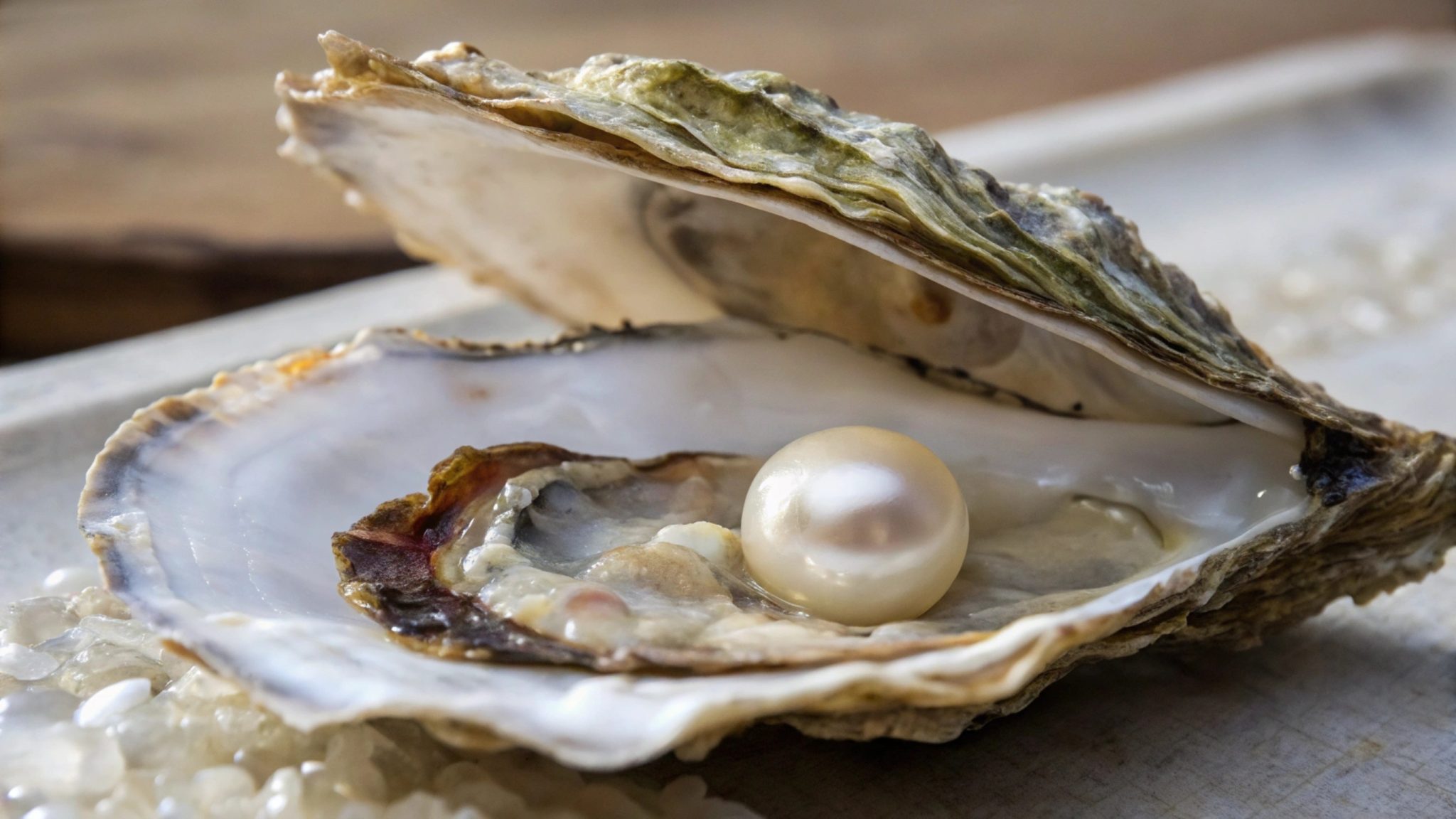
Pearls are created when an irritant, such as a grain of sand or debris, gets trapped inside a mollusk. As protection, a smooth layer of mineral and protein called nacre forms around it. Humans have been fascinated by these iridescent beauties since we first discovered them thousands of years ago. Even the ancient Egyptians and Romans were obsessed with these gems, designating them as a symbol of wealth and beauty.
Scientists have long puzzled exactly how mollusks create these symmetrical wonders around such irregular shaped starting materials. Finally, a paper published in Proceedings of the National Academy of Sciences has linked this ability back to some complex mathematical rules that are seen throughout nature.
Scientists from the Australian National University in Canberra got to this conclusion by studying Akoya pearl oysters, or Pinctada imbricata fucata if you want to call them by their Latin name. A diamond wire was used to chop the pearls into cross-sections, and analysis techniques were carried out to determine its inner structure.
The team found the pearl contained 2,615 layers, which were deposited over 548 days. One key factor which gave the pearl its perfect symmetry was the fact that the thickness of one layer was dependent on the previous one. This phenomenon in nature is called pink noise, where events seem to be random but are really connected. Also, the team found the nacre self-heals when a defect is spotted, allowing for smoothing out of irregularities when they appear.
Only made from calcium, carbonate, and protein, the nacre is actually 3000 times stronger than the materials it is composed of! Laura Otter, author of this paper stated: “These humble creatures are making a super light and super tough material so much more easily and better than we do with all our technology.” This strong nacre could inspire the next generation of super materials, with applications in impact and heat-resistant materials for spacecraft or in solar panels with increased energy efficiency.
Source study: Proceedings of the National Academy of Sciences – The mesoscale order of nacreous pearls