


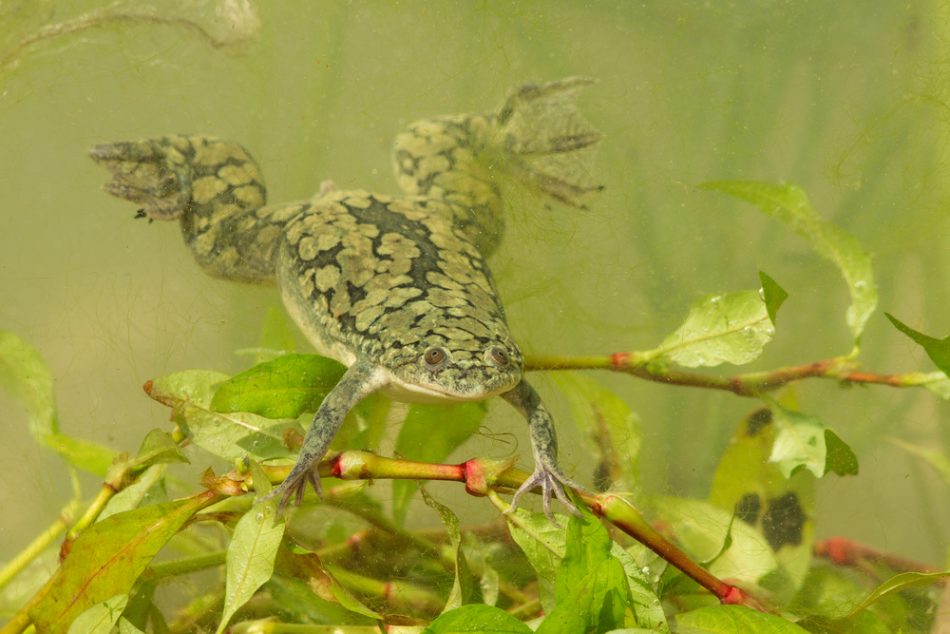
A recent study, published in Science Advances, has brought us one step closer to regenerative medicine. In a collaborative effort from Tufts University and Harvard, the teams were able to regenerate an adult African clawed frog’s (Xenopus laevis) limb, something they are naturally unable to do.
How did they trigger regrowth?
Using a five drug cocktail and placing a silicone bioreactor dome over the stump for 24 hours, the team were able to trigger regrowth in the frog’s leg. From this brief treatment, the leg was grown back over an 18 month period, resulting in the frog gaining back a fully functioning limb. The study reports the animal was able to use it to swim through the water and also the limb reacting to touch.
“It’s exciting to see that the drugs we selected were helping to create an almost complete limb,” said Nirosha Murugan, first author of the paper. “The fact that it required only a brief exposure to the drugs to set in motion a months-long regeneration process suggests that frogs and perhaps other animals may have dormant regenerative capabilities that can be triggered into action.”
Each of the drugs in the mixture carried out a different purpose. Some tackled inflammation and scarring, while the rest encouraged new growth of nerve fibers, blood vessels, and muscle tissue. The purpose of the bioreactor, named BioDome, was to facilitate an environment that fought against the body’s natural urge to close off the stump and trigger the regenerative process.
A hopeful future for amputees
This work obviously could lead to some huge advances for amputees of the future. Although it is exciting, the group still needs to work on fine tuning the process. The frog’s newly formed leg was functioning but did not resemble the shape it naturally occurs in, plus has no toe bones. After these steps, the team is going to try out their biotechnology on mammals.
Source study: Science Advances – Acute multidrug delivery via a wearable bioreactor facilitates long-term limb regeneration and functional recovery in adult Xenopus laevis






