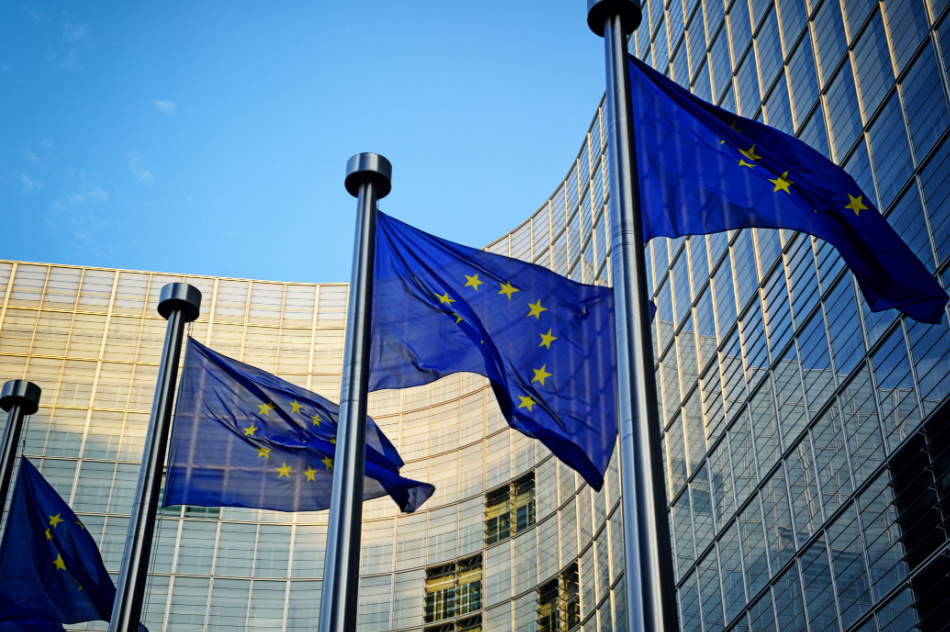
The European Union will invest more than $270 billion in its own “green deal” in order to keep up with the United States and China.
The growing green economy
Many observers interpreted the move as a direct response to the Biden administration’s hefty round of green subsidies, which were included in the Inflation Reduction Act.
The announcement was made last week by European Commission President Ursula von der Leyen, who dubbed the bundle of initiatives The Green Deal Industrial Plan.
“We know that in the next years, the shape of the economy, the net-zero economy, and where it is located will be decided,” announced von der Leyen in a news conference in Brussels. “And we want to be an important part of this net-zero industry that we need globally.”
According to the European Commission, the Green Deal Industrial Plan will focus on simplifying regulation to help get proposed green projects up and running faster, accelerating access to investment and funding, developing programs to train skilled workers in specific industries, and strengthening trade agreements to secure raw earth materials needed for the net-zero transition.
Reaching carbon neutrality goals
The initiative is also meant to assist the EU in meeting its 2050 carbon neutrality objective. This includes a progress check in which member countries would collectively lower greenhouse gas emissions by 55 percent by 2030.
The Green Deal Industrial Plan was rushed through because several EU leaders were concerned that the United States and China were putting protective measures in their own deals — in the form of tax breaks for domestic companies — that would disadvantage European car manufacturers and companies developing green technologies. The Biden Administration, for example, provides tax incentives to American companies that produce certain components of green technology in the United States.
EU critics are also concerned that European companies may be encouraged to relocate their operations to the United States in order to take advantage of the tax incentives, damaging the EU’s own position as a clean energy leader.
However, several European experts believe that these concerns are exaggerated.
Healthy green competition
“There’s nothing that Joe Biden and the US government, in my opinion, has done that’s going to see European jobs shifted to the United States,” Jacob Kirkegaard, a senior fellow at the German Marshall Fund in Brussels, told the German news organization DW. “We want the United States to embrace also the green transition. And we should be less concerned, quite frankly, that our own green transition is put at risk,” he declared.
The Green Deal Industrial Plan, which has yet to be codified, was debated by EU leaders at a conference of EU heads of state and governments yesterday in Brussels.
The EU is made up of 27 member countries, ranging from densely populated and wealthy countries like Germany and France to less developed and resource-poor ones like Bulgaria and Romania. State aid policies have made it simpler for EU governments to provide financial assistance to private enterprises in their own countries. One essential aspect of the Green Deal Industrial Plan would be to extend such assistance to enterprises active in renewable technologies.
To move forward with the Green Deal Industrial Plan, all 27 national governments must approve it.