As the complete solar eclipse of April 8, 2024 approaches, parents and educators have a one-of-a-kind opportunity to pique children’s interest in astronomy. One captivating technique is to compare historical ideas about eclipses with present scientific answers. By comparing and contrasting various viewpoints, children acquire insight into the growth of human understanding over time. Encourage talks concerning ancient fears and interpretations, focusing on the gradual acquisition of knowledge through observation and inquiry. Parents can use the eclipse to discuss how scientific knowledge evolves over time through observation.
Enriching dialogue with scientific language
Engaging in meaningful conversations is the foundation of effective science teaching. During the solar eclipse, use the opportunity to immerse children in scientific terminology, promoting a better understanding of outer space. Encourage the use of terminology like orbit, rotate, and reappear, allowing students to express their observations and predictions with clarity and confidence. Adults can use inquiry-based tactics to encourage youngsters to reflect on their observations, theorize about astronomy, and explain their ideas.
Prior research indicates that young children’s science knowledge is heavily reliant on language. Both parents and teachers help to shape this language.
Hands-on learning using household models
Transform everyday home items into amazing instructional tools to help children understand the solar eclipse. Three-dimensional models give concrete form to abstract notions such as the Earth’s orbit and the Moon’s course. Encourage youngsters to participate in hands-on activities, such as replicating the alignment of the Earth, Moon, and Sun with basketballs and tennis balls. Children learn about scientific principles and visualize complex celestial events through interactive inquiry.
Throughout the process, parents and teachers can invite students to compare and contrast the model with their own observations. They can ask questions like why the Sun and Moon appear to be identical sizes in the sky, despite the fact that the Sun is several times larger than the Moon.
Safety reminder:
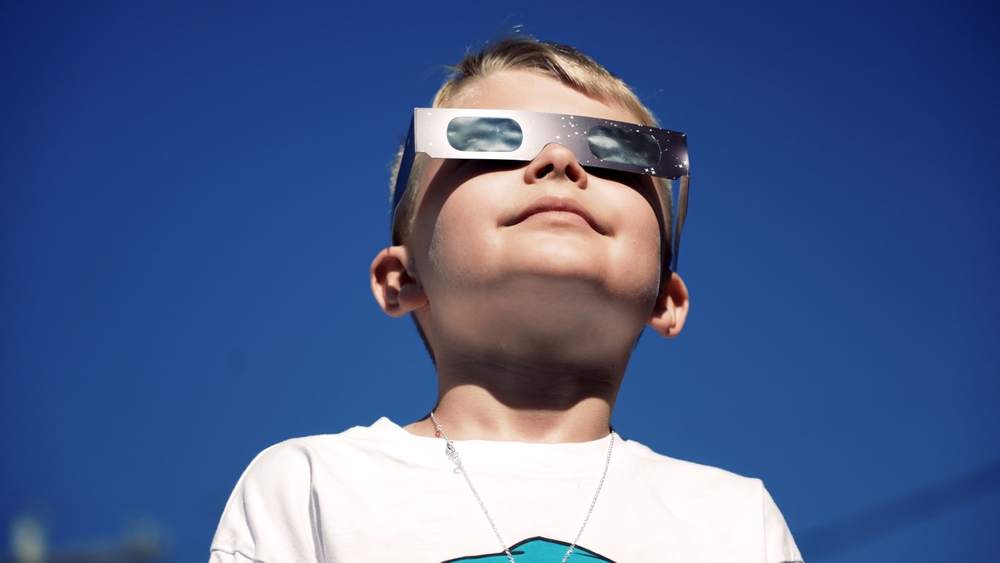
While enjoying the cosmic display, emphasize safety by avoiding direct observation of the Sun without suitable eye protection. To avoid eye injuries, make sure to wear eclipse glasses.
By implementing these ideas, parents and educators may turn the total solar eclipse into an unforgettable educational experience, developing young minds and instilling a lifetime love of science.