BY THE OPTIMIST DAILY EDITORIAL TEAM
The story starts with a newspaper article and a neighborhood that wasn’t getting help.
A few years ago, Mia Heller came across a report about water quality in her community in Warrington, Virginia. Tests had found the local water was heavily contaminated with PFAS and microplastics. Government funds to address it were not coming. “It was up to people to provide their own filtration,” Heller says.
Her parents bought an advanced home filtration system. But the constant upkeep, including frequent membrane replacements, got Heller thinking. What if there were a way to filter water without membranes? What if it could clean itself?
She is 18 years old and attends Kettle Run High School. She now has a working answer to both questions.
Microplastics are already inside us
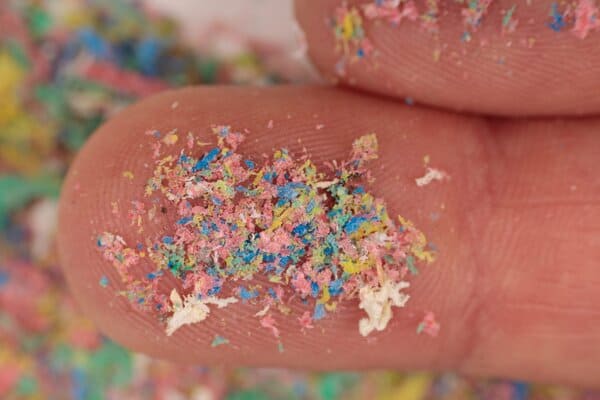
The problem Heller is working against is larger than most people realize. The Environmental Protection Agency defines microplastics as particles measuring about one nanometer to five millimeters in size. They have been found in 1,300 species, including humans. They show up in brain tissue, bones, testes, semen, and the placentas of unborn fetuses. Microplastic intake by organisms has increased sixfold since 1990.
A 2025 study from the University of New Mexico found that concentrations of microplastics in human brain tissue increased by 50 percent in less than a decade. Matthew J. Campen, a toxicologist at the University of New Mexico who co-authored the study, notes evidence “that there might be issues for cardiovascular disease and potentially neurological disease,” though the links are not yet conclusive.
“There are still a lot of questions as to whether these plastics are really impacting our health at this point,” Campen said. What is not in dispute is the accumulation itself: microplastics are getting into human bodies in growing amounts, and drinking water is one of the most direct routes in.
How the filter works
Heller began developing her idea in the spring of 2024 and had a working prototype by early 2025, built through experiments in her garage and kitchen. At the center of her design is ferrofluid, a magnetic oil that binds selectively to microplastic particles as water flows through the system.
Her current prototype is about the size of a standard bag of flour and works in three modules: one holds the contaminated water, one stores the ferrofluid, and a smaller third module handles the core filtration. “A magnetic field pulls the microplastics out of the water, and the ferrofluid is recovered and reused in a closed loop,” Heller explains.
That closed loop is the key advance over her earlier designs. Her first prototype worked but required constant ferrofluid replenishment. Five iterations later, the system recycles itself.
She developed a turbidity sensor to test her results, measuring suspended solids in the filtered water. According to her testing, the prototype removes 95.52 percent of microplastics and recycles 87.15 percent of the ferrofluid. Traditional drinking water treatment plants remove somewhere between 70 and 90 percent of microplastic components.
“The result is an affordable, low-waste filtration system without the use of a solid membrane,” Heller says.
What comes next for Heller’s invention
Campen called Heller’s system a “really great idea” and said she is “doing something that has to be done.” He raises practical questions the technology will still need to answer: confirming it fully disposes of captured microplastics without leaving other residue, and whether it can scale beyond individual home use.
For now, Heller sees it as an under-the-sink solution for households. Because ferrofluid is currently expensive to produce at large scale, municipal application is not yet practical. At home, the prototype filters about one liter at a time, similar to a Brita pitcher.
Heller was named a finalist at the 2025 Regeneron International Science and Engineering Fair, the world’s largest high school science competition, where she received a $500 award from the Patent and Trademark Office Society.
Her next step is independent verification of her results. “I would love to eventually bring it out to market,” she says. “I think that would be something that would be really interesting.”
The filter sitting in her garage started as a response to a local water problem no one else was solving. Heller is taking things one step at a time: first, professional verification of her results, then the longer road toward getting it to market. For now, her prototype is proof that a practical, low-cost answer to a problem that now shows up in human brain tissue can begin in someone’s kitchen, and that sometimes the person most driven to solve something is the one who has been living with it.
Did this solution stand out? Share it with a friend or support our mission by becoming an Emissary.