BY THE OPTIMIST DAILY EDITORIAL TEAM
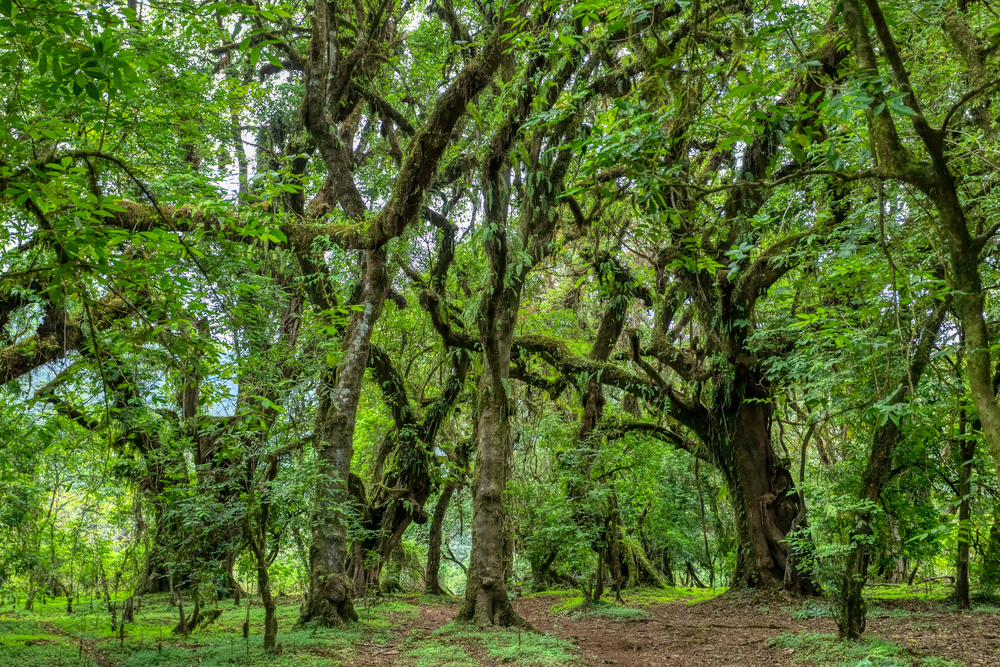
For most of the past century, Ethiopia was losing its forests. From the turn of the millennium to 2025, the country shed 560,000 hectares, about 2,160 square miles, of tree cover to agriculture, logging, and charcoal fuel. Then the government launched the Green Legacy Initiative in 2019, and citizens started planting trees. A lot of them. A lot of trees.
The official numbers raise questions. The government claims to have planted 48 billion trees in seven years, including a reported 353 million seedlings in a single day. The goal is 50 billion by 2030, but researchers who have reviewed Ethiopian tree-planting programs found that 10 of 15 schemes with set targets achieved less than 50 percent success. Studies in Asia suggest nearly half of all reforestation trees don’t survive five years. The government’s own technical committee put Ethiopia’s rates at 83 percent survival in 2019 and 79 percent the year after; some researchers have questioned those figures, and a more systematic independent assessment is now underway.
Yitebitu Moges, who coordinates the UN Environment Programme’s REDD+ deforestation scheme in Ethiopia, acknowledges the uncertainty but doesn’t think it undermines what’s happening. “Even if half of the trees that have been planted survive, we are already gaining moisture, keeping soil and sequestering carbon,” he says. The change he cares about most is harder to measure: “Our history has shifted from deforestation to forestation. People are becoming more and more aware that deforestation is damaging.”
The woman who proved her neighbors wrong
In the Berbere district of Oromia, Halima Kedir started planting trees and kept going despite her neighbors’ doubts. “They thought I was striving for nothing,” she says, sitting in a garden now full of banana, olive, and grevillea. She has planted thousands of trees and lost count of exactly how many. The results changed minds that were once firmly against her.
Her neighbor Fate Abdulahi, once among the skeptics, now calls her “a role model and someone willing to find local solutions to our issues.”
Kedir, 35, describes her relationship with the seedlings through guddifachaa, the Oromo tradition of adopting children into family and community. “Just like we adopt a child in our tradition, I see them like my own children,” she says. The area has severe water shortages. She walks about an hour each way to fetch water for her trees. Her 13-year-old son, Anwar Hassen, says he wants to “make a lifelong commitment in the fight against climate change.”
Thousands of households in the area have joined the initiative. WaterAid Ethiopia has distributed approximately 55,000 indigenous tree seedlings across the district, with an 85 percent growth rate reported so far.
Behind the 50 billion number
Ethiopia’s annual deforestation rate fell from 92,000 hectares (about 227,000 acres) in 2013 to 27,703 hectares (roughly 68,500 acres) in 2023, a drop of roughly 70 percent. Forest cover rose from 15.5 to 23.6 percent over the same period.
Those numbers come from the government. Independent verification of long-term survival rates is still in progress, and how many of the 48 billion claimed trees are still alive has not been established from outside. Moges says a systematic study is now collecting that data. His own view: whether the survival rate turns out to be 50 percent or 80 percent, Ethiopia is already holding more soil, retaining more moisture, and storing more carbon than it was. The gap in the numbers doesn’t cancel out the changes on the ground.
In 2024, the Ethiopian parliament set up the Green Legacy and Landscape Restoration Special Fund, allocating between 0.5 and 1 percent of the annual federal budget, roughly $63 million to $140 million, to restoring degraded land.
From Berbere to Addis Ababa to COP32
In November 2027, Ethiopia will host COP32, the 32nd UN climate summit, in Addis Ababa. Part of the reason is what the country has been doing with its trees. Kedir, tending seedlings in Berbere, already has a message ready for whoever shows up. “They should give the issues of water and trees, which many in such communities lack, the priority they deserve,” she says.
Teshome Soromessa, an environmentalist at Addis Ababa University, says the initiative has brought communities, universities, civil society, and government around a shared goal. Most of it started the same way: someone deciding to plant something and not stopping.
Did this solution stand out? Share it with a friend or support our mission by becoming an Emissary.