BY THE OPTIMIST DAILY EDITORIAL TEAM
A space telescope with 100 times the sky coverage of Hubble lifted off from Florida this past Sunday. Astronomers have been waiting nearly a decade for this.
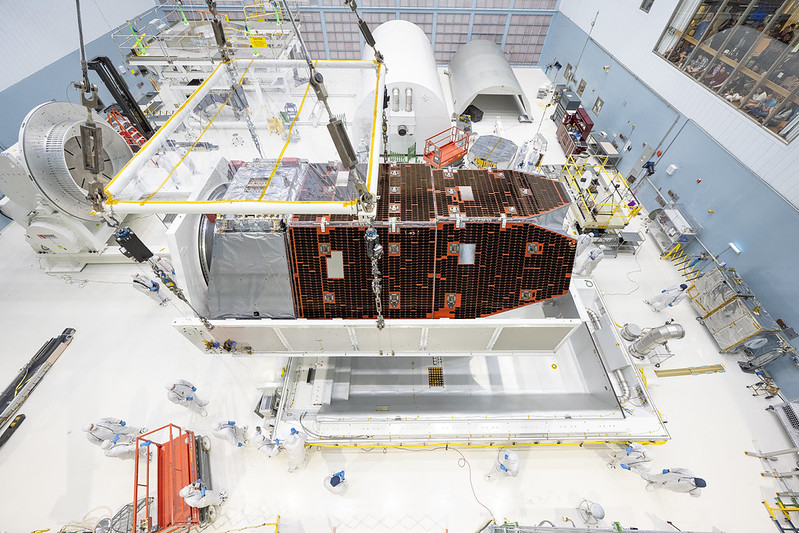
The Nancy Grace Roman Space Telescope survived two White House attempts to cancel it and is now on its way to a stable orbit roughly one million miles from Earth, the same region where the James Webb Space Telescope operates. The price tag was $4.3 billion. The camera is 300 megapixels. The mission is to answer questions about the universe that current telescopes can’t get to.
What Roman can do that Hubble and Webb cannot
Roman isn’t a replacement for Hubble or Webb; rather, it works alongside them at a scale neither was designed for.
Its camera matches Hubble’s sharpness and resolution but covers a field of view at least 100 times larger. Each image captures a patch of sky roughly one and a half times wider than a full moon looks from Earth. Less zoom lens, more wide-angle survey camera. That scale matters: it can cover in a single pass what would take Hubble years to piece together from separate observations.
Roman also carries a coronagraph, an instrument that blocks the glare of nearby stars so scientists can photograph the planets orbiting them more clearly. NASA expects it to photograph “giant worlds that are older, colder, and in closer orbits” than the ones direct imaging has mostly caught so far.
A layered system with Hubble and Webb
The three telescopes work in layers. Roman sweeps wide, picking out targets across billions of galaxies. Hubble follows up with infrared, visible, and ultraviolet light for a fuller picture. Webb goes deepest, with its larger mirror and superior resolution.
Roman can also observe the surrounding areas when Hubble or Webb are zoomed in on something, adding context to what the others see. They each do what the others can’t.
All of Roman’s imagery will be released to the public as it comes in. NASA expects that to start in early 2027, after months of calibration in its final orbit.
The question the mission was built to answer
The universe is not just expanding; its rate of expansion is way faster than it should be. Scientists noticed this at the end of the last century and have never fully explained it. Roman was built to gather the data to try.
“It’s like if you were to throw a ball in the air, and instead of the ball coming back down, it just keeps shooting away,” said Julie McEnery, the telescope’s senior project scientist. “There’s something really fundamental that we don’t understand about the nature of our universe itself, and Roman is purpose-built to address and provide the data that we need to address these questions.”
Dark matter, dark energy, black holes, planetary formation, galaxies by the billions; the initial mission runs five years and could extend to ten.
A close call for American science
This launch almost didn’t happen. A 2025 White House proposal called for what analysts described as “extinction level cuts” to NASA’s science budget, with the Roman mission among the targets. Congress rejected the plan and restored the agency’s 2026 funding to $24.4 billion.
The current administration is now pushing a 23 percent reduction in NASA’s overall 2027 budget, to $18.8 billion, along with a 46 percent cut to science programs. The Planetary Society says that would terminate more than 50 missions.
For now, Roman is in space. Named for Nancy Grace Roman, NASA’s first chief of astronomy, who died in 2018, the telescope spent nearly a decade in development before final approval and construction began in 2020. McEnery spoke at the post-launch press conference: “It feels like I’m on the edge of a precipice, and we’re just about to set a foot off into the unknown.”
Sunday’s launch was also the last flight of SpaceX’s Falcon Heavy rocket. The company is retiring it to concentrate on Starship.
Did this solution stand out? Share it with a friend or support our mission by becoming an Emissary.