BY THE OPTIMIST DAILY EDITORIAL TEAM
For years, biologists cataloguing Bolivia’s Yungas cloud forest would note a small spotted cat and move on. Tiger cat, broadly speaking. The general profile fit and there was no obvious reason to dig further.
Local communities had always called it something different. Tilcayo, a name that treated this animal as its own thing, not a Bolivian stand-in for something from Brazil.
The DNA backed them up. A study published in Current Biology confirms that the tilcayo, now formally named Leopardus tilcayo, is a species science had never documented. It is the first new living feline to be formally named in more than a century.
Not really a discovery, a correction
The tilcayo has been in Bolivia’s Yungas for a very long time. Genetic analysis puts the split from other tiger cat lineages at about 1.4 million years ago. What changed is not the cat. The tools to study it finally caught up.
“We never expected this Bolivian tiger cat to be a separate species, and no one had ever proposed it as a different animal, subspecies or otherwise,” said Jonas Lescroart, evolutionary biologist at the University of Antwerp and co-lead author of the study.
Tiger cats are what biologists call cryptic species: you cannot tell them apart by looking. You need DNA, and for most of the history of field biology, that was not a practical option. Paola Nogales-Ascarrunz, a National Geographic explorer and study co-author, had noticed for years that the Bolivian animals did not match existing descriptions, most of which came from Brazilian populations. That was what prompted the deeper look.
The team analyzed DNA from 38 cats across several South American countries, including eight museum specimens. The result was bigger than the tilcayo alone. Tiger cats are not two species, as currently recognized, but five genetically distinct lineages.
What little is known about the tilcayo
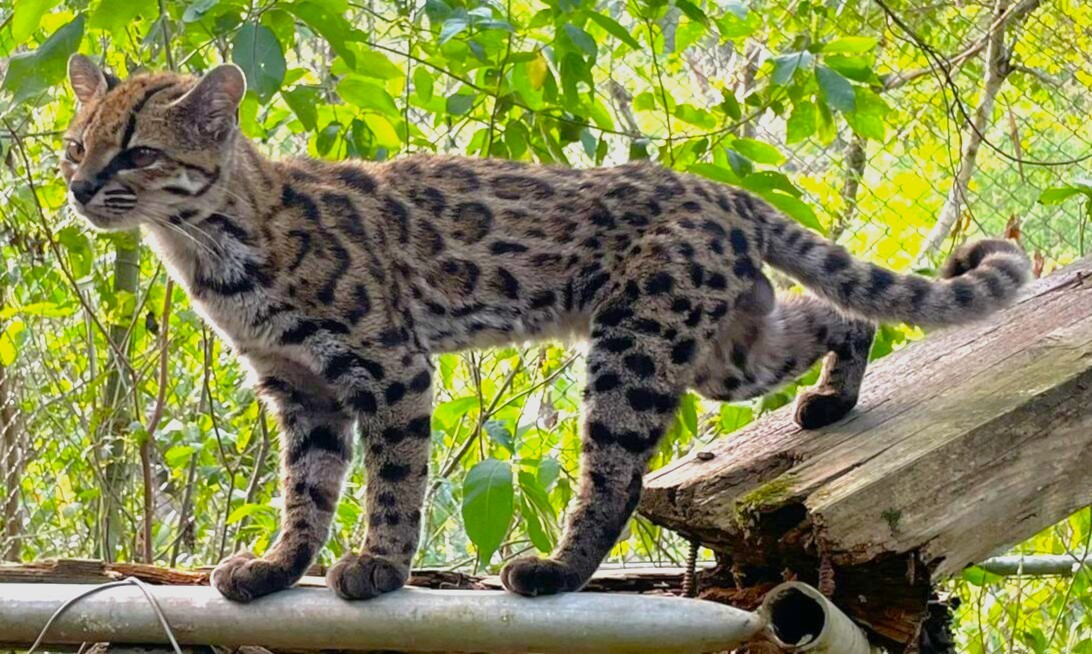
The cat is small, roughly 18 inches (46cm) long and about 3 pounds (1.4kg), lighter than most house cats. Its fur is light brown with irregularly shaped rosettes. Camera traps suggest it is largely nocturnal, and scat samples with rodent remains give some indication of its diet. Beyond that, almost nothing is documented.
Only two live individuals have been examined by the research team. One is a 10-year-old male now at the Senda Verde wildlife sanctuary in Bolivia, where he ended up after years as a household pet with a local family. The rest of what is known comes from camera traps and the animals sampled for the genetic study.
A new species at risk of disappearing
The International Union for Conservation of Nature currently lists tiger cats under two “vulnerable” designations with declining populations. That was assessed without knowing five distinct lineages existed. The research team has shared their findings with the IUCN ahead of its upcoming review, and Lescroart says the tilcayo, assessed on its own, could qualify as endangered.
Its only confirmed habitat is Bolivia’s Yungas forest, one of the most pressured ecosystems in the region. Deforestation, agricultural expansion, fires, and mining are all encroaching. A newly named species with a narrow range, a shrinking home, and almost no population data to go on is a hard situation.
“Showing the general public that even in a flagship group such as cats there are still new species to be discovered may transmit an important message,” said Eduardo Eizirik, evolutionary biologist at the Pontifical Catholic University of Rio Grande do Sul and senior author of the study. “There are many undiscovered species out there in the world, and they are at risk of disappearing before we even discover them.”
The tilcayo got a name. That is not nothing. Restoring fire-damaged forest, protecting native cover, and keeping habitat connections intact across the Yungas are the immediate priorities. The question the research leaves open is how many animals like it are still out there, genetically real and ecologically distinct, in places that won’t hold together long enough to be studied.
Source study: Current Biology- Phylogenomics and museomics reveal five distinct species of tiger cats in South America
Did this solution stand out? Share it with a friend or support our mission by becoming an Emissary.