BY THE OPTIMIST DAILY EDITORIAL TEAM
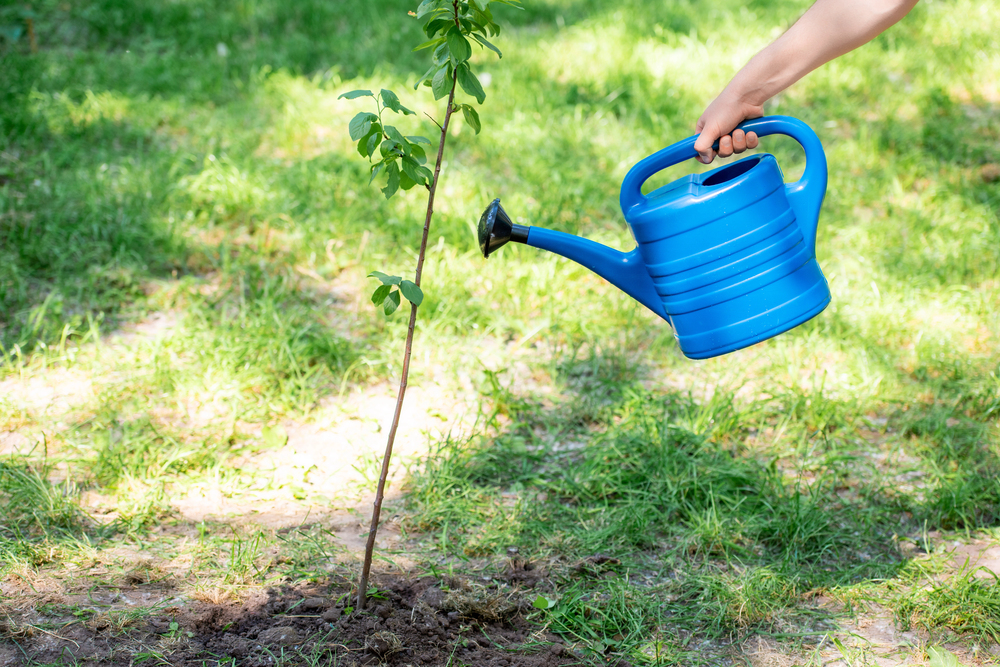
Amanda Gläser-Bligh named her street tree Linda. Linda is a linden, eight years old, growing outside Gläser-Bligh’s apartment building in Charlottenburg, and once a week during Berlin’s hot months, Gläser-Bligh makes a couple of trips up and down the stairs with a watering can until she has carried 20 liters (about five gallons) of water to Linda’s roots. Passersby sometimes stop and stare. They usually end up asking what she’s doing, and most of them, once they find out, look up at the tree a little differently.
Berlin has nearly a million street trees, and like cities across Europe, it’s watching them struggle through increasingly hot summers. A project called Gieß den Kiez, which translates to “water your neighborhood” in German, is trying to close the gap between what the city’s maintenance crews can do and what the trees need, by giving ordinary people a map, a reason, and a social framework for showing up with a watering can. Twelve thousand people have signed up.
900,000 trees color-coded by thirst and updated in real time
Developed by CityLAB Berlin, the Gieß den Kiez app tracks more than 900,000 trees across the city and calculates each tree’s water needs based on its age, species, and local rainfall. Color-coding shows which trees are in critical condition. Saplings, which lack the deep root networks of mature trees, need more frequent watering to survive and are flagged accordingly. Volunteers can log a watering, see when a tree was last watered by someone else, and find the locations of Berlin’s public water pumps.
What separates it from other urban tree maps is real-time coordination. The 12,000 registered volunteers work alongside district maintenance crews who are already watering thousands of trees but can’t keep up when temperatures spike. On June 27, when Berlin recorded an all-time high of 39.9 degrees Celsius (103.8 degrees Fahrenheit), people poured 8,000 liters (roughly 2,100 gallons) of water over trees across the city in a single day.
Berliners are caring about trees like they care about pets
Anna Mehrländer, who has been leading the project for more than a year, expected to find that people cared about trees. She didn’t expect the intensity. “I was really surprised at just how deeply people care about trees — for many people it’s almost like caring for a pet,” she says.
The project launched in 2020, at the start of the Covid lockdowns, and the timing mattered more than anyone anticipated. The single biggest annual peak in waterings, nearly half a million liters, came in those early pandemic months. Mehrländer thinks people seized on the activity as a reason to go outside and reconnect with neighbors at a moment when ordinary social structures had fallen away. “Climate change is happening on our doorsteps,” she says. “But watering a tree is a small action that helps your neighbourhood cope as summers get hotter. It also creates community at a time when people are increasingly working from home and on their phones all day.”
Gläser-Bligh describes the experience as almost playful. “It feels very fun, almost like a video game,” she says. She’s also noticed that people who see her watering often discover they could do the same and simply hadn’t known they were allowed to. “Many people may want to water the trees, but they might feel weird about doing it or they’re not sure if it’s their responsibility. But if you have this app encouraging you, you know it’s the right thing to do.” The app is doing something alongside the map: giving people the social cover to act on an impulse they already had.
It’s about “critical infrastructure,” not aesthetics
Urban forestry expert Dr. Cecil Konijnendijk has proposed what he calls the 3:30:300 rule for city greening: every resident should be able to see at least three trees from their home, live in a neighborhood with 30 percent tree canopy cover, and be no more than 300 meters (about 985 feet) from a park or green space. Most cities fall well short, and it matters more than it used to.
Studies show trees cool the air during heatwaves, break up urban heat islands, reduce flooding risk, cut air pollution, and improve mental health outcomes. “In the past, trees were thought of as a nice aesthetic element in cities,” Konijnendijk says. “But now we’re starting to see them as critical infrastructure.” This makes the trees already in the ground the most urgent priority. It takes 30 to 40 years before a new tree starts delivering the full ecosystem services of a mature one. The ones wilting through summer droughts right now are not replaceable on any useful timeline. Konijnendijk also points to soil sensors and lidar-based canopy scanning as tools for monitoring tree health at scale, with cities like Malmö and Singapore already using them.
The open-source offer
Because the code is open-source, any city can adapt it. Residents in Potsdam, Leipzig, Magdeburg, and the 17th arrondissement of Paris have already built their own versions. “Anyone can copy the code and set up their own Gieß den Kiez,” Mehrländer says. “The main requirement is a data set of all the trees in your city. It’s possible to replicate anywhere, from China to the UK.”
The platform needs two things: city tree data, which most urban administrations already have in some form, and people willing to show up with a watering can. If Berlin’s numbers are any guide, the second one isn’t usually the problem.
Did this solution stand out? Share it with a friend or support our mission by becoming an Emissary.