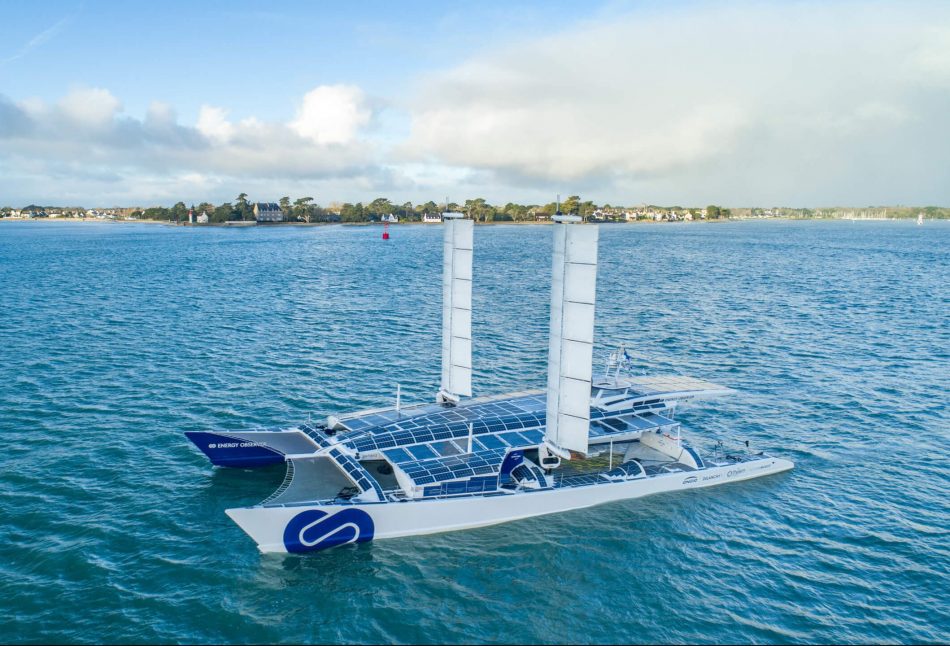
Somewhere in the vast ocean, a little boat covered in solar panels is doing something extraordinary: making its own hydrogen fuel from the seawater underneath it.
Built as a proof of concept, the boat hopes to make a case for hydrogen as a clean-energy alternative to fossil fuels. Though it has long been touted as a viable green candidate to replace diesel engines, but it has so far failed to catch on in our daily lives.
Essentially, the conundrum lies in the fact that people are hesitant to buy hydrogen cars until there are enough hydrogen refueling stations – and there’s not much incentive to build hydrogen refueling stations until more people are driving hydrogen cars. That’s one thing the Energy Observer team hopes to change.
The Energy Observer uses a patchwork of different cutting-edge technologies to generate enough energy to power nine homes each day. During the day, 200 square meters of solar panels charge up the boat’s lithium ion batteries, while the extra energy is stored as hydrogen with the help of a special fuel cell, called Rex H2. The fuel cell is able to bring in seawater, remove the salt and then separate the hydrogen from the pure water with electricity.
The Energy Observer began its journey in 2017, but it was only producing hydrogen when it stopped. That changed in a big way with the addition of two 12-meter sails that improved the boat’s efficiency from 18 percent to 42 percent, to the point where it can now produce hydrogen even while sailing.
When it comes to the debate as to which technology is best for powering a post-fossil fuel world, one of the main benefits of hydrogen is that it’s able to store more electricity by weight than its lithium ion competition. This benefit is especially useful at sea, where weight capacity is an important consideration.
Because fossil fuels have had more than a century’s head start, we now find ourselves far beyond the point of any one technology being a silver bullet for our growing energy needs. A sustainable future will require a patchwork of new technologies, like the one powering the Energy Observer – and the investment to develop and scale them up for future generations.