


BY THE OPTIMIST DAILY EDITORIAL TEAM
Easter is observed by roughly 2.4 billion Christians worldwide. That covers an enormous range of countries, climates, and histories. There is no single Easter, really. There’s the version you grew up with, and then there are all the others.
Florence explodes a medieval cart on Easter Sunday
Every Easter Sunday in Florence, a nine-meter-tall (about 30 feet) antique cart called the Brindellone gets hauled through the streets by four flower-garlanded white oxen and parked in front of the Cathedral of Santa Maria del Fiore. Then it’s loaded with fireworks and set off.
The Scoppio del Carro, “Explosion of the Cart,” goes back to the First Crusade. In 1097, a Florentine nobleman named Pazzino de’ Pazzi was reportedly the first soldier to scale the walls of Jerusalem. His reward was three flints from the Church of the Holy Sepulchre, carried home to Florence and kept as relics. The three original stones are still at the Church of Santi Apostoli in Piazza Limbo. What grew up around them over centuries was an Easter fire ritual: a holy flame struck from those flints and carried through the city, first by torchbearers, then on a cart, then as fireworks.
The ceremony itself is worth knowing in detail. During Easter Mass, a mechanical dove rocket called the Colombina is ignited at the high altar and shoots along a wire through the cathedral doors to strike the cart outside. If the dove completes its flight and the cart goes up cleanly, Florentine tradition holds it predicts a good harvest, stable civic life, and strong business for the year. Farmers from the surrounding countryside still make the trip specifically for that forecast.
Norway spends Easter reading crime fiction
In Norway, Easter is the season for murder. Not literally: Påskekrim, which translates as “Easter crime,” is the national tradition of spending the nine-day Easter holiday reading crime novels, watching crime dramas, and, in a detail that should be exported widely, solving short mysteries printed on milk cartons.
It traces back to one publicity stunt. In 1923, Norwegian writers Nordahl Grieg and Nils Lie published a crime novel, and their publisher placed a front-page ad in the newspaper Aftenposten, designed to look like a genuine breaking-news report about a train robbery. Readers thought it was real. The book sold out. A century later, the Easter-crime connection is fixed into Norwegian culture. In the week before Easter 2024, nearly half of all adult books sold in Norway were crime stories, according to the Norwegian Booksellers Association. Television runs crime dramas through the holiday. Yellow Påskekrim banners go up in bookshops across the country every spring.
Ukraine’s hand-decorated eggs predate Christianity
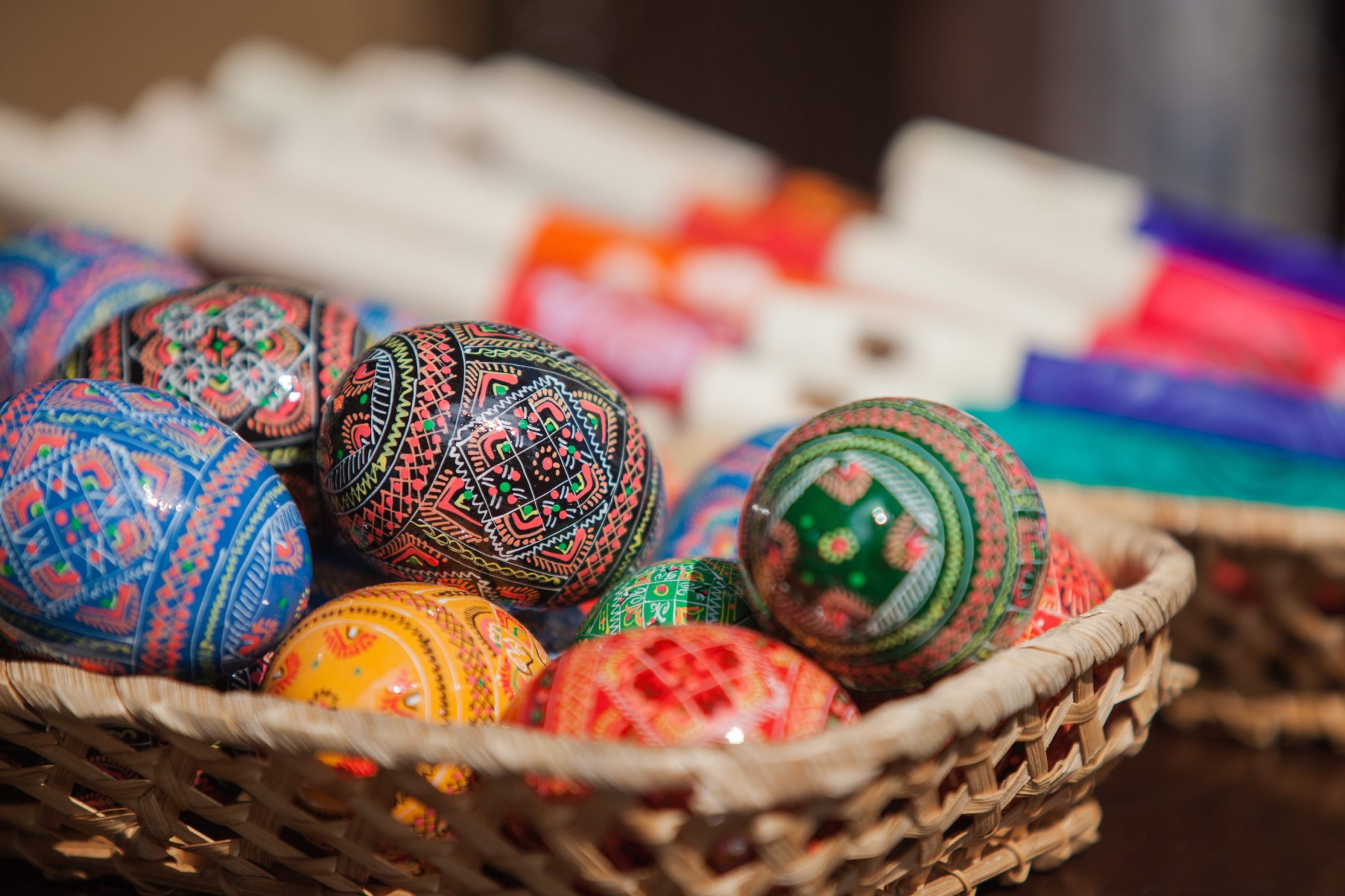
Pysanky, Ukrainian Easter eggs decorated with a wax-resist technique, are older than Christianity in Ukraine by several thousand years. Ceramic eggs with similar ornamentation have been found at Trypillian culture sites dating to roughly 4500 to 2000 BC. Pre-Christian Ukrainians made them as spring talismans connected to the sun god Dazhboh. When Ukraine adopted Christianity in 988 AD, the meaning shifted to the Resurrection, but the older design patterns stayed.
The process is meticulous: melted beeswax applied through a writing tool called a kystka, then a dye bath, then more wax, then a darker dye, repeated until the wax comes off and the full layered design appears. Spirals protect against evil. The endless line, or bexkonechnyk, means immortality. In December 2024, UNESCO added pysanka to its Representative List of the Intangible Cultural Heritage of Humanity. The timing is not incidental. Russian forces have destroyed over 1,000 Ukrainian cultural heritage sites since the full-scale invasion began. The inscription is a record as much as it is recognition.
Sweden’s Easter witches go door to door for treats
In Sweden, children dress as witches or old women on Maundy Thursday and go door-to-door, wishing neighbors “Glad Påsk” (Happy Easter) in exchange for sweets. The custom is called påskkärring, roughly “Easter hag,” and structurally it’s Halloween in spring.
The roots are darker. Folk belief in Sweden held that witches flew to a place called Blåkulla on Maundy Thursday to hold a Sabbath with the devil. The reasoning was theological: with Christ dead and not yet risen, divine protection was briefly suspended, and malevolent forces could move freely. During Sweden’s witch trial period from 1668 to 1678, this belief was taken seriously enough that children were interrogated about being taken to Blåkulla, contributing to one of the largest witch trial waves in European history. What was once genuine fear is now painted faces and candy. In Finland, a related custom called virvonta happens on Palm Sunday, with children carrying decorated willow branches and reciting blessing verses door-to-door for sweets.
Bermuda’s Good Friday kites are built to hum
Good Friday in Bermuda means kites. Families fly handmade kites from beaches and hillsides across the island, most famously at Horseshoe Bay. The kites are traditionally hexagonal, made from clear white pine and tissue paper, with a feature called a hummer built in: strips of tissue paper along the headstick that create a low, audible tone when the kite catches wind. Somerset kitemakers have a reputation for the loudest hummers, and the technique is treated as a closely held craft secret.
The attached story involves a Sunday school teacher who built a cross-shaped kite to explain Christ’s Ascension to students and let it climb until it disappeared from view. Bermudian historians say the actual origin isn’t documented, but the image of the kite rising and going has stayed central to how the tradition gets described. Good Friday also means codfish cakes and hot cross buns on the island, both foods tied to the day.
Ethiopia observes the world’s longest Christian fast before Easter
For Ethiopian Orthodox Christians, Fasika is the most important occasion of the year, and it arrives after the longest Christian fast in the world. The Abiye Tsom, or Great Fast, runs 55 days. During that time, adherents eat no animal products, and many eat only once a day, after three in the afternoon. The fast has three phases: eight days honoring a Byzantine emperor’s vigil before a Crusade-era campaign, 40 days of Lenten fasting, and seven days of Holy Week.
The Paschal Vigil begins at midnight before Easter morning, with worshippers holding candles through prayers, hymns, and scripture until the priest calls out “Kristos tenestwal!” — Christ is risen. The fast is first broken with linseed, honey, and water or milk, and then the larger meal follows: doro wot, a slow-cooked spiced chicken stew served over injera sourdough flatbread with hard-boiled eggs, alongside tibs, shiro, and drinks including tella barley beer and tej honey wine. The rest of the day is music, eskista dancing, and communal coffee.
Catalonia’s Maundy Thursday procession features skeleton dancers
The village of Verges, in the Girona province of Catalonia, has sent skeleton dancers through its streets every Maundy Thursday since at least 1666. Five figures in full skeleton costumes, two adults and three children, arranged in the shape of a cross, walk through the torchlit streets to a drumbeat. One carries a scythe and a black banner reading “Nemini Parco,” Latin for “I spare no one.” Two carry plates of ash. The third carries a clock with no hands.
The Dansa de la Mort draws on the Danse Macabre that spread through European art and theater after the Black Death in the 14th century. Plague put death in front of everyone, and artists responded by placing skeletons beside merchants, priests, and kings as equals. Most of that tradition faded centuries ago. Verges is one of only two places in Europe where the Dance of Death is still performed at Easter. The village has around 1,100 residents; the procession brings roughly 8,000 visitors.
France makes a giant omelette to feed a thousand people
In Bessières, a town in the Haute-Garonne region of southwestern France, Easter Monday means an omelette made from 15,000 eggs, cooked in a pan 4.2 meters (about 14 feet) across and weighing 850 kilograms (roughly 1,875 pounds), served to around 1,000 people in the town square.
The founding story involves Napoleon stopping in the area, eating an omelette that a local cook had made for him, and ordering the villagers to pool every egg they had and cook for his whole army. Historians treat this as a folk legend. The annual festival, launched in 1973, now draws around 10,000 visitors. Haux, another village in the Bordeaux region, runs a similar version with around 4,500 eggs. The tradition has also crossed the Atlantic: Abbeville, Louisiana, holds its own Easter omelette festival, and both towns are members of the Brotherhood of the Giant Omelette, an international association of communities that share the meal and its legend.
Papua New Guinea churches offer tobacco as an Easter decoration
In parts of Papua New Guinea, Easter church decorations include tobacco. Some communities hang cigarettes and packets of tobacco on small decorated trees near the altar as offerings and distribute them to the congregation after the service.
Tobacco has carried ceremonial weight in Papua New Guinea for centuries, long before Christian missionaries arrived in the 19th century. It was part of a gift exchange and community ritual, used to mark occasions that mattered. In communities where this practice exists, the Easter calendar took on that existing meaning rather than displacing it. The result is a version of the same holiday that runs on entirely different materials, which maybe says something about what traditions actually are: a new container with old contents.
Did this solution stand out? Share it with a friend or support our mission by becoming an Emissary.






