BY THE OPTIMIST DAILY EDITORIAL TEAM
This article kicks off The Optimist Daily’s Local Changemakers 2026 series, spotlighting changemakers 30 and under.
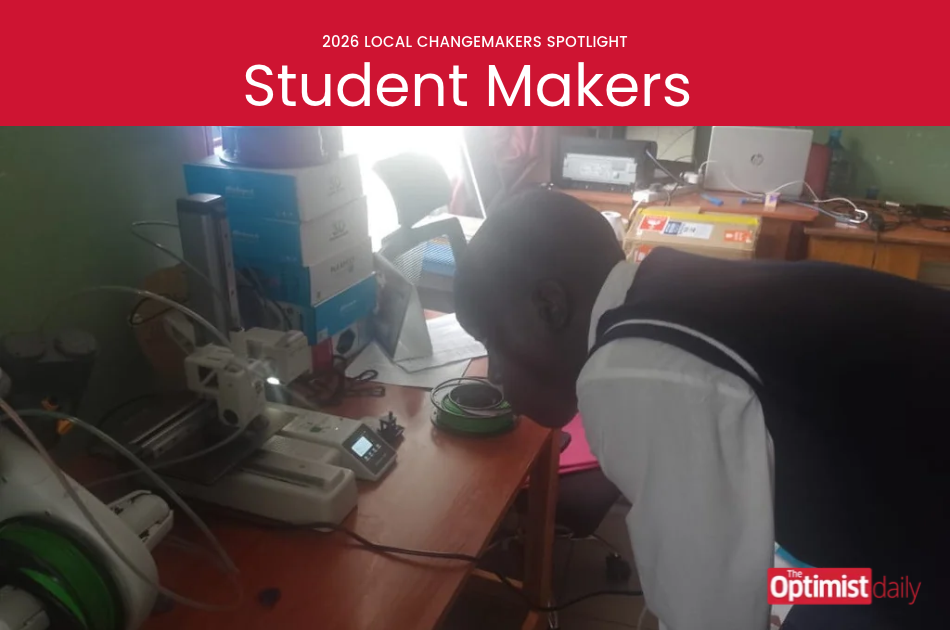
It was winter break, and Dilan Mehta had time on his hands. His dad was packing for a mission trip to Kenya, where he’d been volunteering with Kenya Relief, a medical organization that runs a school in Migori, for years. Dilan packed a bag of stuffed animals for the children there. Then he glanced at his 3D printer.
He started designing LEGO-inspired sets, printing each one out, and tucking them in alongside the stuffed animals. Somewhere between one print and the next, a different thought took shape. The school had students who could use a curriculum, and his dad had room in a suitcase.
That’s how a 3D printer ended up in Migori, Kenya, and why it’s still being used to teach students today.
What is Student Makers?
Student Makers is a nonprofit that offers free STEM workshops to students across the United States, Kenya, and India, and every instructor is a former student. Most of them are still in high school.
The organization was founded in California in 2019 by Anthony Neil Tan, then a high school senior. There was no space at his school where students interested in technology and making could come together to learn, so he built one. He called it the Maker Hub Club Initiative, secured a $5,000 grant from a social impact scholarship, and got it off the ground. The framework was three steps: learn a skill, make a project, showcase it. He was in his first year of college when he started handing it off.
Serve: the fourth pillar
Dilan didn’t find Student Makers; rather, Anthony found him. Roughly six years ago, Dilan was only in 8th grade and had entered an Autodesk design contest with a 3D-printed fingerboard, one that used flexible filament on the grip surface to behave like rubber. Anthony came across it and reached out. Would Dilan want to join a group where students build things and learn from each other?
He joined, took the 3D printing course, came back as an instructor, and eventually rebuilt the entire curriculum from scratch around design thinking rather than output. A few years later, he was running the organization.
But he felt that the project’s mission needed some rethinking. The original framework had three steps: learn, make, showcase. Dilan added a fourth, serve, because the workshops were primarily reaching students who already had resources, and that wasn’t what he’d signed up for. His dad’s Kenya-bound suitcase gave him the opening for a bigger idea to launch.
Teaching through rain and static
When Dilan sent that 3D printer to Kenya Relief Academy, he wasn’t thinking about it as a program. He was thinking about a school with 800 students, roughly 170 to 190 of them orphaned children, consistently ranked the top primary school in its region out of more than 800, and without any STEM infrastructure. His dad’s Kenya Relief contacts connected him to the teachers there, and he started meeting with them remotely three times a week.
Every session ran over video call, Dilan in the US and the teachers in Migori, and when the Wi-Fi dropped, which it often would, they’d wait, reconnect, and keep going. He trained them in Autodesk Fusion 360, Tinkercad, and 3D printer operation, working through how to teach all of it to a classroom he’s never seen in person.
“They constantly have Wi-Fi issues,” Dilan said. “Anytime there’s rain, they basically lose connection. Just being patient, being empathetic, understanding that that’s just the situation.”
Ruth Agongo, a teacher at Kenya Relief Academy, described what it looked like from the other end. “You are a game-changer,” she said. “Whatever you have taught us, we are putting into action because the kids are really excited by the technology.”
Jacob
A few semesters into his time at Georgia Tech, once Dilan had actually taken a step back from Student Makers and was serving mostly as an advisory board member, Dilan got a message from the teachers at Kenya Relief Academy. They needed help with a science fair project: an Arduino-based robot that could navigate a garden, measure soil moisture at different points, and decide where to water.
Dilan didn’t know much about robotics, but he was at Georgia Tech, so he asked around. Twelve students from the university ended up on the project. They built components in Atlanta while the Kenya team built in Migori, troubleshot over video call, and sent physical supplies through a similar suitcase network that had carried the original printer.
That team placed third at regionals of the Kenya Science and Engineering Fair. One of the students on it, a ninth-grader named Jacob, now leads Kenya Relief Academy’s robotics team. His dream is to become a rocket engineer at NASA.
A family connection in India
Rohan Naegle, who led Student Makers before the current team took over, brought a similar program to Dr. R.V. Shah English Medium School in rural Gujarat, India, after his grandfather put him in touch with the school. Live 3D printing classes run there over video call, using the same structure. More than 25 secondary students have completed the program, and a donated printer stays at the school. Both the Kenya and India connections came organically, through family.
How the pipeline runs
Aarush Goel, who now leads the high school chapters, came in the same way Dilan did: a friend pulled him in to co-teach a Python workshop, and he showed up not entirely sure what he was doing. “You just start teaching and everything goes into place,” he said. He’s since led five workshop tracks across the US, and next year he’ll start a Student Makers chapter at his own college.
Instructors are recruited the same way at every level. At the end of each cycle, a call goes out for anyone who wants to come back and teach the next round. Usually one or two students say yes. They already know the program from the inside, which tends to make them good at the part that matters most: building something new students actually want to stay in.
Anthony, watching from his current advisory role, put it plainly. “It’s more relatable, a high schooler showing a middle schooler how to do some 3D printing than someone who’s already a young adult,” he said. “So it’s nice keeping that peer-to-peer instruction model.” He’s 25. The organization he started as a high school senior just turned seven.
Growing the network
Student Makers recently joined a partnership with Youth Technology Corps Global Alliance, a network of schools across roughly 12 countries that has been running a similar peer-learning model since 1998. YTC has been doing this for nearly three decades and has school connections worldwide; Student Makers brings the volunteers and the curriculum. This fall, programs are launching under the partnership in Mexico, Colombia, Ethiopia, and Illinois, with the 3D printing and CAD curriculum going into Mexico specifically.
“I would have never imagined that we would have this extensive of a reach,” Anthony said. The reach he couldn’t have imagined started with a simple observation: students interested in technology and making didn’t have a space to come together. So he built one.
Why Student Makers opens this year’s series
Each year, The Optimist Daily’s Local Changemakers series runs in the weeks before Thanksgiving, and this year, for the first time, every person in it is 30 or under. When Aarush reached out to us with the Student Makers story last summer, we spent weeks talking with the people who built this organization and were honestly floored by their dedication, hard work, and willingness to serve others.
The five other changemakers in this year’s series were nominated by The Optimist Daily community, but Student Makers was not. It was the story that inspired the decision behind this year’s “30 and under” theme.
This article skims the surface of the deeper story behind Student Makers. If you want to learn more about their incredible work, hang tight for a podcast episode featuring the voices behind this initiative. It’ll be coming out in early 2027. In the meantime, you can learn more and support their work at www.studentmakers.org.