


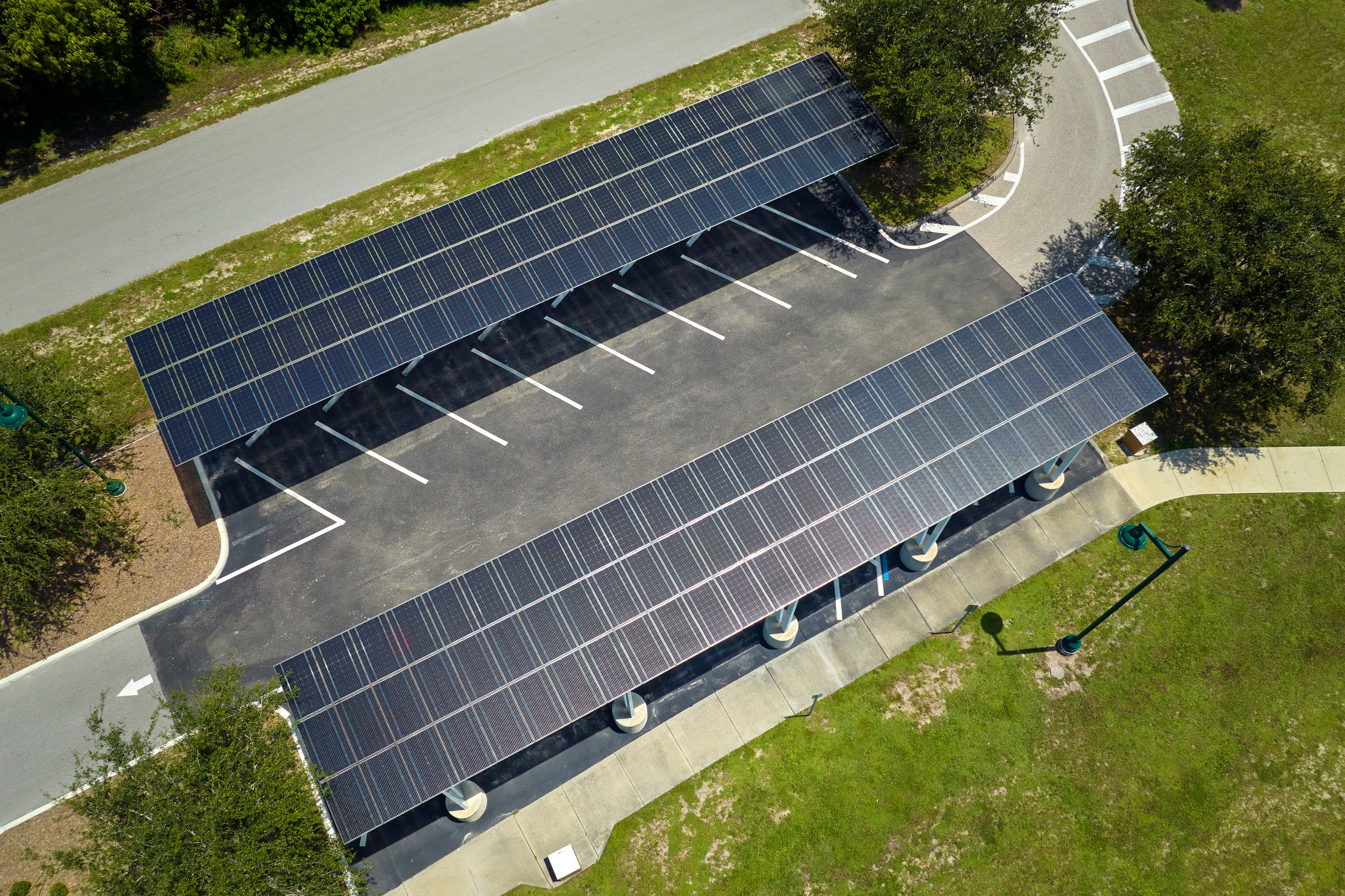
Last week, the French Senate passed legislation mandating the installation of solar panels on all new and current parking lots with room for at least 80 vehicles— an enormous boost for solar power.
Doubling solar and wind energy
The new provisions are part of French President Emmanuel Macron’s large-scale renewables investment plan. This plan aims to double the amount of solar energy produced in the country and double the power generated by land-based wind farms.
Smaller car parks with 80 to 400 spots will have five years to comply with the new regulations beginning July 1, 2023. Car parks with more than 400 spots have a shorter deadline: they must comply with the new requirements (at least half of the parking lot’s surface area covered in solar panels) within three years of July 1.
According to the government, this strategy, which focuses on major parking lots near commercial hubs and train stations, has the potential to generate up to 11 gigawatts, the equivalent of ten nuclear reactors. That’s enough to power millions of households.
In order to avoid “distorting” them, the Public Sénat stipulates in an amendment to the bill that parking lots for trucks transporting big loads and parking sites in historic or protected locations be excluded. While it is uncertain, subsequent versions of the law will likely specify the parking lots that will be excluded, as well as how this plan will be funded and the penalties for noncompliance.
Plans for further renewable energy expansion
Other proposals include constructing enormous solar farms on vacant land near highways and railways, as well as on agricultural fields where possible. Macron has stated that any bill that is passed must include funding to ensure that local communities directly benefit from the energy transition.
SNCF, France’s national train operator, also wants to install 190,000 square meters of solar panels in 156 stations across the country by 2025, and 1.1 million square meters by 2030, with the goal of reducing energy use by 25 percent.
By 2050, the government aims to develop roughly 50 more wind farms like the one off the coast of Saint-Nazaire in France. Delays in developing offshore wind farms have been reduced from 10-12 years to six years, while delays for large solar farms have been reduced from six years to three years.
Following a large public debate involving 15,000 people this summer, the French government established two zones for offshore wind farms off the coast of the Atlantic, with environmental preservation being the primary concern.
The first wind farm, with a capacity of roughly 1,000 MW, is scheduled to be located off the island of Oléron, more than 35 kilometers (21.7 miles) off the coast of La Rochelle. The second wind farm is anticipated to be located further out at sea, with both wind farms producing enough electricity to power 1.6 million people.






