This article is part of The Optimist Daily’s Local Changemakers 2026 series, spotlighting changemakers 30 and under.
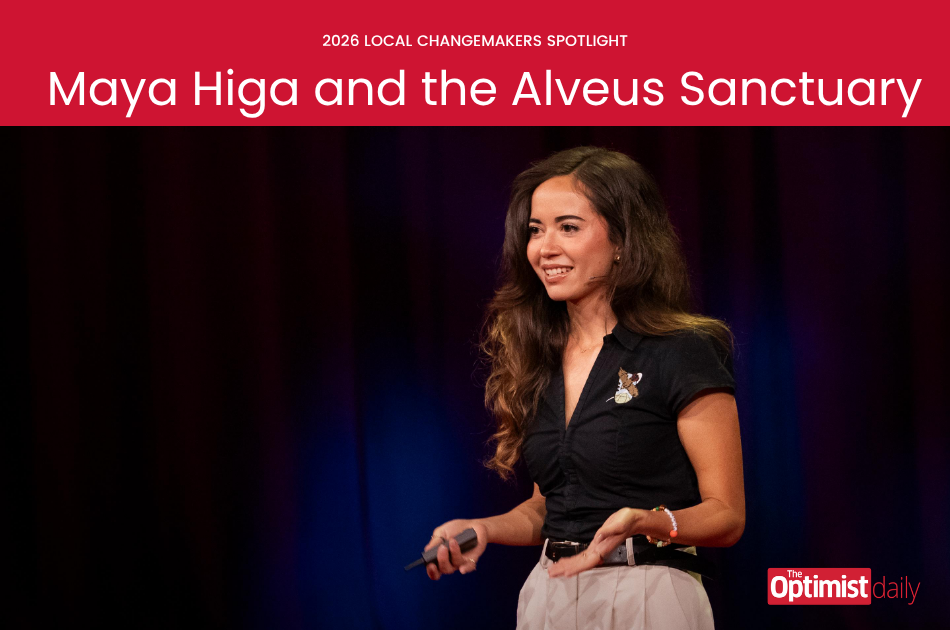
Image alt text: Maya Higa at Alveus Sanctuary with an animal ambassador during a live Twitch conservation education stream
Earlier this year, on a trip to Dominica to learn about the sperm whales that live in those Caribbean waters, Maya Higa was offered the chance to swim with them. She said no.
Her reason was simple. “She would not participate in an activity that her followers would not be able to do,” wrote Maggie Kaplan, who nominated Maya for this series and was on the same trip. For most wildlife creators, that would have been the perfect moment for the cameras to come out. Maya turned on her livestream instead, talked with the boat crew and local staff about their work and lives, and shared the whales from her view on the surface.
Kaplan came away moved by Maya’s resolve. “I was very impressed with her dedication on all fronts,” she wrote. But what she was describing wasn’t a sacrifice. It was consistency. Maya was doing exactly what she built Alveus Sanctuary to do.
Building Alveus
Maya founded Alveus in 2021 with a 21-hour charity stream on Twitch that raised more than $500,000. The platform came after the expertise, not the other way around.
She grew up in Northern California and studied agricultural education and communication at Cal Poly San Luis Obispo. In college, she took a job as a zookeeper and completed internships at AZA-accredited facilities. She even got her falconry license. Part of the work involved going to schools and birthday parties to teach kids about animals in person, which gave her a taste for hands-on outreach and education. She went on to become a licensed wildlife rehabilitator. When she started streaming, all of that prior knowledge and experience came with her.
Alveus is both a physical wildlife sanctuary in Austin, Texas, and a virtual education center. The sanctuary houses non-releasable animal ambassadors, animals that can’t survive in the wild but can represent their species and the ecosystems they come from. A 24/7 livestream on Twitch lets viewers watch them, get to know them by name, and connect with information about their wild counterparts. Other content creators can visit the sanctuary, run education programs, and extend the conservation message into communities Alveus wouldn’t otherwise reach.
What exactly is Alveus?
Alveus is both a physical wildlife sanctuary in Austin, Texas, and a virtual education center. The sanctuary houses non-releasable animal ambassadors, which are animals that can’t survive in the wild but can represent their species and the ecosystems they come from. A 24/7 livestream on Twitch lets viewers watch them, get to know them by name, and connect with information about their wild counterparts. Other content creators can visit the sanctuary, run education programs, and extend the conservation message into communities Alveus wouldn’t otherwise reach.
Conservation for a generation that grew up on Twitch
The demographic Maya is reaching is one that traditional conservation organizations have struggled with for years. Maya “is reaching a whole new generation of 18 to 30 year olds through social media platforms that speak to their demographic,” Kaplan wrote. That generation didn’t grow up watching nature documentaries on television. They watch streams, follow creators, and decide what they care about based on communities they already belong to.
“She is creating a new type of outreach,” Kaplan wrote, “a teaching platform about different species and their importance to our environment.” A teaching platform built around the creator-viewer relationship works differently from a broadcast. Viewers are compelled to come back. They recognize the individual animals. They get into discussions in the chat about things they’ve learned. Conservation education needs that kind of sustained attention, and with conventional methods, it doesn’t get it very often.
Maya has over a million followers across her platforms, and those followers have made Alveus financially self-sustaining through their donations. Twitch donated $100,000 to the sanctuary directly. A partnership with WWF extended the work beyond the sanctuary itself. And Maya’s own TED talk, “The wildlife sanctuary you can visit from anywhere,” which she delivered in London earlier this year, brought the model to an even broader professional audience.
What comes next
By 2026, Alveus has raised more than $7.5 million for conservation causes since its founding. The organization is actively expanding: new animal ambassadors coming in, enclosures being built out, and staff added to keep pace.
Two projects are currently underway. The Pollinator Census is Alveus’s first community science initiative, where community members observe pollinator species in the sanctuary’s garden, and entomologists identify them, generating data to support insect conservation research. The larger effort is the Alveus Research and Recovery Institute (ARRI), developed in partnership with the Association of Zoos and Aquariums‘ Saving Animals from Extinction (SAFE) program. ARRI’s first goal is a conservation breeding and release program for two critically endangered species: the Mexican Gray wolf and the Red wolf. It moves Alveus from education into direct intervention in species survival.
The sperm whale moment in Dominica illustrates something about the whole operation. Maya went to Dominica to learn. When the choice came up, she ran the same calculation she’s always run: the point isn’t the experience she gets to have. It’s the one her audience gets to share with her. With a million people watching, that adds up to a different kind of reach than the field has seen.
Learn more at bio.link/mayahiga.