BY THE OPTIMIST DAILY EDITORIAL TEAM
When a fish moves through water, it doesn’t simply pass through and vanish. It leaves a trail of disturbed water behind it, something like the contrail of a plane across a clear sky. That trail is invisible to human eyes and fades within seconds, but to a harbor seal, it carries usable information: which direction the fish went, how fast it was moving, and possibly even what species it is.
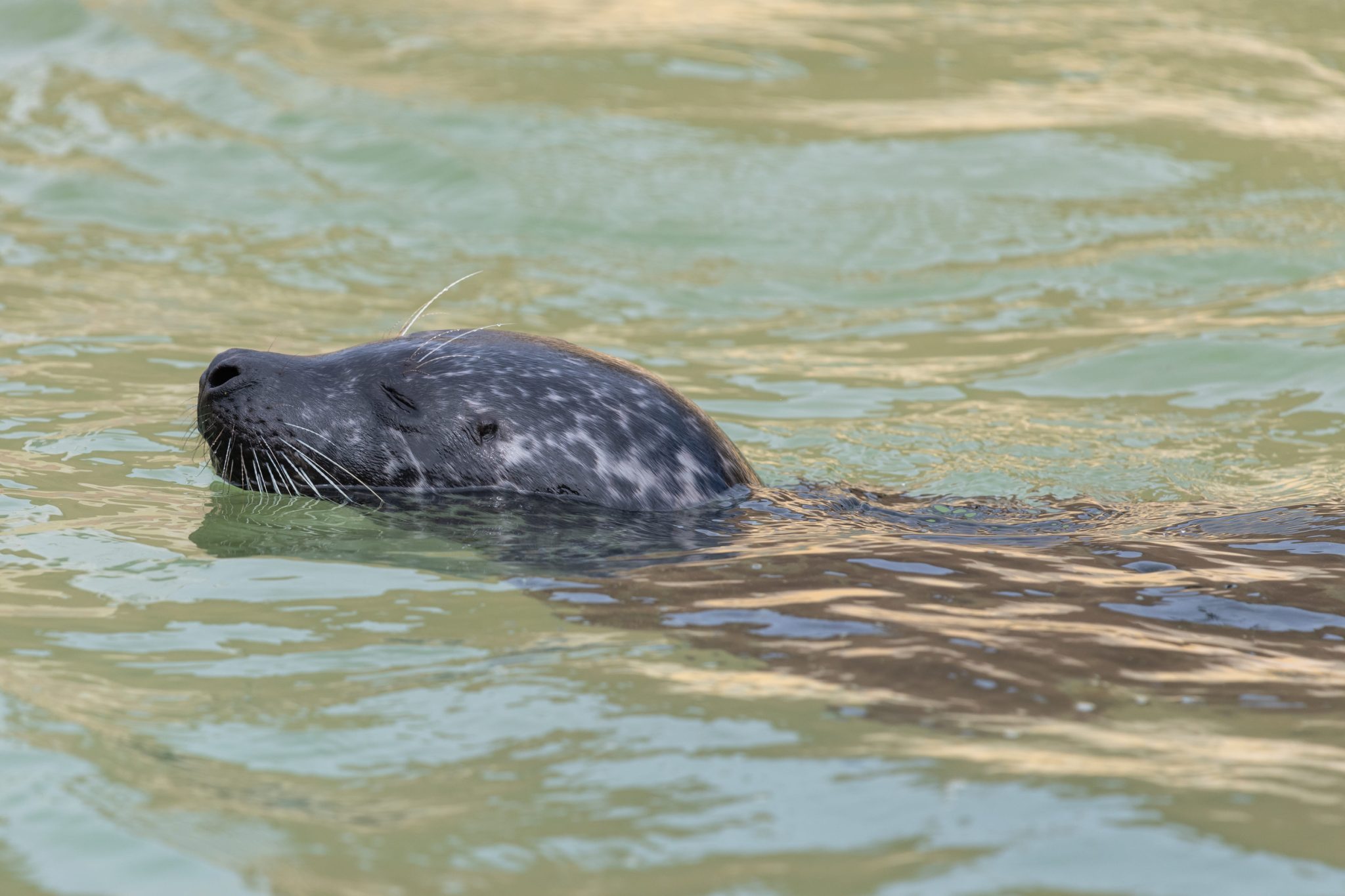
“These are sensory hairs in the facial region,” says Yvonne Krüger, a biologist at the University of Rostock in Germany, describing the roughly 100 whiskers a harbor seal carries on its face. “And with these whiskers, they can sense the water movements that are generated by fish.” The result is a sensory ability that lets seals track prey they cannot see, in water that is dark, murky, or both.
“If you look at an airplane, you can see a trail left behind,” Krüger explains by way of analogy. “And this is similar to what you have if a fish is swimming through the water column. You can’t see it, but you can sense it, with the whiskers.”
When the fish tries to disappear
Harbor seals are effective hunters, but their prey has not evolved without defenses. Rainbow trout, which seals actively pursue, have developed a particularly well-timed evasive move.
“Rainbow trout are able to camouflage their swimming direction by bending into a C-shape,” says Krüger, “and then they swim away in a different direction than they have been swimming before.” That abrupt shift in body position generates two opposing vortex rings in the water, think of them as smoke rings made of water. Only one of those rings moves in the direction the fish is actually heading. The other points the opposite way, a decoy built into the physics of the escape itself. Any predator chasing the wrong ring loses the fish.
Krüger wanted to know whether a harbor seal could see through that trick. Could one learn to identify the correct vortex ring, the real trail, even when both rings were present and pointing different ways?
Filou, the seal who got frustrated when he made mistakes
To find out, Krüger spent close to two years working with Filou, an adult male harbor seal at a marine science center in Germany. She describes him with obvious affection. “He looks very beautiful,” she says. “We have a very strong bond. Filou likes to do everything correct. He likes learning new things. If he has one mistake, he gets frustrated.” In short, “he’s a nerd,” she says.
Krüger trained Filou to select the larger of two vortex rings generated artificially underwater, a task designed to mimic the real-world problem of distinguishing a real fish trail from a decoy. “You have to be patient with animals,” she says. “You have to give them time to learn.”
After nearly two years, Filou could reliably distinguish between the rings, even when the difference in size was less than the width of a human thumb, far smaller than what any seal would need to detect in the wild. When Krüger covered his whiskers with a nylon stocking, he could no longer do it. The whiskers were doing the work.
What this means for hunting at night
The results, published in the Journal of Experimental Biology, point to a capacity that likely extends to harbor seals more broadly.
“If we think about a harbor seal swimming in the ocean, trying to find its food, they are actually able to read where a fish had been and where it’s going to,” Krüger says. “So if they hunt in murky waters or if they hunt at night, they don’t have to see the fish.” Vision, it turns out, may be close to optional for a seal that can read hydrodynamic trails with enough resolution to cut through a fish’s built-in decoy.
Robyn Grant, a sensory biologist at Manchester Metropolitan University who was not involved in the research, called the work “a really important step in working out how the seals use their whiskers to extract tiny bits of information from these hydrodynamic trails.” She added that understanding this sensory system matters beyond basic biology: extreme weather events could disrupt the very signals seals rely on to hunt, making this kind of research relevant to conservation work too.
The technology angle
Grant also pointed to an unexpected application. The mechanics of how a seal whisker reads subtle disturbances in water could inform the design of sensors for underwater robots used in archaeological surveys, subsea mapping, and biological monitoring. A mechanism refined over millions of years of marine predation might turn out to be a useful blueprint for human-made machines navigating the seafloor.
Krüger’s two years of patient work with one nerdy seal have opened questions that will take considerably more time to answer fully. But the core finding is already clear: the ocean is not as blank as it appears to us. For a harbor seal, it is covered in readable trails, and they have been decoding them all along.
Did this solution stand out? Share it with a friend or support our mission by becoming an Emissary.