BY THE OPTIMIST DAILY EDITORIAL TEAM
Decades after the conflicts that planted them, landmines remain one of the most persistent threats to civilian life in parts of Southeast Asia. In Cambodia alone, more than one million people continue to live and work on land contaminated with mines and unexploded ordnance, according to the United Nations. Removing them is painstaking, dangerous, and slow — unless the right animal is trained for the job.
Who Magawa was
Magawa was an African giant pouched rat, bred in Tanzania and trained by the Belgian charity Apopo as part of its HeroRATS program. He arrived in Cambodia in 2016 and spent five years in the field, becoming the most successful landmine-sniffing rat Apopo had ever deployed.
His record is specific: 100 landmines detected and 1,517,711 square feet (about 35 acres) of land cleared and returned to safe use. He could sweep a field the size of a tennis court in just 20 minutes, a task that would take a person with a metal detector several days. His small size and light weight meant he could cross suspect ground without triggering the devices he was hunting for.
In 2020, Magawa became the first rat to receive the UK’s People’s Dispensary for Sick Animals Gold Medal, considered one of the highest honors an animal can receive, awarded for his “life-saving devotion to duty.” He retired and passed away in 2022.
The statue and what it represents
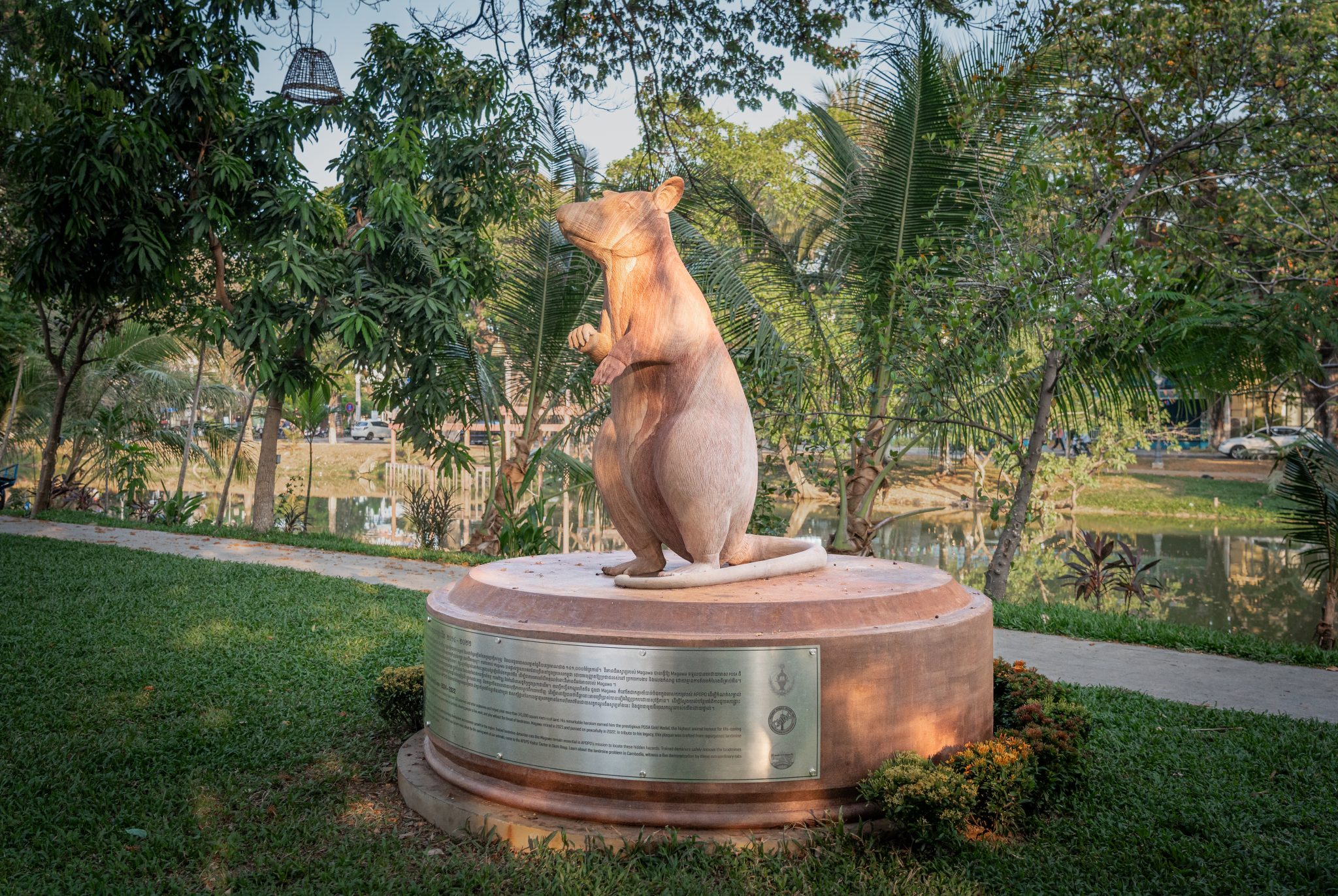
A stone statue of Magawa was recently unveiled in Cambodia ahead of the International Day for Mine Awareness, making it the world’s first monument dedicated to a landmine-detecting rat. The timing was not incidental.
“A symbol of hope and resilience, the monument makes visible the ongoing impact of landmines and the quiet work of HeroRATs saving lives every day,” Apopo wrote on Instagram. The unveiling was intended both as a tribute and as a reminder: the landmine crisis in Cambodia is not resolved, and the animals trained to address it are still working.
Why rats are so well-suited to the job
The HeroRATS program works because African giant pouched rats combine a highly sensitive sense of smell with qualities that most detection methods lack. They are light enough not to detonate pressure-sensitive devices. They can be trained to alert handlers without disturbing what they find. And they cover ground faster than both metal detectors and trained dogs across many field conditions.
The program, running in Cambodia and several other mine-affected countries, is one of the more inventive responses to a problem the world inherited from decades of armed conflict. By pairing animal ability with systematic field training, Apopo has restored access to large stretches of land that communities could not safely use before.
Magawa is gone, but the rats trained after him continue clearing ground across Cambodia. His statue, in the country where he spent five years working, is a tribute to one animal and a reminder of how much of that work still lies ahead.
Did this solution stand out? Share it with a friend or support our mission by becoming an Emissary.