BY THE OPTIMIST DAILY EDITORIAL TEAM
Researchers at Northwestern University and UC Santa Barbara identified a specific contact point on tau proteins where the misfolding that drives Alzheimer’s disease begins. The finding, published in the Proceedings of the National Academy of Sciences, suggests the site could be targeted with drugs designed to slow tau tangle growth in the brain.
How tau proteins misfold
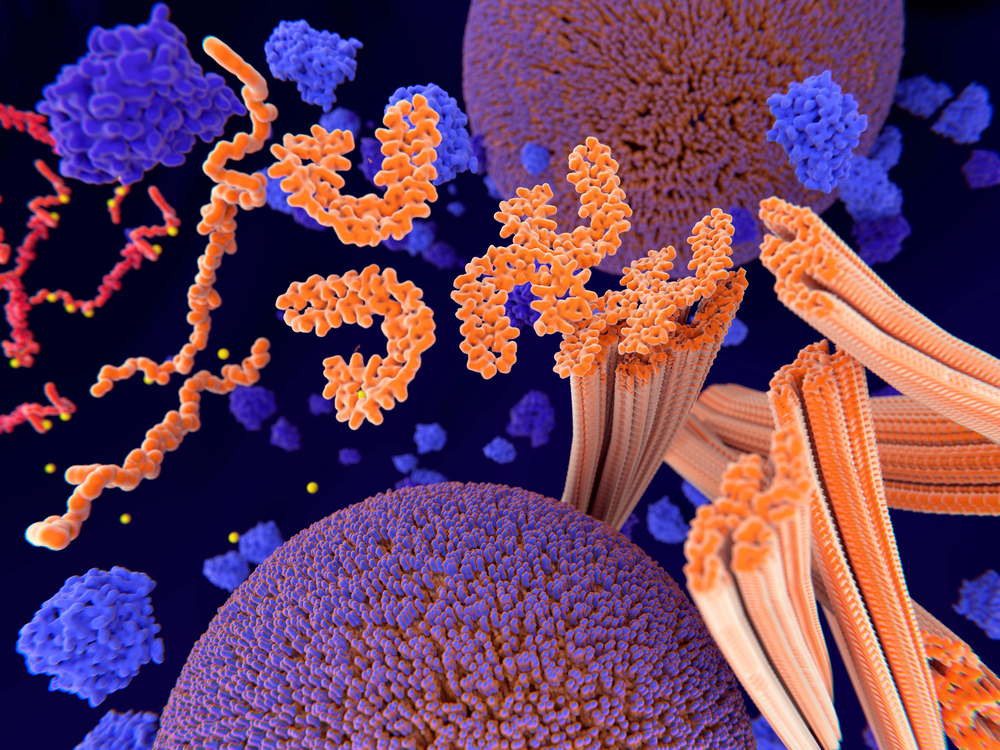
In healthy brains, tau proteins stabilize the internal scaffolding of nerve cells. In tauopathies, including Alzheimer’s disease and frontotemporal dementia, tau misfolds and recruits healthy proteins to adopt the same abnormal shape. The result is fibrillar aggregates: knotted threads that accumulate and spread through brain tissue.
What happens the moment a newly produced tau protein first encounters an existing tangle wasn’t well understood. To find out, chemist Songi Han and colleagues at Northwestern used nuclear magnetic resonance spectroscopy to track engineered tau as it attached to pre-existing tau fibers, watching individual regions as the process unfolded.
The region around amino acid 300 stood out because it made contact with existing aggregates faster than any other site examined, acting as an initial anchor. The rest of the protein then aligned to the fiber’s structure. The team calls it “dock-and-lock”: tau docks at the contact point first, then the remaining sections fall into place.
Where water comes in
The anchor’s stickiness wasn’t fully explained by the protein’s structure. Molecular simulations and water dynamics experiments added a piece: the region around amino acid 300 has an unusual arrangement of water molecules that are easy to dislodge when another tau molecule gets close. That displacement lowers the energy cost of attachment and nudges the docking forward.
Chemically blocking the anchor site inhibited fiber growth. Blocking other positions had much less effect. That gap in response is what gives the finding traction as a potential drug target.
A possible drug target
“Once you know that aggregation-prone tau proteins always have a hotspot that is first attracted to the same site of tau that is stacked to fibrils, then you know there’s always some part of the protein that you can target to neutralize,” said Han. “If you know where to block its action of misfolding, you could block it to prevent it from propagating.”
The experiments used a shortened tau construct with a disease-associated mutation, not full-length tau from human tissue, so translation to disease conditions isn’t established. The anchor point’s location may also shift between tau variants and disease types. Whether the mechanism holds across different tau structures, and whether it can be safely disrupted in a living brain, are the next questions.
Source study: Proceedings of the National Academy of Sciences- A water-pinning hot spot drives templated tau aggregation
Did this solution stand out? Share it with a friend or support our mission by becoming an Emissary.