BY THE OPTIMIST DAILY EDITORIAL TEAM
In a year marked by rapid change, scientific progress gave us reasons to wonder, dream, and keep pushing forward. For our Best of 2025 Science roundup, we’re celebrating the breakthroughs that didn’t just advance human knowledge; they sparked possibility, opened new frontiers, and reminded us why curiosity is a superpower.
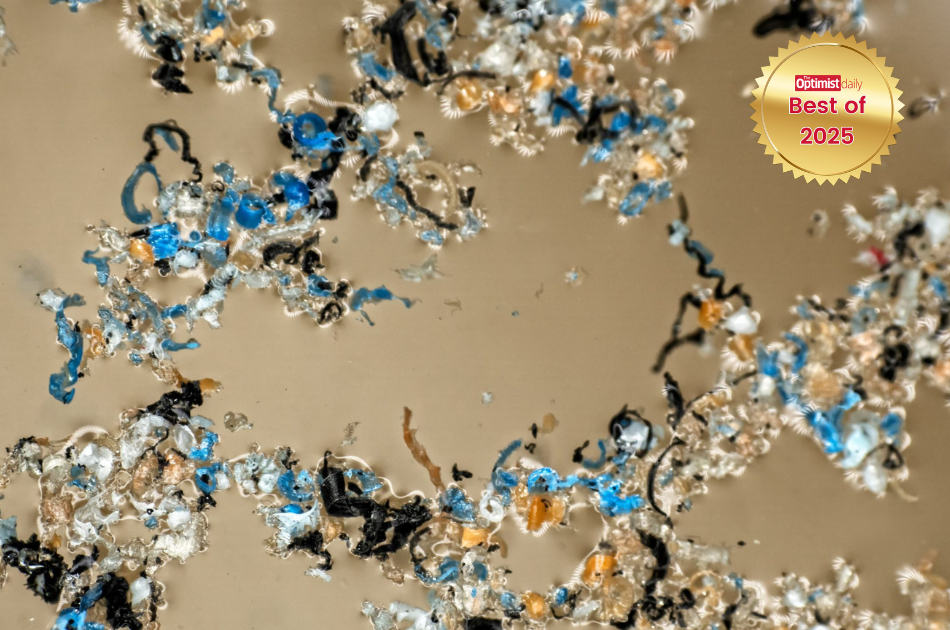
The slimy and sticky qualities that make okra divisive on dinner plates might just help clean our water. Researchers have found that natural polymers from common plants like okra and fenugreek are surprisingly effective at capturing and removing microplastics, the tiny, persistent pollutants that have infiltrated oceans, rivers, and even our drinking water.
Published in ACS Omega, the study shows that okra and fenugreek extracts can remove up to 90 percent of microplastics from a range of water sources, including ocean water, freshwater, and groundwater. The findings point to a plant-powered method that could someday replace synthetic, less environmentally friendly water treatment chemicals.
From a kitchen staple to a clean water tool
Rajani Srinivasan and her team at Tarleton State University have been exploring plant-based solutions for environmental cleanup. Their research focuses on using polysaccharides, natural, sticky polymers found in many plants, to clump microplastics together so they can be more easily removed from water.
To make the plant powders, researchers soaked sliced okra and blended fenugreek seeds in separate containers of water overnight. The dissolved polymers were then extracted and dried into powder. Lab analysis confirmed that the powders were rich in polysaccharides, making them ideal candidates for microplastic removal.
Lab results show strong performance
Initial tests using distilled water mixed with microplastics showed promising results. Just one gram of either plant powder in a liter of water removed a significant amount of the plastics within an hour:
- Fenugreek removed 93 percent.
- Okra removed 67 percent.
- A 1:1 mixture of the two reached 70 percent efficiency in just 30 minutes.
Importantly, the plant powders outperformed polyacrylamide, a synthetic polymer widely used in wastewater treatment.
When the researchers moved on to real-world water samples from across Texas, they found the results varied depending on water type:
- Okra was most effective in ocean water, removing 80 percent.
- Fenugreek worked best in groundwater, with removal rates between 80 and 90 percent.
- The okra-fenugreek combination showed the highest efficiency in freshwater, removing 77 percent.
Srinivasan explained that these differences likely stem from the diversity in microplastic shape, size, and type across different water sources.
A biodegradable and nontoxic alternative
Currently, water treatment plants often rely on synthetic chemicals like polyacrylamide to remove contaminants. But these substances come with their own risks. The plant-based powders, on the other hand, offer a nontoxic, biodegradable solution.
“Utilizing these plant-based extracts in water treatment will remove microplastics and other pollutants without introducing additional toxic substances to the treated water,” says Srinivasan. “This reduces long-term health risks to the population.”
The research was funded by several organizations, including the U.S. Department of Energy, the Welch Foundation, the National Science Foundation, and Tarleton State University.
As microplastic pollution continues to mount, this promising breakthrough highlights how traditional knowledge and modern science can meet in surprising ways with a little help from the garden.
Source study: ACS Omega— Fenugreek and okra polymers as treatment agents for the removal of microplastics from water sources
Did this solution from 2025 stand out to you? Support The Optimist Daily so we can fill 2026 with more positive headlines like this. Become an Emissary and help guide more people to solutions with us here.