BY THE OPTIMIST DAILY EDITORIAL TEAM
For most of human history, the kiwiberry was valued for its flowers while the fruit was just an afterthought. These days, that seems almost hard to believe, given what scientists are finding. But the kiwiberry spent centuries being grown as an ornamental vine, appreciated for its looks rather than what it offered to eat. It is only in the past decade or so that researchers have started taking its nutritional profile seriously.
An ancient fruit with a surprisingly recent commercial story
Botanically known as Actinidia arguta, the kiwiberry has been around far longer than its larger cousin. Fossil evidence places the plant or its direct ancestors across Far East Russia, China, Korea, Japan, and Malaysia for at least 25 million years. Western botanists did not describe it until 1843. And commercial crops did not arrive until the late 1990s in Oregon.
From there, interest spread. New Zealand, Chile, Italy, France, and Switzerland came on board. China and South Korea, where the plant already had roots in traditional medicine, revived commercial interest around the turn of the century. The rebranding from “hardy kiwi” to “kiwiberry” happened in the 2010s, and that name shift has tracked a real shift in how the fruit is perceived: from novelty to nutritional contender.
Why the skin is the whole point
Here is what makes the kiwiberry genuinely different from its larger relatives: you eat the whole thing, skin included. And it turns out that is where most of the nutrition lives.
Research from 2015 found that the kiwiberry’s skin contains 10 times more phenolics, 13 times more flavonoids, and 10 times more vitamin C than the fruit’s own flesh. Here’s why that matters: most people do not eat the skin of a large fuzzy kiwi, and by peeling it they are missing the most nutrient-dense part. With kiwiberries, there is nothing to remove. The whole fruit is the package, and the package is the point.
What researchers are finding about the health benefits
Scientists are still working through the full picture, but the early findings are substantial. Studies have identified bioactive compounds in the kiwiberry with antioxidant, anti-inflammatory, antidiabetic, and anti-obesity properties, among others. Researchers have also noted neuroprotective and potential antitumor activity, with some papers pointing toward compounds that could inform future drug development.
As one 2025 research review put it, the goal is “perceiving mini kiwi not only as a tasty fruit but also as a source of bioactive ingredients with beneficial, health-promoting effects on the body,” adding that work on isolating those compounds could “contribute to the future development of antiaging and anticancer drugs, which undoubtedly will lead to further research and promote this species.” Studies on the anti-inflammatory properties and potential for countering type-2 diabetes are still ongoing.
The plant’s complicated relationship with the wild
One wrinkle worth knowing: in parts of the northeastern US, the kiwiberry vine is considered invasive. According to Long Island’s Invasive Species Management, “hardy kiwi is capable of rapid growth and can form dense stands which block sunlight and smother native vegetation, possibly causing serious alterations in the natural communities it invades.” Sites in Vermont, Massachusetts, New York, and New Jersey have shown what the vines can do unchecked.
There is something a bit ironic in the fact that the qualities making the plant a nuisance in the wild (adaptability, hardiness, rapid growth) are exactly what made it commercially viable. The kiwiberry is also not a product of selective breeding or genetic engineering; it is its own ancient lineage, adapted over millions of years to colder climates. Unlike miniaturized versions of familiar fruits engineered for the snackable market, the kiwiberry was small long before anyone was paying attention.
Finding them and what to expect
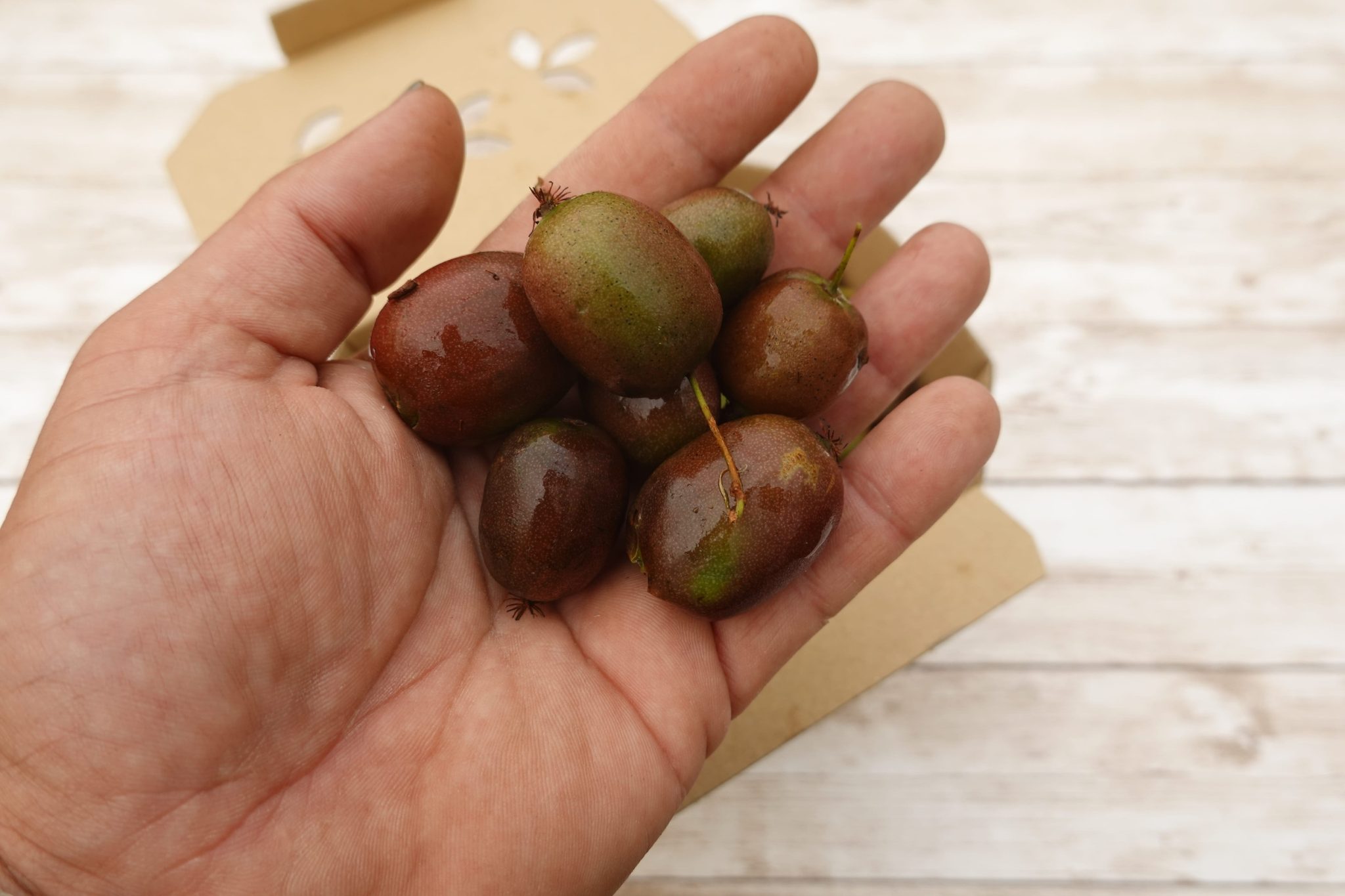
Kiwiberries are still seasonal and not yet stocked everywhere, but they are appearing in specialty grocery stores and farmers’ markets in growing numbers, particularly in the fall. They look like elongated green grapes with slightly thicker, smoother skin. When ripe, they are soft, sweet, and mild. Shelf life and bruising sensitivity are ongoing challenges researchers are actively working to solve, which is part of why the fruit has not gone fully mainstream yet.
Given what the science keeps turning up, that may not be the case much longer. Twenty-five million years of growing, and the kiwiberry might finally be having its moment.
Did this solution stand out? Share it with a friend or support our mission by becoming an Emissary.